Aippasi Storm Strikes the Chozha Region
Ponniyin SelvanThe Aippasi Storm Strikes the Chozha Region after an untimely, hesitant monsoon turns a season of drought into sudden disaster. Its force is measured not only in shattered trees and flooded coastlines, but also in the immediate strain it places on travel, shelter, information, and royal responsibility. The storm changes the conditions under which people move and govern: roads become dangerous, ordinary plans fail, and reports of devastation outrun the evidence available to confirm them.
A Delayed Monsoon Breaks
The storm arrives after the rains have twice appeared imminent and then failed to begin. By the time it comes, the landscape has registered the delay: the Kaveri River and its sister rivers have grown markedly thinner, their flow steadily diminishing, while newly planted saplings in field after field wilt in the scorching sun. The opening contrast is stark. A region already short of water does not receive a gradual, sustaining rain; instead, relief gives way to an abrupt deluge.
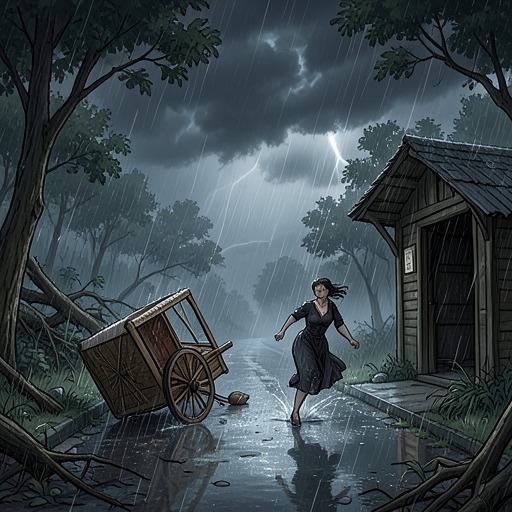
The change is so unexpected that travelers remark that the month of Aippasi seems more like the blazing season of Vaikasi. A chilly breeze follows the passage of the Pazhuvoor palanquin, leaves begin to rustle, and the northeastern sky darkens. Storm clouds crowd the horizon and race across it, likened to a herd of elephants running wild. In moments the breeze becomes a sharp wind, rain cuts through it, and a drizzle swells into a thunderous downpour in less than a quarter of a naazhigai. The speed of the shift matters: people on the road have little time to prepare before the weather becomes dangerous.
Wind, Darkness, and Immediate Danger
The storm makes the landscape hazardous in several ways at once. Wind and rain batter the trees until branches splinter and crash down. Birds flee their nests in every direction, while people scatter either to escape the rain or to avoid being killed by falling limbs. Thunder adds another cause for panic, sounding like the eruption of the cosmos. Though the downpour has lasted only a short time, blinding rain brings on near-night darkness across the landscape.
Sendhan Amudhan and Poonguzhali abandon their plan to enter the Thanjavur fort that evening. They turn instead toward Amudhan’s nearby garden dwelling, walking carefully through the darkness and driving rain. The episode sets the storm’s broad violence against the practical choices it forces on particular travelers: reaching the fort is no longer feasible, and shelter must be found close at hand. Poonguzhali’s experience at sea is contrasted with her fear of this downpour, underscoring that familiarity with dangerous water does not make every form of danger manageable.
A flash of lightning briefly reveals the scale of the destruction. An enormous banyan tree opposite a mandapam has been almost completely uprooted: its roots are in the air, and its branches and aerial shoots lie smashed and broken. Two horses and five or six men are trapped beneath the wreckage. Rescuers already surround the tree, trying urgently to pull away its tangled limbs and free those caught underneath. The scene gives the storm a human measure: the damage is not only a ruined tree but an immediate rescue under perilous conditions.
Disaster, Reports, and Relief
The storm’s consequences reach the court through an uneven flow of information. Kundhavai tells Aniruddhar that Sundara Chozhar’s physical health is much as before, but that the storm has deeply disturbed him. He slept little, lamented the hardship faced by poor people in flimsy huts, and sent Kundhavai out at dawn as his envoy to arrange aid for lives ravaged by the cyclone. His response makes relief a matter of royal duty, even as the extent of the need remains unknown.
Aniruddhar warns that Kundhavai’s offer of her own possessions and her mother’s would be inadequate to the scale of the disaster. He says that practically all of Chozha Nadu has been savaged and that proper reports have not yet reached him. His disciple has brought alarming news that the sea surged inland and submerged towns from Kodikkarai to Naagai, but Aniruddhar immediately qualifies the claim: he does not fully trust it, and there have not yet been official communications from the coast. He expects messengers, even those traveling on horseback, to begin arriving only later in the afternoon. Until then, the government can offer what comfort it can, but cannot yet assess the full damage.
Kundhavai has also heard reports from Naagai and raises the fate of the Buddhist monks at Choodamani Viharam, to which the royal family has recently granted endowments. Her concern makes the possible reach of the storm concrete without turning rumor into confirmed fact: coastal communities and a religious institution may be at risk, but their condition remains unknown at this point. The delay between disaster and dependable news becomes part of the crisis itself.
Political and Narrative Consequences
The storm strikes a kingdom already unsettled by the report that Arulmozhi Varman has drowned. Before the storm, public talk about that presumed loss had been linked to predictions of conflict between the Pazhuvettarayar and the Kodumbalur Velaar; in Kadambur, some residents also regard festivities for Aditha Karikalan’s expected arrival as ill-timed while the prince’s fate remains uncertain. These political strains are not caused by the weather, but they form the unsettled background against which disaster reports circulate.
The storm also produces competing accounts that must be distinguished from what is confirmed. Later, Sundara Chozhar hears allegations about a breakdown in security and a near-massacre involving crowds entering the capital and the Velakkara Regiment; those charges form part of the political accusations brought before him, rather than a demonstrated direct consequence of the storm. In another exchange, Aniruddhar explains that he had urged that Arulmozhi Varman remain away from Chozha Nadu, while the story that Pazhuvettarayar’s men forced the prince onto a ship and caused his drowning has spread among the people. Sundara Chozhar counters with Parthibendra Pallavan’s account that the prince traveled on the Pallava vessel and jumped into the sea of his own will to save someone. The storm’s coastal devastation and this contested account are distinct matters, but together they show how urgent, incomplete news circulates through a politically vulnerable kingdom.
As an event, the storm turns environmental violence into a test of shelter, rescue, communication, and rule. Its suddenness overturns ordinary movement; its reported reach makes relief urgent; and the delay in verification leaves both the scale of suffering and the reliability of news in question. The narrative moves from drought to destructive rain, from a trapped group beneath a tree to a court trying to respond, without allowing rumor to stand in for a final accounting of the damage.