Chinna Pazhuvettarayar
Ponniyin SelvanChinna Pazhuvettarayar, the younger of the Pazhuvoor brothers and chief of security in Thanjavur, is a formidable local authority whose command is tested by a capital crowded with visitors, a tense relationship with the chief minister Aniruddhar, and the disappearance of Mandhakini. He complains that the city’s defenses have become dangerously porous, yet his own accusations and interventions make him an active participant in the political disorder he claims to contain.
Office and a strained chain of command
Aniruddhar’s residence had become a center of government business, receiving officials, lords, generals, foreign ambassadors, mercantile representatives, temple officials, and scholars. Its entrance was almost continually thronged. Because the chief minister had neither a personal regiment nor a substantial retinue, Chinna Pazhuvettarayar found little grounds for an open security dispute with the Pazhuvettarayar Faction; nevertheless, he objected that the crowds endangered the fort and palace. Visitors claimed appointments with Aniruddhar and displayed his insignia, while the credentials of those pressing past the guards seemed impossible to establish.
The complaint was more than a question of visitor management. Aniruddhar’s residence stood beside the royal palace, where Sundara Chozhar was staying, so the flow of people around the chief minister’s home also affected the approaches to the king. Chinna Pazhuvettarayar believed that the number of people claiming access to Aniruddhar made the security arrangements inadequate. Yet although he longed to confront the chief minister, he lacked the courage to do so in person. His frustration was sharpened by the absence of his elder brother, Elder Pazhuvettarayar, who was stationed at Kadambur: Chinna felt deprived not merely of a brother but of a necessary partner in devising a response.
Aniruddhar’s discreet commands, presented as courteous requests for favors, further unsettled the security chief. Their differences thus concerned more than the volume of traffic at the palace. They also reflected a contest over whose authority could direct people and resources in the capital, and over whether the chief minister’s private network of agents could operate beyond the security commander’s scrutiny.
Surveillance and the missing woman
Chinna Pazhuvettarayar’s suspicions extended to activity around the palace of Elder Pazhuvettarayar. He had been concerned by reports that a sorcerer frequently visited there. Since the visitor also appeared to seek audiences with Nandhini, Chinna did not immediately intervene; instead, he kept the mansion under surveillance. A spy later reported seeing someone climb over the rear wall. Chinna ordered his guards to seize the intruder, who proved to be Azhwarkkadiyaan, Aniruddhar’s close disciple.
In his account to Sundara Chozhar, Chinna emphasized that questioning had produced no explanation beyond Azhwarkkadiyaan’s claim to be acting on the chief minister’s orders. The disciple’s silence left Chinna unable to establish what he had been doing in the garden, but the incident gave him a concrete example with which to challenge Aniruddhar’s authority. He asked how he could remain responsible for the city’s security if the chief minister authorized such activity. His charge remained an accusation, not proof of a larger plot; its force came from the visible breach of the palace wall and the captured man’s refusal to explain himself.
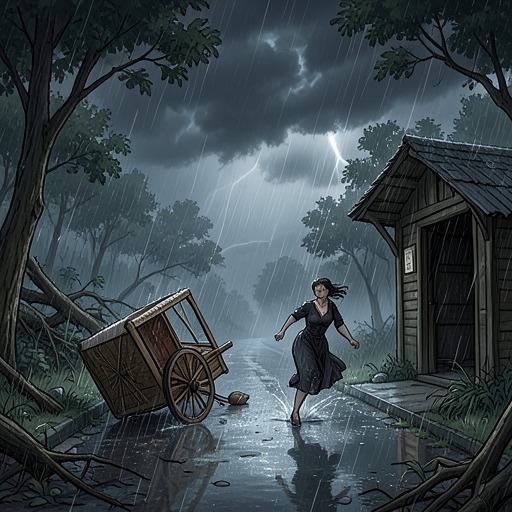
The disappearance of Mandhakini became a more serious point of conflict. Aniruddhar had requested the use of a Pazhuvoor palanquin and escorts for a covert journey connected with a woman brought from Kodikkarai. During the storm, the cavalcade was caught near the fort, where a tree fell across its route and injured some of the party. The palanquin itself escaped damage; Chinna presented that good fortune as averting the sin of a woman’s death. The circumstances, as he reported them, made the use of Pazhuvoor transport a matter of public accountability as well as a private concern about Aniruddhar’s methods.
Intervention in the streets
The arguments over the capital’s security were not confined to reports delivered at court. A confrontation between new arrivals in the city and the Velakkara Regiment escalated toward a massacre. Chinna Pazhuvettarayar intervened at a critical moment, speaking sense to both sides; the crowds dispersed before the conflict became a riot. In a separate surge of street disorder, rival groups shouted support for the Pazhuvoor patrons, Sundara Chozhar, Kodumbalur Velaar, and Thirukkovilur Malayaman. Chinna rode into the street on his stallion, and his appearance quieted the crowd at once. The Velakkara Regiment advanced as best it could, while Pazhuvoor soldiers gathered around their commander to voice their grievances.
His intervention had an immediate consequence beyond restoring order: in the disturbance, Mandhakini vanished. Poonguzhali and Azhwarkkadiyaan, who had been standing beside the road, discovered her absence and searched nearby after Chinna and his men had departed. They found no trace of her. The episode brings out the double edge of Chinna’s authority. His arrival can disperse a crowd and give his soldiers a focal point, but public order does not ensure the safety of a vulnerable person caught within the same turbulent streets. Nor does the narrative establish that Chinna caused Mandhakini’s disappearance; it presents the loss as an alarming consequence of the disorder around his intervention.
The case before Sundara Chozhar
Chinna’s complaints reached the king during a period of grave physical and mental weakness. Sundara Chozhar was already emotionally strained after a stormy night without sleep, and Chinna’s official visit added to the pressure. The security chief first alleged that Aniruddhar’s stream of unverified visitors had broken down the defenses protecting the king. Sundara Chozhar responded with a rueful smile, giving these particular complaints little weight. Chinna then raised the near-massacre between the newcomers and the Velakkara Regiment, describing how his intervention had prevented the city from erupting into riots.
He next accused Aniruddhar of arranging the abduction of a woman from Kodikkarai through Pazhuvoor men and a palanquin. Chinna asked whether the chief minister’s conduct matched his public reputation for piety and integrity, and whether the Pazhuvoor clan would be blamed if the operation led to calamity. He presented the injury to the escort and the tree’s fall as evidence of the danger involved, while insisting that the king should investigate both the woman’s disappearance and Azhwarkkadiyaan’s presence in the garden.
The timing and order of the allegations mattered. Chinna began with security complaints that the king could dismiss, but reserved the most troubling charges for last: the alleged abduction, followed by the breach of the treasurer’s palace. When Sundara Chozhar said he would question Aniruddhar about the woman, Chinna affirmed that the palanquin-bearers and escorts had supplied their account during the night. He then withdrew before Aniruddhar arrived. The chief minister’s habit of asking questions Chinna considered irrelevant—and difficult to answer—made a direct encounter unwelcome. Chinna also wished to avoid Aniruddhar’s possible request for permission to open the treasure vault and release funds for people affected by the storm, a prospect that left him anxious about facing his elder brother.
Authority, family, and political significance
Chinna Pazhuvettarayar’s standing rests on practical command: he directs guards, maintains surveillance, rides into a volatile crowd, and can make rival groups fall quiet by appearing among them. At the same time, his reluctance to confront Aniruddhar privately and his repeated reference to his absent brother reveal limits to that authority. He can act decisively in the street, yet in court he must persuade a frail king to take his accusations seriously, and he prefers not to face the chief minister’s questions without his elder brother beside him.
Sundara Chozhar later instructed Aniruddhar to arrange the return of Elder Pazhuvettarayar and Nandhini, and made clear that Chinna was to help bring them from Kadambur. The order places Chinna within the practical machinery of assembling the court’s principal figures, even as his earlier conduct has made him a source of dispute within it. His part in the book’s political tension is therefore not simply that of a guard who detects breaches. He is both an enforcer of public order and an interested accuser, trying to protect the capital while defending the standing of his family and its influence over the king’s surroundings.