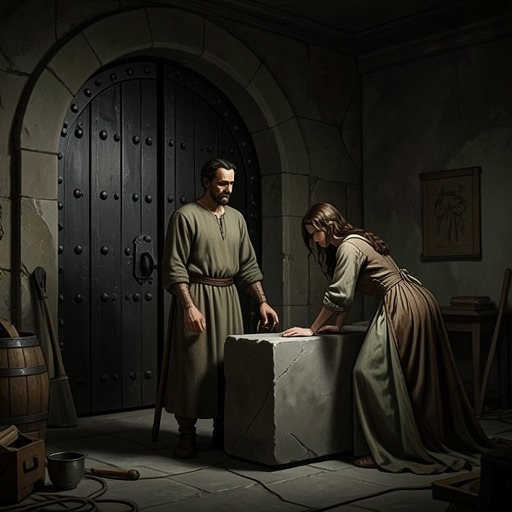
Chola Royal Palace at Thanjavur
Ponniyin SelvanThe Chola Royal Palace at Thanjavur is the residence of the ailing Sundara Chozhar and a focal point of the kingdom’s political and emotional turmoil. Its proximity to Aniruddha Brahmaraayar’s residence draws a constant stream of petitioners into the surrounding palace complex, while the emperor’s sickroom becomes the setting for his fears over his children, the past, and the kingdom’s safety.
Setting and Access
The palace stands beside Aniruddha Brahmaraayar’s mansion, which has served as the chief minister’s residence for several days. That arrangement makes the palace environs unusually busy: government officials, lords, army generals, foreign ambassadors, mercantile representatives, temple officials, and scholars crowd the minister’s entrance, while visitors claiming appointments pass the fort guards and display his insignia. Because the emperor is staying in the neighboring palace, the traffic spills across the wider complex.
The crowding has a security consequence. Chinna Pazhuvettarayar complains that the credentials of those entering are uncertain and that the number of people moving around the fort and palace is alarming. His concern is sharpened by Aniruddha’s lack of a personal regiment and small retinue; the chief minister’s discreet commands, issued as courteous requests for favors, add another layer of activity to a place already filled with visitors.
The Palace and Sundara Chozhar’s Past
The palace is where Sundara Chozhar’s private history repeatedly returns to disturb his present. During a visit to the city to inaugurate the Sundara Chozhar Infirmary, he recounts to his daughter the shipwreck off Ilankai in which a mute woman saved him from a bear. He remembers their life together on an island, his return to Thanjavur, and seeing her again amid the crowds at the palace entrance. He then sent Aniruddha to find her; Aniruddha returned with the false report that she had died by throwing herself into the sea.
Sundara Chozhar later tells his family that the woman’s spirit haunts him. Vanathi’s earlier experience in the palace lends force to the family’s suspicions: after hearing the emperor lament, she went to investigate and fainted at the sight of a figure before his bed that resembled Nandhini. The palace thus holds both the emperor’s memories and the disturbing image that leads Kundhavai to wonder whether Nandhini is the mute woman’s daughter.
Sickroom, Storm, and Political Danger
During the storm, the palace’s royal sickroom becomes the center of a family crisis. Sundara Chozhar’s fear that Arulmozhi Varman has drowned intensifies as the gale rages; he imagines the waves reaching the height of coconut trees and Nagapattinam being destroyed. Convinced that his son is in danger at a Buddhist monastery there, he tries to rise from his bed and go to save him, but his weakness forces him back. The palace itself trembles during the storm, making the king’s terror seem to reverberate through the building.
Aniruddha eventually reveals that Arulmozhi Varman is safe at the monastery. Sundara Chozhar initially refuses to believe him, then demands that his son be brought to Thanjavur. When Aniruddha explains that Arulmozhi’s weakness makes travel impossible and that his arrival could intensify political disorder, the emperor’s response turns against the kingdom itself: he fears that royal power and its conflicts are endangering his sons. The sickroom concentrates this collision of dynastic responsibility and paternal dread.
A Watched and Vulnerable Residence
The palace is also visible from beyond its walls. From a window reached by climbing a sheer wall, Ravidasan points out that one can clearly observe a particular place inside the palace: Sundara Chozhar’s sickbed. The view is useful for gauging the movement of people around the emperor. The palace is therefore not only a crowded center of government but also a vulnerable residence whose most private chamber can be watched from outside.
Across these episodes, public access, family memory, and physical exposure converge at the palace. Petitioners and political actors fill its approaches; the emperor’s past returns in the sickroom; and an observer can monitor that room from afar. Its significance lies in this contrast between the authority associated with a royal residence and the insecurity of the king and dynasty sheltered within it.