Chozha Empire
Ponniyin SelvanThe Chozha Empire is both a dynastic inheritance and a contested political order: its rulers claim legitimacy through ancestry and military achievement, while the crisis over succession reveals how fragile that authority becomes when the court, the princes, and the public no longer agree. In the chapters surrounding Adithan’s arrival at Kadambur, the empire’s scale magnifies every private ambition into a question of territorial unity, popular allegiance, and who has the right to choose its next ruler.
Dynastic Identity and Public Legitimacy
The empire’s public identity is voiced most grandly in the proclamation announcing Adithan’s arrival. The herald places the crown prince within a long royal genealogy, recalling ancestors associated with self-sacrifice, justice, temple-building, and conquest. The catalogue does more than celebrate lineage: it presents the dynasty as a succession of rulers whose inherited authority is reinforced by exemplary conduct and military achievement. Adithan is announced not simply as a prince, but as the heir to a history that gives his appearance immediate political weight.
That weight is visible in the reception at the fort. People of different ages and social positions press forward for a glimpse of Adithan, and the crowd becomes so dense that his mounted party is separated from its retinue. From an upper balcony, the three riders—Adithan, Parthibendra Pallava, and Vallavarayan Vandhiyathevan—seem to struggle through a human tide. The scene makes public attention a form of political presence: the prince’s popularity is not an abstract claim but a force that can obstruct the movement of his own escort.
The proclamation’s celebration of dynastic descent is set against a different source of legitimacy: the attachment of subjects to a living ruler and his family. When Pazhuvettarayar tells Adithan that the empire’s many subjects already hold him and his father in their hearts, he frames the prince’s place in the realm as a bond of public affection as well as hereditary right. Elsewhere, allies express their loyalty in reciprocal terms, treating the Chozha Empire’s friends and foes as their own. Such declarations show how political belonging is imagined through personal allegiance, even as competing factions seek to direct the state.
A Realm Larger Than the Court
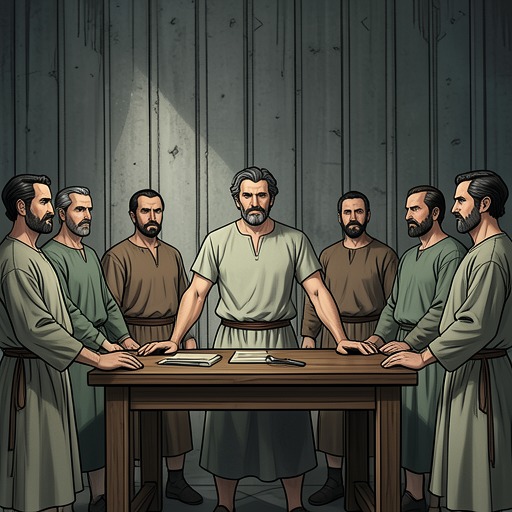
The empire is repeatedly described as too extensive to be treated as a private possession that can be divided without consequence. In a proposal made at Sambuvaraiyar’s palace, the claim that the realm has grown far beyond its earlier boundaries serves as the rationale for partition: one region would go to Madhuranthakan and another to Adithan. The proposal presents division as a practical compromise between rival claims, but its very scale makes the danger plain. Partition would not settle a family disagreement within a small domain; it would alter the structure of a realm built and maintained across generations.
The geographical language of the debate anchors that abstract danger in familiar boundaries. The proposed division assigns the lands south of the Kollidam River to Madhuranthakan and the north to Adithan. The plan is discussed among powerful lords as though regional allocation might reconcile competing claims, yet the Emperor rejects the premise that the empire can be cut into portions. He insists that Madhuranthakan may be made ruler only over an undivided Chozha realm, and says that even opposition from his sons or the Pazhuvettarayars will not change that resolve.
The question of unity is therefore inseparable from the question of who may decide. The Emperor’s stated command asserts sovereign authority; the negotiations at Sambuvaraiyar’s palace imply that powerful nobles are already attempting to arrange the outcome; and Adithan’s challenge to those nobles accuses them of controlling access to his father. The political crisis is not merely about which claimant has the stronger title. It is also about whether the Emperor’s decisions can be communicated and carried out without mediation by those who command the palace and its channels of access.
Succession, Public Opinion, and Control
The competing claims to the throne bring formal designation into conflict with popular expectation. Adithan recalls that his father publicly crowned him heir, but says that the Emperor now appears to favour Madhuranthakan and has repeatedly invited him to Thanjavur. Adithan has declined those invitations rather than travel to the capital only to confront his father’s changed intentions. His account exposes the political cost of an unresolved change: a public act of succession remains a powerful precedent even when rumours suggest that the ruler’s preference has shifted.
The Emperor, for his part, declares Madhuranthakan the rightful successor and treats that decision as binding even if his subjects or sons object. Yet reports of public feeling make clear that the people may not accept the choice. They believe the Emperor is being held within his own palace, know that ships were sent to arrest Arulmozhi Varman, and suspect that the Pazhuvettarayar lords arranged for the prince to drown at sea. These beliefs have made the kingdom seethe with anger; the prospect that Arulmozhi Varman might be present in the country is described as enough to provoke an uprising that could crown him immediately.
The possibility of keeping Arulmozhi Varman away from public view is itself treated as a means of preventing the succession dispute from turning into open conflict. If Madhuranthakan were crowned while Arulmozhi Varman remained nearby, the account warns, the public would not accept the arrangement and the realm could become a battlefield. The prince’s absence is thus politically consequential whether or not the reports of his death are true: uncertainty about his fate becomes a resource around which competing expectations gather.
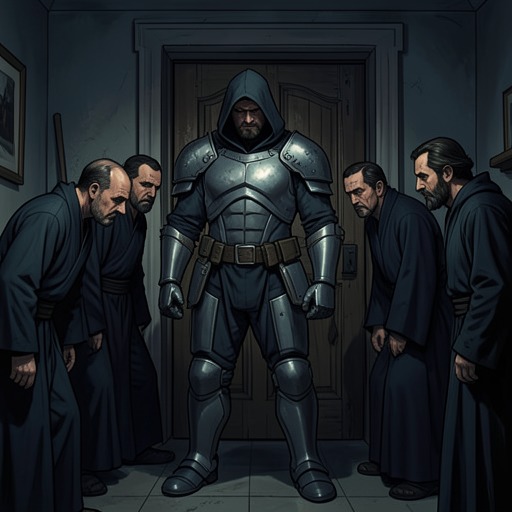
Adithan’s confrontation with the nobles makes the issue of control explicit. He accuses them of keeping his father effectively confined and of restricting who can approach the Emperor. He also questions whether the order to arrest Arulmozhi Varman came from the sovereign or from those acting in his name. These accusations distinguish royal authority from practical power: the Emperor may issue decisions, but the ability to shape access, information, and enforcement can lie with the lords around him. Adithan’s anger is directed not only at a proposed outcome but at the possibility that the machinery of rule has been captured by intermediaries.
Bloodline, Allegiance, and Political Risk
The struggle over succession reaches beyond the recognised heirs because concealed kinship can change the meaning of dynastic belonging. Kundhavai connects earlier memories and reports about the mute woman to the possibility that Nandhini is her daughter. Aniruddhar then recounts events from twenty-five years earlier, including the woman’s reported death at Kodikkarai and later information that she gave birth to twins in a royal garden. The account leaves the children’s fate within a guarded secret, but establishes that a hidden family history sits close to the centre of royal politics.
Adithan eventually tells Nandhini that she is Sundara Chozhar’s daughter, born to Mandhakini after Sundara Chozhar formed a gandharva marriage with her on an island off Ilankai. He presents the revelation as a claim of kinship rather than as a fresh contest for the throne: Nandhini is his sister and has a right to share in the family’s honour and inheritance. The disclosure complicates the boundary between the dynasty and its adversaries. A woman whose political alignment has placed her against the Chozhas is also, by blood, a daughter of the reigning house.
That contradiction has immediate political stakes. Adithan understands that Nandhini’s involvement with the Pandiya plotters, her crowning of a child as king, and her oath to protect that child’s crown are not erased by the revelation of her parentage. He nevertheless urges her to regard these actions as belonging to a horrifying past and offers familial recognition in their place. The gesture reveals a possible alternative to treating every allegiance as permanent: kinship might reopen a claim to belonging, although the evidence does not establish that the offer resolves the conflict.
Unity Under Pressure
The conspiracy at the Thiruppurambiyam memorial demonstrates why succession cannot be separated from the empire’s security. Adithan recounts seeing Nandhini with Pandiya plotters as they crowned a child and pledged to defend the child’s crown against their enemies. The episode sets a rival claim to kingship against the Chozha dynasty and turns a struggle within the royal family into a threat from organised opposition. Its secrecy and defiance sharpen the danger of a court already divided over its own successor.
Even Adithan’s response shows how the dispute presses on the idea of imperial unity. He admits that he has considered destroying Kadambur Palace and punishing those involved in the midnight conspiracy, but says that remembering his father restrains his anger. He also doubts whether he will leave Kadambur alive and describes the Emperor as caught within the Pazhuvettarayars’ power, while the palace built for his parents at Kanchi stands unused. These statements bind personal danger to the state of the realm: the prince’s uncertainty about his own safety reflects a broader uncertainty about whether the royal family can govern, reunite, or even meet freely.
The Chozha Empire consequently appears not as a stable backdrop but as the contested object of every major political action. Dynastic memory lends authority to Adithan; a public coronation and the Emperor’s later preference pull succession in different directions; nobles negotiate partition while claiming to serve the realm; popular suspicion threatens to turn opinion into rebellion; and concealed blood ties unsettle the line between family and enemy. The insistence that the empire remain whole is therefore more than a territorial principle. It is the unresolved test of whether royal command, noble power, and popular allegiance can still be made to serve one political order.