Chozha Nadu
Ponniyin SelvanChozha Nadu is the political landscape in which a contested succession and a feud within the royal family threaten to become a struggle for the kingdom itself. The narrative presents it not through a comprehensive map, but through the people who claim authority over it: a celebrated crown prince, rival political houses, a feared succession meeting, and a concealed royal parentage whose disclosure could either reconcile or further endanger the dynasty.
Realm and Royal Authority
The kingdom’s identity is tied to a long royal lineage. In defending that legacy, Aditha Karikalan’s grandfather recalls a dynasty said to have prospered for more than two thousand years. Its ancestors had ruled on differing scales: some as celebrated monarchs whose authority extended widely, others content with Uraiyur and its immediate surroundings. Their religious allegiances and marriages also varied. Some kings revered Siva Peruman, some princes worshipped Thirumaal, and others rejected both gods and demons; one ancestor, Paranthaka Chakravarthy, married seven women. In the grandfather’s account, these differences did not diminish the line’s defining inheritance: none had dishonoured the clan by desiring another man’s wife. His warning to Aditha is thus framed as a defense of dynastic reputation as much as personal conduct.
The prince’s public standing is made visible at the Kedilam River crossing. During Aippasi, floodwaters and crowds gathered there as a royal procession approached. Its ushers presented Aditha as the warrior who had entered the Sevur battlefield at twelve and beheaded Veera Pandiyan, as a terror to Rettai Mandalam, lord of Thondai Mandalam, commander of the northern Chozha forces, and heir to Sundara Chozhar. The crowd cleared the crossing and climbed onto the banks to catch sight of him. The scene sets the splendor of royal authority against the private burdens carried by its heir: the procession announces a victorious prince, while nearby conversation dwells on his grief and the strain visible in his face.
Rumors and Political Instability
The immediate crisis deepens after news spreads that Ponniyin Selvan has drowned. People arriving from Chozha Nadu are said to predict hostilities, and one speaker links the kingdom’s turmoil to the prince’s disappearance. Another hopes that peace will last as long as Aditha remains alive, a remark that makes the stability of the realm seem dependent on one man’s survival. The exchange identifies the danger without resolving it: the speakers ask which factions might fight, then name the Pazhuvettarayar Faction and Kodumbalur Velaar as likely opponents.
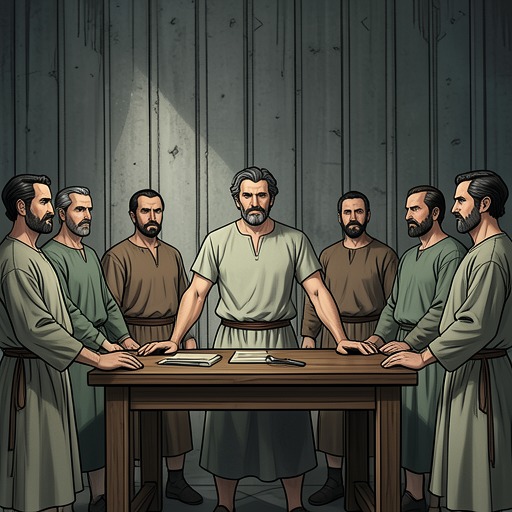
Their lords are assembling at Kadambur Sambuvaraiyar’s palace in an effort to prevent open conflict, and Aditha is expected to attend. The meeting therefore carries stakes beyond a gathering of nobles: it takes place amid fears of factional war and uncertainty over who will succeed to the throne. The bystanders also read the political emergency through family feeling. They attribute Aditha’s drawn appearance to his love for his missing younger brother and to Sundara Chozhar’s illness. The kingdom’s condition is consequently registered both as public rumor about armed conflict and as a strain on the royal household.
Rival Houses and Competing Claims
The conflict at Kadambur has deep roots in inherited rivalry. Kadambur Sambuvaraiyar’s house claims descent from the extended family of Kolli Valvil Ori and treats Ori’s ancestral friends and enemies as its own. Its old enmity with the descendants of Thirukkovilur Malayaman makes it difficult for the house to welcome a grandson and heir of that rival line, much less endorse his ascent to the throne. Aditha’s conduct compounds the problem: his arrogance and belittling treatment of lords and chieftains turn early dissatisfaction into hostility. Kadambur Sambuvaraiyar consequently commits himself to Madhuranthakan’s claim to the Thanjavur throne.
That position begins to shift when Aditha arrives at Kadambur and his host imagines that the prince has become interested in Manimekalai. Rumors that Aditha intends to avoid marriage seem contradicted by his frequent visits to the women’s quarters and lively conversations there. Kadambur Sambuvaraiyar takes Aditha’s praise of his daughter’s liveliness, and her own heightened spirits, as signs of mutual affection. He begins to picture her as the future queen and their son as the kingdom’s heir. In that imagined future, honours associated with Thirukkovilur Malayaman might pass to him as well. A house that had backed a rival succession therefore sees a possible marriage alliance as a route to its own advancement. The episode shows how dynastic claims are shaped not only by inherited hostility but by hopes attached to family marriage.
Hidden Kinship and the Threat of Revenge
The kingdom’s political danger is bound to a secret history within the royal family. Aniruddhar confesses to Kundhavai that, twenty-five years earlier, he reported Mandhakini’s death after learning that she had survived her fall into the sea. He had seen her rescued by a fisherman and bribed him to take her to Ilankai, intending, he says, to spare Sundara Chozhar further distress. Later, Aniruddhar learned that Mandhakini had stayed in a royal garden and given birth to twins, but he did not discover their identities. He suspected that she had saved the young Arulmozhi when he fell into the Kaveri River; Arulmozhi later told Kundhavai that he had reached the same conclusion after meeting Mandhakini in Ilankai. These revelations connect a private concealment to the succession crisis now facing the kingdom.
Aditha eventually tells Nandhini that she is Sundara Chozhar’s daughter and therefore his sister, born to Mandhakini after Sundara Chozhar formed a Gandharva bond with her on an island off the coast of Ilankai. He recalls recognizing in Nandhini the beauty of his grandmother Kalyani, which he had only understood as an inheritance from their father after leaving Kanchi. The disclosure gives Nandhini a place in the royal genealogy, but it does not erase the injuries and political commitments that have shaped her life. Aditha also tells her that she had joined the Pandiyan plotters, sworn to destroy the Chozha clan, and crowned a child king near a Pallippadai in the Kollidam jungles. He urges her to set that past aside and promises to redress the wrongs done to her.
The Realm at the Edge of Rupture
Aditha’s fear that revealing the family truth may not reconcile Nandhini captures the danger facing Chozha Nadu. He argues that her anger may not yield even if she learns she is Sundara Chozhar’s daughter, and describes the kingdom’s salvation as dependent on one of three outcomes: his death, hers, or both. He even considers killing her to save the realm, then recoils into alarm at the implications of his own words. His reasoning is not presented as a settled political solution; it exposes how completely the royal crisis has fused kinship, vengeance, and the use of force.
Across these episodes, Chozha Nadu is defined by the distance between its public image and its precarious reality. The procession at the Kedilam celebrates an heir whose reputation rests on victory; the conversations surrounding him predict factional conflict; and the gathering at Kadambur combines old rivalries with fresh hopes of advancement. Beneath all of them lies a family history that has been concealed in the name of protection and now returns as a question of succession and survival. The kingdom’s peril is therefore not a single battle but the convergence of political ambition, unresolved loyalties, and a truth that may arrive too late to heal the divisions it explains.