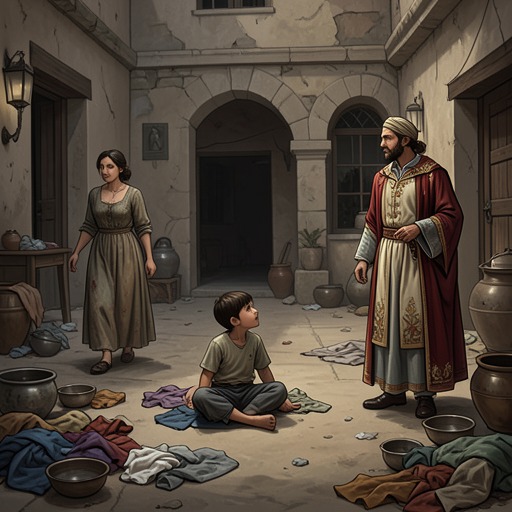
Elder Pazhuvettarayar
Ponniyin SelvanElder Pazhuvettarayar is a senior Chozha power broker, identified as chief treasurer, whose marriage to Nandhini becomes the centre of rumour about Adithan’s low spirits. The evidence gives him two strikingly different public faces: an imposing lord arriving with a large retinue, and a husband whose devotion to his much younger queen is so conspicuous that it shapes how others move through his household. Yet the most sensational story about his marriage remains gossip, not confirmed history.
Identity and Reputation
The Kadambur crowd knows Elder Pazhuvettarayar as a figure of exceptional rank. His title as chief treasurer marks his place in the political order, and his arrival is important enough that the palace and its gates are decorated with flags, buntings, and scented garlands. The fortress is more heavily guarded than before in anticipation of the crown prince and the two parties travelling with him and Elder Pazhuvettarayar’s consort. His presence helps turn Kadambur into a place of ceremony and heightened political expectation.
That stature also makes him the subject of stories traded as explanations for Adithan’s melancholy. One market rumour claims that the prince fell in love with a Pandya woman, only for Elder Pazhuvettarayar to marry her while Adithan was away fighting in the Vada Pennai wars. In this telling, Nandhini’s influence has made her word law in Chozha Nadu and left the prince almost deranged. The conversation itself immediately questions the account: another speaker objects that it makes little sense for a woman supposedly loved by the prince to marry a man described as over sixty. The episode establishes the story’s circulation, not its truth. The broader narrative later identifies Nandhini as the daughter of Sundara Chozhar and Mandhakini, and as Adithan’s sister; that revelation makes the market’s romantic explanation still less reliable, without undoing the fact of her marriage to Elder Pazhuvettarayar.
Marriage and Household
Elder Pazhuvettarayar’s relationship with Nandhini is presented through other people’s observations rather than through a direct account of their private life. Manimekalai recalls that, on an earlier visit eight months before, he would not allow Nandhini to enter the women’s wing. The recollection makes his solicitude appear also as restriction: his care is so controlling that even access to the women’s quarters is decided by him. During the current visit, the palace is being reorganized to prepare an entire women’s apartment for Nandhini, an undertaking that shows the resources and attention her presence commands.
The same account suggests that his attachment is widely recognized. Manimekalai remarks that the whole world knows how much he adores his queen, and imagines that he would react violently if Vallavarayan Vandhiyathevan were discovered in Nandhini’s rooms. Her warning gives his devotion a threatening edge: the protection that elevates Nandhini’s status also makes the prospect of an uninvited encounter dangerous. The evidence does not show him carrying out that threat, but it shows that those around him take his jealousy and authority seriously enough to plan around them.
Arrival at Kadambur
Elder Pazhuvettarayar travels to Kadambur with Nandhini and an extensive entourage. His arrival is staged as a public display: he descends from a majestic elephant, and Nandhini follows him into view rather than remaining concealed in a closed palanquin. Azhwarkkadiyaan Nambi notices the change in how she is presented. The open arrival makes the queen visible to the watching town and distinguishes this entrance from the more private or screened mode of travel expected by the observers.
The preparations around the couple expose the scale of their presence. Guards reinforce the fortress; flags, buntings, and garlands dress the approach; and the town anticipates several days of activity. Kadambur’s people also hear that Kadambur Sambuvaraiyar has gone as far as Kanchi with his son to escort Adithan home. Thus Elder Pazhuvettarayar’s arrival belongs to a larger convergence of courtly parties and political expectations, rather than a merely domestic visit. At the same time, townspeople quietly register discomfort that such elaborate festivities accompany the reported drowning of Arulmozhi Varman. Their muted disapproval supplies a counterpoint to the official display: spectacle cannot erase the crisis that shadows it.
Political and Narrative Significance
Elder Pazhuvettarayar’s influence operates through both office and marriage. His presence at Kadambur brings an imposing retinue and helps define the political occasion; Nandhini’s position beside him makes their union a subject of public speculation. The rumour that he displaced Adithan in love turns a marriage into a ready-made explanation for princely distress, while the speakers’ scepticism exposes how quickly public talk converts uncertain motives into a confident tale. The later disclosure of Nandhini’s parentage further changes the meaning of those rumours: she is not simply the Pandiya woman imagined by the market, but a daughter of the Chozha emperor and a sister to Adithan.
The portrayal also holds devotion and domination together without resolving them into a single judgement. Elder Pazhuvettarayar’s willingness to prepare a whole apartment for Nandhini and his publicly visible care suggest attachment; the remembered restriction of her access and the feared violence toward a man found near her reveal the coercive reach of that attachment. The contrast matters because his household is not separate from political life. His marriage attracts rumour, his rank magnifies its consequences, and the guarded, decorated arrival at Kadambur makes the couple’s private bond part of a public spectacle.