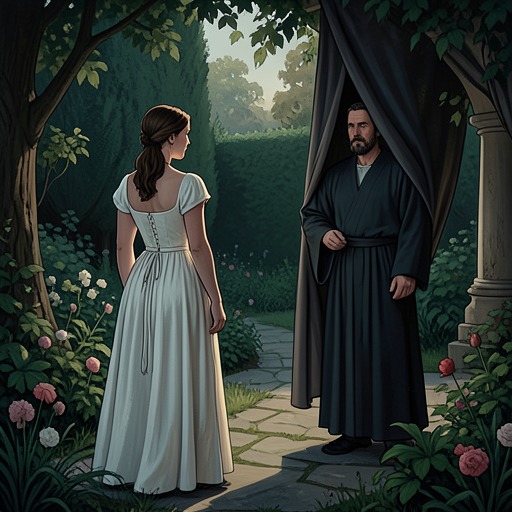
Karikalan Reveals Nandhini’s Parentage
Ponniyin SelvanKarikalan Reveals Nandhini’s Parentage turns a confrontation between Aditha Karikalan and the Pazhuvoor Ilaiya Rani into a disclosure about the Chozha royal family. Aditha tells her that she is Sundara Chozhar’s daughter, born to Mandhakini Devi, and therefore his sister. The revelation gives their estranged childhood relationship a new meaning, but it does not reconcile them: the family history he offers as a reason to forgive is set against the political treachery she refuses to forgive or forget.
The history behind the revelation
The disclosure rests on secrets that have been withheld for years. Aniruddhar later recounts to Kundhavai that, twenty-five years earlier, he was sent to find Mandhakini Devi at Kodikkarai. After hearing that she had fallen into the sea from the lighthouse, he discovered that a fisherman had rescued her. Aniruddhar recognized her, paid the fisherman to take her to Ilankai, and returned to report that she was dead. He says he acted to spare Sundara Chozhar pain, but admits that he concealed the truth without anticipating its consequences.
Aniruddhar’s later account also connects Mandhakini Devi to the royal family’s buried history. He learned that she had stayed for several days in Sembian Maadevi’s garden at Pazhaiyarai and given birth to twins, whom she left behind. He was not told what became of the children; that secret, he was informed, belonged to Sembian Maadevi. Aniruddhar suspected that Mandhakini Devi had rescued the young Arulmozhi Varman from the Kaveri River, a suspicion Arulmozhi later shared after meeting her in Eelam. These details establish Mandhakini Devi’s concealed life and maternal history, but they do not, by themselves, identify the twins. Aditha’s declaration to the Pazhuvoor Ilaiya Rani supplies the specific parentage claim.
Kundhavai had earlier considered whether the Pazhuvoor Ilaiya Rani might be Mandhakini Devi’s daughter, prompted by their striking resemblance and by what she had heard from Vallavarayan Vandhiyathevan and Arulmozhi Varman. At that point, she could only speculate: resemblance did not prove whether the women were mother and daughter or sisters. Aditha’s account changes the status of that suspicion, presenting the Pazhuvoor Ilaiya Rani as his father’s daughter and Mandhakini Devi’s child.
The disclosure at Kadambur
The conversation takes place against the expectations surrounding Aditha’s arrival at Kadambur. News of his coming draws a huge crowd to the fort, where the royal crier announces his ancestry, military standing, and title as the man who beheaded Veera Pandiyan. The public welcome presents him as a prince whose identity is bound to dynastic lineage and public honor. Inside the palace, however, Aditha’s most consequential statement concerns a hidden branch of that same lineage.
Sambuvaraiyar has his own reasons to watch Aditha’s interactions with his daughter, Manimekalai. Although he had supported Madhuranthakan’s claim to the throne, he begins to imagine that Manimekalai might win the crown prince’s affection and marry him. In that possibility, he sees a path to the throne for his daughter and her future son, as well as a reversal of the distinction enjoyed by the Thirukkovilur Malayaman. The prospect makes the arrival at Kadambur politically charged even before Aditha reveals his kinship with the Pazhuvoor Ilaiya Rani. His announcement disrupts a courtly world in which descent, marriage, and succession are already being read as instruments of power.
When the Pazhuvoor Ilaiya Rani treats Aditha’s claim with disbelief, he answers not with a new document or witness but with his memory of her appearance. He says he had looked at her since she was five years old, yet only while travelling from Kanchi to Kadambur did he understand what her features suggested. He compares her beauty to that of his grandmother Kalyani of the Vaithumbaraayars, whose celebrated features, he argues, the Pazhuvoor Ilaiya Rani inherited through her father. He says that this quality is present in her rather than in himself, Kundhavai, or Arulmozhi Varman. His reasoning turns recognition into an intimate, retrospective act: what he had seen since childhood acquires a new explanation only after the journey toward their meeting.
A new meaning for a broken bond
Aditha first tries to claim the Pazhuvoor Ilaiya Rani as a sister in the language of shared loyalty. He reminds her that, as a boy, he quarrelled with Kundhavai on her behalf despite Kundhavai being his own sister. When the Pazhuvoor Ilaiya Rani challenges the contradiction between his tenderness and his royal status, he clarifies that he means literal kinship: she is the Emperor’s daughter. He then explains that, before Sundara Chozhar married Aditha’s mother, the Emperor met and fell in love with Mandhakini Devi on an island off Ilankai and entered a celestial bond with her. The Pazhuvoor Ilaiya Rani, he says, was born from that union.
The announcement changes the terms of their past without undoing its injuries. Aditha recalls Sembian Maadevi’s efforts to keep him and the Pazhuvoor Ilaiya Rani apart. As a boy, he had resented those interventions; now he believes that Sembian Maadevi prevented a catastrophe by separating them, though he condemns the concealment of the truth as an injustice to the Pazhuvoor Ilaiya Rani and an evil done to him. He proposes that the past be left behind and that they forgive even if they cannot forget. Kinship offers him a way to reinterpret separation as protection, but the years of silence also make the revelation a belated injury rather than an uncomplicated reunion.
Political allegiance and unresolved betrayal
Aditha’s appeal to family does not rest on ignorance of the Pazhuvoor Ilaiya Rani’s political actions. He says Vallavarayan Vandhiyathevan had reported that she was working with the Pandiyan plotters and had pledged herself to the destruction of the Chozha clan. He has also heard that she worshipped a fish-emblazoned broadsword for that purpose and crowned a child king near a pallippadai in the jungles by the Kollidam River. He urges her to set these acts aside as remnants of a terrible past and insists that, as Sundara Chozhar’s daughter, she has a right to the family’s honor and inheritance. He promises to make it his foremost duty to avenge insults against her and redress the wrongs done to her.
The Pazhuvoor Ilaiya Rani does not accept that appeal as a settlement. She asks why, if Aditha believed what he had just revealed, he waited after arriving at Kadambur rather than meeting and speaking with her sooner. When he returns to the possibility of forgiveness, she distinguishes the wrongs she might pardon from one betrayal committed that day, which she says she will neither forgive nor forget. The exchange leaves the central conflict open: Aditha offers shared blood as grounds for renewed solidarity, while she judges him by the immediate encounter and its breach of trust.
The scene’s significance lies in that unresolved collision between lineage and allegiance. The revelation makes the Pazhuvoor Ilaiya Rani not merely a former companion or political adversary, but Sundara Chozhar’s daughter and Aditha’s sister. Yet family identity cannot by itself erase the conspiracy, the concealment of her parentage, or the betrayal she names. The truth reorganizes the meaning of their relationship at the very moment their opposing claims make reconciliation uncertain.