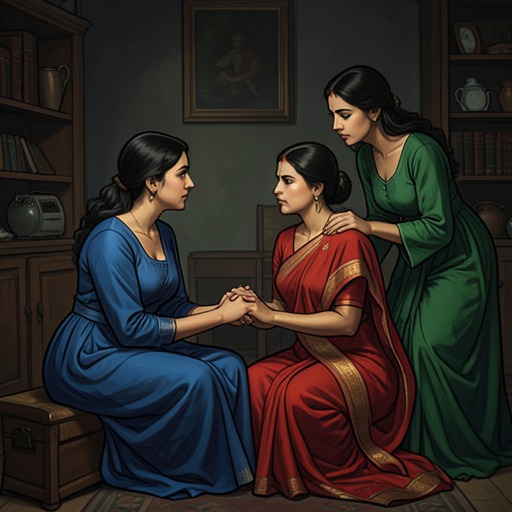
Nandhini–Manimekalai
Ponniyin SelvanNandhini–Manimekalai is a close, sisterlike relationship whose warmth coexists with a marked difference in power: Manimekalai offers Nandhini devoted assistance, while Nandhini claims the authority to direct her choices. Their companionship is expressed through private confidence, teasing, and shared leisure, but it also becomes part of Nandhini’s argument about marriage, loyalty, and the uncertain fate of Aditha Karikalan.
Bond and Mutual Confidence
Manimekalai identifies herself as Nandhini’s dependable support when Nandhini’s husband, Pazhuvettarayar, worries about leaving her among people he distrusts. She answers that she is not without help because Manimekalai “will do anything for my sake.” This is more than a reference to a companion’s presence: Nandhini offers Manimekalai’s loyalty as a reason her husband need not fear for her in his absence.
Nandhini calls Manimekalai her boon companion, and Manimekalai addresses her as Akka, a familiar term for an elder sister. Their language places the younger woman within a kinlike intimacy, though they are companions rather than sisters by blood. The relationship is presented as emotionally close and practically useful: Nandhini trusts Manimekalai’s devotion, and Manimekalai turns naturally to Nandhini for company and shared plans.
Loyalty, Marriage, and Influence
Pazhuvettarayar suspects that Manimekalai’s loyalty might be challenged if Aditha Karikalan were to offer her marriage and the prospect of becoming queen at Thanjai. Nandhini rejects that concern emphatically. She says that Manimekalai would refuse even the position of Indrani if it went against Nandhini’s wishes, and makes the claim deliberately stark: at her command, Manimekalai would kill Karikalan with a sword. The statement is a demonstration of the influence Nandhini says she possesses, not an account of Manimekalai carrying out such an act.
Nandhini then distinguishes her own wishes from what she sees as Manimekalai’s welfare. She says she loves Manimekalai as she would her younger sister, and that this affection prevents her from agreeing to bind the young woman to someone whose life may not last. Her reference to Karikalan’s uncertain longevity is ominous; as she speaks, her gaze seems fixed on an event far away. The scene therefore holds two claims in tension: Nandhini describes Manimekalai as obedient to her, but also presents herself as protective of Manimekalai and unwilling to sacrifice her to a potentially dangerous marriage.
Private Companionship at Kadambur
After Aditha Karikalan and the other men leave on a hunting expedition, the palace seems bleak to Nandhini without their noisy presence. She mock-laments that men are pests when they are near but a nuisance when they depart, leaving the women with nobody to tease. Manimekalai joins the playful exchange, says she wishes she could have gone on the hunt, and wonders whether her brother, Kandamaaran, had insisted that she stay behind out of consideration for Nandhini’s dislike of hunting. Nandhini corrects her gently: she admits that blood frightens her, but suggests Kandamaaran’s intention was instead to keep Manimekalai apart from one of the guests.
Manimekalai dimpled, looked down, and proposed that the two women disregard the men and visit the lake’s bathing pavilion. Nandhini agrees, and Manimekalai promptly goes to seek her father’s permission and arrange the outing. Their exchange shows ease and intimacy: Nandhini can tease her companion about her feelings, and Manimekalai responds not with withdrawal but by redirecting them toward time together. The passage does not specify the guest’s identity in this exchange, so the teasing remains a glimpse of Nandhini’s attentiveness rather than confirmation of a particular attachment.
Shared Leisure and Its Interruption
The women are rowed to a secluded island bathing place, nearly two kaadhams along the lakeshore, where the ladies of the Kadambur household often went to bathe or amuse themselves. Two maids bring them ashore and prepare a meal. On the quay-stairs, Manimekalai entertains Nandhini by mimicking Pazhuvettarayar, Karikalan, Kandamaaran, Parthibendran, and Vandhiyathevan. Nandhini laughs loudly, although her attention also slips into abstraction; the narration suggests that she is absorbed in a private reverie even amid her enjoyment of Manimekalai’s performance.
That leisure is abruptly broken when Manimekalai springs up, announces that the hunt has come to them, and draws a dagger from her waist. Nandhini follows her startled gaze and sees a leopard on a large branch, watching the women as if considering a leap. The moment shows Manimekalai acting quickly in the face of danger and Nandhini responding to her warning. The evidence ends at the sight of the animal, before either woman’s response to the threat or its outcome is given.
The Relationship’s Emotional Tension
The relationship is marked by genuine familiarity but is not presented as an exchange between equals in influence. Nandhini’s language makes Manimekalai’s devotion evidence of her own power; her hypothetical command to kill Karikalan tests the extremity of that claim. Yet she also describes her affection as sisterly and frames her refusal of the proposed marriage as protection. The contrast matters: care and control occupy the same conversation, without the text resolving how freely Manimekalai would choose if her wishes conflicted with Nandhini’s.
In the quieter Kadambur scenes, their bond takes a less political form. They joke about the men, share an excursion, and enjoy Manimekalai’s affectionate impersonations. Nandhini’s laughter and intermittent abstraction stand side by side, making the companionship real without making it a cure for whatever occupies her thoughts. Taken together, the scenes establish Manimekalai as Nandhini’s trusted intimate and willing companion, while leaving open the limits of that loyalty and the consequences of Nandhini’s influence over her.