Parrots
Ponniyin SelvanParrots are at once creatures in a riverside scene and the governing image in Poonguzhali and Sendhan Amudhan’s conversation about freedom. One bird’s abrupt flight prompts a debate over whether liberty is simply the ability to leave, or whether birth, habit, and the conditions of one’s life can make escape difficult even when it is possible.
Appearance and Encounter
As Poonguzhali and Sendhan Amudhan drift by boat along the canal from Nagapattinam toward Kodikkarai, an emerald-green parrot settles on a golden thazhampoo flower. Its weight makes the flower sway like a small swing; the bird moves with it, then bends to peck at a petal with its coral beak. The approaching craft seems to alarm it. It flutters away with a shriek, interrupting the quiet observation and turning a brief sighting into the subject of their exchange.
The parrot is not described as tame or as belonging to anyone. Its single, startled departure gives Poonguzhali a visible example of the movement she admires: it can take to the sky rather than remain where it landed. Yet the bird’s sudden flight also means that its freedom is not presented as carefree. The boat’s approach appears to frighten it, and its escape is a response to alarm, not a demonstration that it can go wherever it wishes without constraint.
Freedom and the Palace
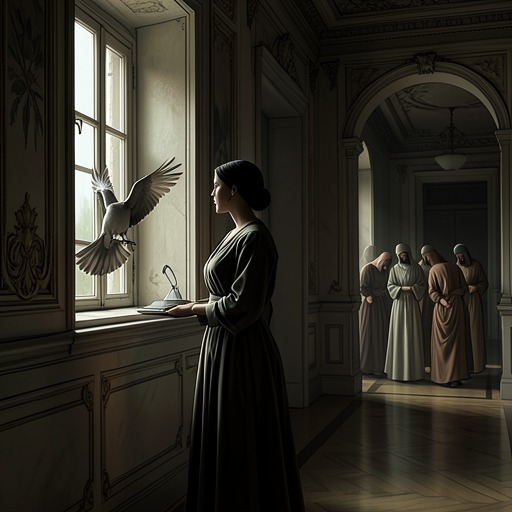
Poonguzhali imagines being born as a parrot because, in her view, flight offers a freedom unavailable to people bound by palace life. Her admiration is not an abstract fondness for birds: it rests on their capacity to move through open sky at will. She contrasts that imagined mobility with the confinement of palace parrots, kept in cages by princesses despite being treated with affection. To her, affectionate handling does not undo the basic fact of imprisonment.
Sendhan Amudhan complicates this contrast by comparing palace life to a gilded cage. Princesses may inhabit splendid surroundings, but he describes them as subject to restrictions, rules, security, and secret measures. Even leaving the palace would not necessarily give them the independent mobility Poonguzhali takes for granted: they could not simply set off alone by boat or wander through the forest as she does. His comparison places the bird and the princess within one image of confinement, while preserving the differences between their lives.
Poonguzhali resists that analogy. She challenges the assumption that palace women must accept limits placed on them, asking why they do not leave and roam freely. Her response makes freedom a matter of refusal as well as circumstance. Sendhan Amudhan, in turn, argues that a person’s opportunities are shaped by birth and upbringing: Poonguzhali’s relatively unfettered childhood by the seashore has given her a kind of freedom that gently bred royals do not share. The parrot image thus connects physical movement to social position without making the two conditions identical.
Captivity and Habit
Sendhan Amudhan introduces a second, less obvious aspect of captivity: a caged parrot may not fly away even after its cage is opened. He says he has seen parrots in the palaces of Thanjai and Pazhaiyarai, where birds accustomed to being fed from princesses’ hands leave the cage only briefly before returning. In his account, release alone does not restore the wish or capacity to live outside. A bird can be physically free to depart and still return to the place that confined it.
That observation directly challenges Poonguzhali’s belief that flight guarantees liberty. It does not make her accept confinement; instead, she insists that she would resist being kept, even by someone who also fed and cherished her. Her refusal exposes the distinction between care and freedom that structures the exchange. The princess may offer food and affection, but those gestures do not change the cage’s boundaries. Poonguzhali’s extreme response to the thought of being confined shows how firmly she identifies a life worth living with the ability to move beyond another person’s control.
Narrative Significance
The parrot motif holds together two contrasting ideas. The bird in the canal scene is quick to take flight when the boat approaches; the palace birds in Sendhan Amudhan’s account have grown accustomed to their cages and return after a short excursion. Together, these examples distinguish immediate escape from lasting independence. The same creature can signify apparent freedom in the open landscape and the effects of prolonged confinement in a palace.
The image also makes the conversation’s social contrast concrete. Poonguzhali’s access to boats, streams, and forest paths is set against the princesses’ restricted movement, while the caged bird gives both speakers a shared point of reference. Their disagreement is not resolved: she stresses the possibility of defiance, and he stresses how birth and a settled way of life shape what escape means. The parrot therefore functions not as a simple emblem of liberty, but as the means by which the scene tests the distance between being allowed to leave and being able to live freely.