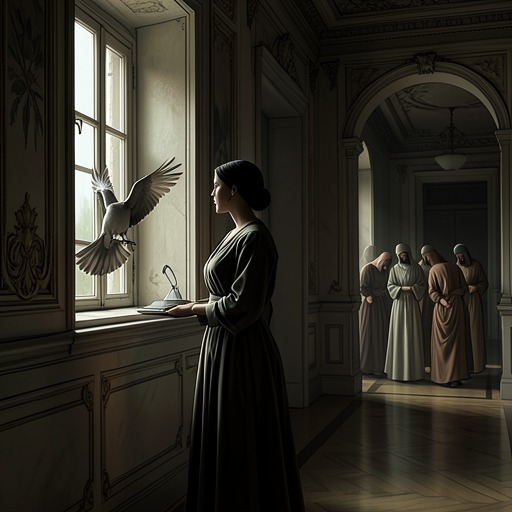
Parrots in gilded cages
Ponniyin SelvanParrots in gilded cages is an image through which Poonguzhali and Sendhan Amudhan debate the difference between apparent privilege and lived freedom. It gives form to Poonguzhali’s refusal to accept confinement as affection, while Amudhan uses the parrot’s dependence on its cage to question whether freedom is simply a matter of will.
The Image of Captivity
The image arises in a conversation about birds kept in royal households. Poonguzhali condemns the practice of shutting up parrots and then treating them tenderly, seeing the affection shown to a captive as no answer to its loss of liberty. Her anger extends to the princesses who keep the birds, and she insists that she would rather be a fearsome outsider than a princess confined by palace life.
Amudhan broadens the comparison. A princess, he suggests, may inhabit a splendid palace yet remain bound by restrictions, rules, security, and secret precautions. The gilded cage therefore signifies not only physical enclosure but a way of life in which rank and comfort do not guarantee freedom of movement.
Freedom, Birth, and Habit
Poonguzhali challenges the idea that palace restrictions make independent movement impossible: she asks why princesses cannot simply go where they wish. Amudhan answers that desire alone cannot erase the conditions created by birth and upbringing. Poonguzhali’s own freedom, in his account, is connected to a relatively unfettered childhood by the seashore, a freedom he does not regard as readily available to royals raised within palace life.
He adds a more unsettling qualification to the metaphor. Parrots kept for a time and fed by princesses may not fly away when released: they flutter only a short distance, cry out, and return to their cages. Amudhan says he has witnessed this pattern in the palaces of Thanjai and Pazhaiyarai. Captivity, in this example, can shape attachment and habit so deeply that the cage remains a destination even after its door is open.
Poonguzhali’s Rejection
Poonguzhali refuses to accept such habituation as a model for her own life. She declares that she would never submit to imprisonment and rejects the imagined role of a bird dependent on a princess’s care. Her response turns the metaphor into a declaration of self-determination: for her, affection cannot make confinement acceptable, and the prestige of royal status cannot make a restricted life desirable.
The exchange leaves the image deliberately unsettled. Amudhan uses the returning parrot to show that freedom is shaped by circumstance and learned dependence; Poonguzhali insists that her own answer to confinement would be refusal. The gilded cage thus holds both sides of their disagreement: privilege may conceal constraint, and release may not by itself undo the habits captivity has formed.