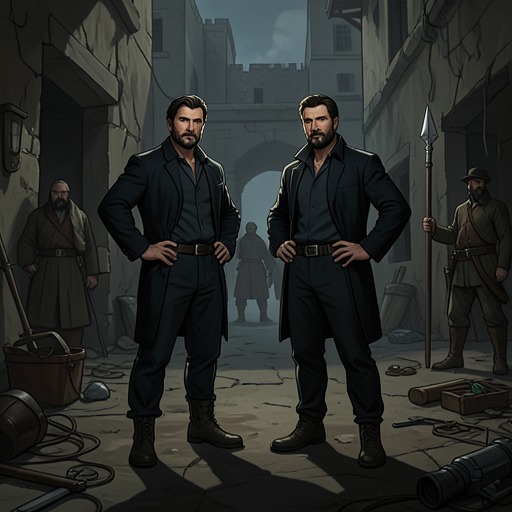
Parthibendra Pallava
Ponniyin SelvanParthibendra Pallava is a companion of Aditha Karikalan whose confidence readily becomes contempt and whose suspicions help ignite a dispute over the disappearance of Arulmozhi Varman. At the royal cavalcade’s roadside reunion with Vandhiyathevan, Parthibendra moves from policing the road to accusing the returning warrior of culpability. The countercharge—that Parthibendra himself failed to protect the prince—leaves the central question unsettled and exposes the strain beneath the companions’ public camaraderie.
Identity and Introduction
Parthibendra appears among the men accompanying Aditha Karikalan. Before the prince’s arrival, onlookers identify one of the riders beside him as Parthibendra Pallavan, while mistaking the other for Vandhiyathevan. They are corrected: the second man is Kandamaaran, sent by his father, Sambuvaraiyar, as a personal escort because an invitation alone was not considered sufficient. The exchange presents Parthibendra as a recognizable member of Karikalan’s circle, while the added escort underscores the importance attached to the prince’s visit.
A later conversation reveals how Parthibendra regards an older figure in the same company. Watching Thirukkovilur Malayaman pause to speak privately with his grandson, Parthibendra tells Kandamaaran that he had feared the old man would insist on accompanying them. Kandamaaran replies that he had planned to throw him into the Vellaaru River; the two exchange contemptuous laughter. Parthibendra’s participation makes his dismissiveness plain: he is willing to turn a senior lord’s presence into the subject of a cruel joke, and shares the joke rather than restraining it.
Conduct on the Road
When two riders approach the royal party at speed, Parthibendra and Kandamaaran stretch out their spears to block the road, outraged at the prospect that the newcomers might pass without acknowledging the company. The precaution proves unnecessary: the riders rein in their horses at a distance and reveal themselves as Vandhiyathevan and Azhwarkkadiyaan. The moment gives Parthibendra a practical role in the scene, but also shows how readily he and Kandamaaran assume that the royal party’s standing demands deference.
Karikalan’s response to Vandhiyathevan is an embrace of unmistakable joy. Parthibendra, by contrast, soon occupies the less celebratory role of challenger. When the companions’ quarrel reaches the question of what has passed between them, he proposes that the dispute concerns a woman and that the men should be questioned separately. Karikalan agrees, teasingly attributing the quarrel to the Pazhuvoor Ilaiya Rani’s power to ensnare men. Parthibendra’s suggestion momentarily offers a way to contain the argument, but it also reduces a conflict whose stakes soon prove much graver than romantic rivalry.
The Accusation and Countercharge
Parthibendra’s principal suspicion is that Vandhiyathevan bears responsibility for Arulmozhi Varman’s apparent loss at sea. He points to the contrast that troubles him: Karikalan’s brother plunged into the raging water to save Vandhiyathevan from a burning ship, yet Vandhiyathevan has returned without a broken limb or even a bruise, while the prince’s fate remains unknown. Parthibendra turns that contrast into an accusation, asking Karikalan to question Vandhiyathevan and suggesting that, if Arulmozhi is lost, the blame lies with the man he rescued.
Vandhiyathevan refuses to answer on those terms alone. He first demands an explanation from Parthibendra, who had escorted Arulmozhi from Ilankai in his own vessel. The prince had been urged to remain on the island by Chief Minister Aniruddhar and Senathipathi Boodhi Vikrama Kesari, but had chosen to honor his elder brother’s wishes. Vandhiyathevan presses Parthibendra to explain why he did not bring his royal charge safely home, what he was doing when the prince entered the sea, and why he and his men watched rather than protecting him. The questions invert Parthibendra’s charge: the returning survivor is no longer the only man whose conduct requires scrutiny.
Parthibendra splutters and protests that Vandhiyathevan has effectively called him a murderer. His bodily agitation—the burning face, twitching limbs, and trembling—marks the force of the challenge, but does not answer it. The exchange establishes reciprocal suspicion, not a verdict. Parthibendra’s claim remains an accusation, and Vandhiyathevan’s questions leave the circumstances of the sea rescue contested.
Conflict and Narrative Role
Karikalan recognizes that the three companions are close to tearing into one another. He orders Parthibendra and Kandamaaran to ride slowly ahead while he follows with Vandhiyathevan, whose account of his travels he wants to hear and whose accusers he intends to question. He also insists that the men must stop nurturing resentment. The arrangement separates Parthibendra from the immediate conversation without declaring him either vindicated or guilty.
Parthibendra’s importance in this encounter lies in the sharp reversal of positions. He begins by presenting himself as Vandhiyathevan’s prosecutor, using the apparent mismatch between the rescue and the return to imply betrayal. Vandhiyathevan answers by making Parthibendra’s own escort duty the subject of judgment. Karikalan’s intervention preserves both questions for investigation. Parthibendra therefore contributes not a resolution but a pressure point: his confidence helps expose the uncertainty surrounding Arulmozhi Varman’s disappearance and the fracture of trust among the prince’s companions.