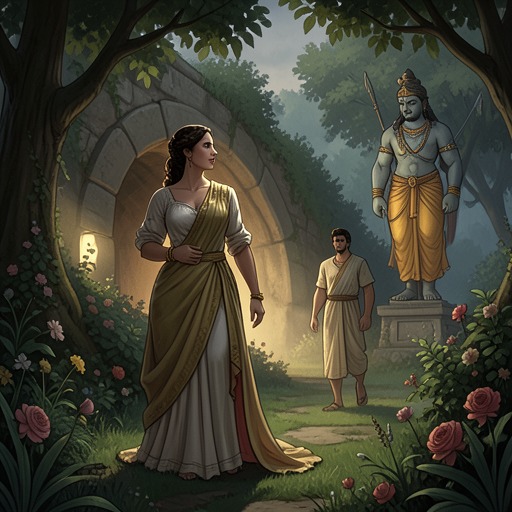
Pazhuvoor Ilaiya Rani
Ponniyin SelvanPazhuvoor Ilaiya Rani is at once a subject of political gossip, a figure of intense private sorrow, and an actor whose plans are not fully visible to those around her. She invites Aditha Karikalan to Kadambur, where he hopes to seek her forgiveness for Veera Pandiyan’s death; meanwhile, Ravidasan recognizes that she has preserved Vandhiyathevan for a purpose he does not know. Her authority and beauty attract public attention, but the narrative’s sharper distinction is between what others say about her and what they can actually understand of her intentions.
Identity and Public Reputation
In a conversation about Aditha Karikalan’s troubled spirits, a newcomer claims that the prince fell in love with a Pandiya woman and that Periya Pazhuvettarayar married her while Karikalan was away fighting in the Vada Pennai wars. The speaker further alleges that the queen’s word has become law in Chozha Nadu and links this supposed history to the prince’s state of mind. The story circulates as rumor, not established fact: another speaker challenges its logic, questioning whether a woman in love would immediately marry a much older man. The exchange establishes how readily political influence and private feeling are turned into public explanation, while leaving the rumor itself unresolved.
Her position as Periya Pazhuvettarayar’s young queen is nevertheless visible. When he arrives at the palace on an elephant, she rides with him in public rather than using a closed palanquin. Azhwarkkadiyaan Nambi notices the difference and remains fixed on her, even as Vandhiyathevan begins to leave. The moment makes her public appearance an event in its own right: she is not simply hidden within her husband’s household, but seen and watched by those who may be trying to read her significance. Her turn in the direction of Nambi’s gaze offers no explanation of what she recognizes or intends.
The Invitation to Kadambur
Aditha Karikalan confirms to Thirukkovilur Malayaman that he has received an invitation from Pazhuvoor Ilaiya Rani and that it prompted his journey to Kadambur. He denies that he is going for reasons of friendship or marriage. The invitation therefore carries substantial political and personal weight without being reducible to either courtship or an ordinary social visit. At this point, the journey’s meaning is contested even among those close to Karikalan.
Karikalan later explains a more personal reason for accepting the invitation: he intends to ask her pardon for the harm he caused. He believes she is willing to let the past go and sincerely wants to dispel the disorder and confusion in the realm. That understanding gives the invitation a conciliatory appearance, but it does not disclose all of her aims. Ravidasan’s later assessment confirms the gap between her apparent actions and others’ knowledge: he admits that he had misunderstood her motives and now believes she spared Vandhiyathevan for an important purpose. Even while praising her intelligence, he says her reason need not be shared with his companions. Her strategy remains deliberately unreadable to them.
Veera Pandiyan and Karikalan’s Remorse
Karikalan’s account to Malayaman places Pazhuvoor Ilaiya Rani at the center of the memory that has burdened him. Three years earlier, he hunted Veera Pandiyan to a secret lair. She intervened and pleaded for his life; Karikalan rejected her appeal, then killed Veera Pandiyan. He tells Malayaman that he has been unable to erase the incident from his memory and has found no peace in the years since. His planned apology is thus not a vague gesture: it responds to a specific plea he refused and to the death that followed.
The account also complicates the circulated story of the queen’s influence. The gossip reduces her to a woman whose supposed marriage redirects a prince’s life; Karikalan’s recollection instead shows her acting directly to protect Veera Pandiyan. Her intervention did not change the outcome, but it became inseparable from Karikalan’s remorse. He treats her willingness to forgive, and her invitation, as reasons to seek a personal reckoning while also attending to the realm’s confusion. The narrative does not confirm whether she will grant the pardon he hopes for.
Private Grief and Moral Judgment
At Kadambur, the narrative presents her in a chamber reserved for royal guests, absorbed in thought despite her composed, lavish appearance. Her attention rests on an urn releasing aromatic smoke. As the smoke disperses, she reflects on how fleeting her dreams are and associates them with sorrow, grief, dishonour, and disrepute. The scene does not explain every source of her distress, but it sets the public image of beauty and rank against a private consciousness occupied by loss and damage.
That private strain becomes unmistakable when Manimekalai speaks admiringly of Aditha Karikalan’s martial prowess and asks whether he beheaded Veera Pandiyan in a single stroke. Pazhuvoor Ilaiya Rani’s expression changes before she turns away briefly; when she faces Manimekalai again, her usual composure has returned. Rather than endorse the killing as heroic, she asks Manimekalai to consider a loved one hunted while wounded and unable to leave his bed, then attacked by an enemy. Her hypothetical recasts the question of valor as a question of how one judges violence against someone helpless. The contrast between her momentary reaction and restored composure shows how much effort it takes to keep her response from view.
Narrative Role
Pazhuvoor Ilaiya Rani is characterized through competing acts of interpretation. Rumor assigns her a romantic history and sweeping authority; Karikalan remembers the woman who pleaded for Veera Pandiyan; Manimekalai encounters a controlled but visibly affected response to his death; and Ravidasan discovers that her actions have purposes he cannot see. These perspectives do not settle her motives into a single explanation. Instead, they make the limits of other characters’ knowledge part of her power.
Her influence is shown less through a catalogue of commands than through consequential choices: she sends the invitation that brings Karikalan to Kadambur, intervenes for Veera Pandiyan, and spares Vandhiyathevan for reasons withheld from Ravidasan. Each action changes how others must respond, even when its full intention remains unknown. The result is a portrait of a queen whose public visibility and political reach coexist with guarded private feeling. The gap between what she reveals and what others infer sustains both the uncertainty around her and the danger of mistaking her restraint for passivity.