Pazhuvoor palanquin
Ponniyin SelvanThe Pazhuvoor palanquin is a closed, crest-marked conveyance whose importance lies in the difference between the identity it displays and the passenger it conceals. Associated with Pazhuvoor Ilaiya Rani, it becomes a vehicle for transporting a highborn woman under official arrangements, but during a storm its screened interior also enables Mandhakini and Poonguzhali to exchange places without the bearers realizing what has happened. Its passage through the rain turns an apparently straightforward escort into a chain of mistaken identifications.
Identity and Political Use
The palanquin is identifiable by the Pazhuvoor crest: its curtain bears the Pazhuvettarayar palm tree, and the vehicle is recognized as belonging to Pazhuvoor Ilaiya Rani. That visible mark gives it a public identity even while its curtains hide the person within. The distinction matters because the conveyance is used not merely to carry a passenger but to carry her without making her identity readily visible to observers.
Aniruddha arranges for the palanquin to escort a highborn lady from Thiruvaiyaaru. His request includes bearers, and he specifies a palanquin emblazoned with the Pazhuvoor crest. Chinna Pazhuvettarayar supplies it, while privately wondering who the privileged guest might be and why Aniruddha is transporting her in a closed conveyance. The choice of a recognizable vehicle thus produces both protection through concealment and suspicion among those who know its emblem.
Aniruddha later explains that he had anticipated Mandhakini would come to Kodikkarai to learn whether the young prince had survived the gale. He had arranged for men to seize her if she appeared and says that, after she submitted, she was brought to the palace in a closed palanquin. The use of Pazhuvoor Ilaiya Rani’s vehicle is part of that plan: it serves as an escort whose distinguished appearance does not disclose the passenger’s identity.
The Palanquin in the Storm
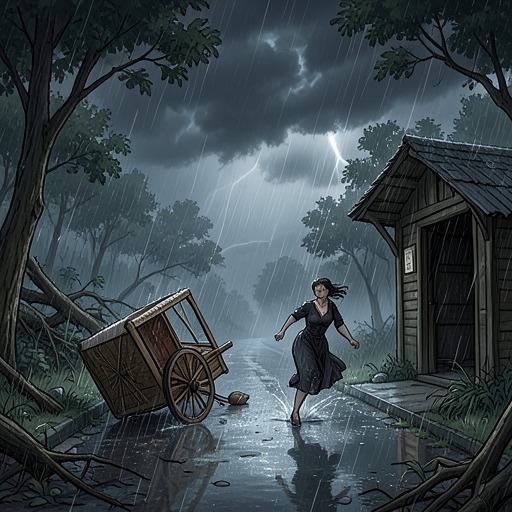
The vehicle’s part in the deception begins when a violent storm interrupts its journey. Near a mandapam, a tree has been uprooted, and rescuers are struggling to free people caught beneath its branches. While most of the men are occupied with the rescue, two remain beside the palanquin resting nearby. Sendhan Amudhan and Poonguzhali notice it apart from the disorder around the fallen tree and recognize its association with Pazhuvoor Ilaiya Rani.
Lightning briefly reveals what the darkness hides. The two men lift the palanquin and carry it toward the mandapam rather than continuing away from the scene; they set it down at the entrance. In another flash, a woman pushes aside the screen and looks intently toward Sendhan Amudhan and Poonguzhali. Her smile suggests that she has recognized them. When the lightning fades, the darkness again conceals both the woman and the interior of the conveyance.
The palanquin’s screened entrance makes the next movement possible. In the darkness, a figure steps out quietly, unnoticed by the sentries at the entrance. Poonguzhali recognizes her aunt, Mandhakini. Mandhakini takes Poonguzhali and Sendhan Amudhan by the hands and draws them toward the rear of the mandapam, where she embraces her niece and communicates with her through signs. The palanquin is now more than a carriage waiting out the storm: it provides the concealed point from which Mandhakini can leave and the cover under which another passenger can take her place.
Exchange of Passengers
After their exchange of news, Poonguzhali accepts her aunt’s strategy. She embraces Mandhakini, then follows her example by approaching the palanquin on noiseless feet. Poonguzhali climbs inside and draws the silk curtains closed. The screened vehicle therefore carries a different person from the one whose arrival Aniruddha believes he has arranged, while retaining the same visible crest and the same outward appearance.
Aniruddha later reconstructs the sequence from the evidence and Azhwarkkadiyaan’s account. He supposes that the bearers set the palanquin down amid the gale, that Poonguzhali brought her aunt out and took her place, and that Sendhan Amudhan failed to notice the change after being knocked unconscious by the falling tree. Azhwarkkadiyaan confirms the essential exchange: he saw the young woman enter the palanquin, realized in a flash of lightning that she was not the woman who had just emerged, and watched the bearers lift the vehicle and continue on. The bearers had noticed nothing.
The episode turns on a practical limit of what the crest can establish. Observers can identify the conveyance as the Pazhuvoor palanquin, but that mark does not guarantee the identity of its passenger. Aniruddha believes the palanquin has delivered Mandhakini safely; the account of the exchange shows instead how its enclosure and the storm’s darkness have separated the passenger from the assumptions attached to her escort.
Consequences and Narrative Significance
The palanquin’s journey allows the mistaken belief about its occupant to persist. Aniruddha says it arrived safely at midnight and that only then could he rest. Yet Azhwarkkadiyaan’s description establishes that the bearers departed with Poonguzhali inside, while Mandhakini had left the vehicle at the mandapam. The object has completed its outward task of carrying someone under the Pazhuvoor crest, but the intended passenger and the actual one are no longer the same.
Its role depends on the convergence of ordinary features and exceptional circumstances: a closed carriage, a recognized crest, bearers who do not detect the switch, and darkness broken only by intermittent lightning. The crest invites confidence in the vehicle’s identity; the curtains frustrate certainty about the person it contains. In this sequence the palanquin is at once a sign of elite authority, a means of discreet transport, and the material instrument of a substitution that alters what Aniruddha believes has happened.