Political turmoil in the Chola kingdom
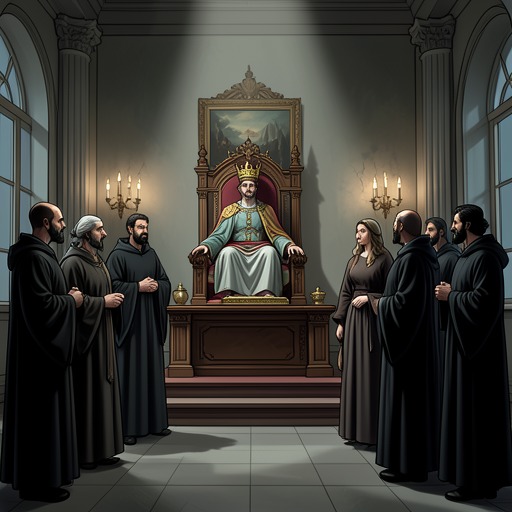
Ponniyin SelvanPolitical turmoil in the Chola kingdom is a crisis of both succession and government: rival claims to the throne coincide with disputes over who controls the army, who can reach the emperor, and which reports the public will believe. The uncertainty surrounding Arulmozhi Varman’s reported drowning gives those conflicts an immediate popular charge, while negotiations over the crown threaten to turn factional competition into open division of the realm.
Rumors and Rival Factions
Reports circulating beyond the capital describe Chozha Nadu as unsettled since news of Arulmozhi Varman’s drowning. Travelers are said to predict hostilities, and the Pazhuvettarayars and Kodumbalur Velaar are rumored to be on the verge of fighting. The lords’ gathering at Kadambur Sambuvaraiyar’s palace is presented as an attempt to prevent that clash, with Adithan among those expected to attend. The account establishes the crisis first as public talk: the danger is real enough to shape expectations, but the reports do not amount to a settled explanation of what is happening.
Rumor also supplies a personal explanation for Adithan’s troubled state. One speaker dismisses the public accounts as invented and claims that the real cause is Adithan’s former love for a Pandiyan woman, whom Periya Pazhuvettarayar supposedly married while Adithan was away fighting near the Vada Pennai River. The speaker further alleges that Pazhuvoor Ilaiya Rani’s word has become law in the kingdom. This is presented as hearsay, not confirmed history. Its importance lies in the way political anxiety and private scandal become entangled: listeners are offered a story that explains the prince’s mood while casting suspicion on the influence of the Pazhuvettarayar household.
Lineage, Acclaim, and Authority
The succession dispute draws force from the dynasty’s remembered past. At Kadambur, Thirukkovilur Malayaman recalls Adithan’s birth twenty-four years earlier in his own palace, celebrated on a scale that, he says, surpassed even Sundara Chozhar’s coronation festivities. Kings and chiefs from Chozha Nadu and Thondai Mandalam attended, and the gathering brought such expense that the treasures accumulated in Malayaman’s vaults were spent within three days. The recollection frames Adithan’s birth as a public dynastic event: his place in the succession was associated from infancy with the hopes of the ruling house and its allies.
Malayaman also recalls the choice of the prince’s name. Some wished to honor Karikal Valavan, while others favored Rajadithyar; the chosen name, Aditha Karikalan, joined the memory of both celebrated warriors. The story supplies a vocabulary of inherited legitimacy that later claims to the throne cannot easily escape. Adithan’s authority is not simply a matter of his father’s favor: it is bound to the expectation that the dynasty’s history, military achievement, and succession arrangements should continue through him.
That inheritance is made visible at Kadambur when Adithan arrives. A vast crowd presses around the palace, with elderly people leaning on staffs, children pushing forward, and spectators climbing trees or attempting to scale the fort walls. The royal crier introduces the prince through an extended genealogy of Chola rulers and their deeds, ending with his titles as commander of the northern forces and the man who beheaded Veera Pandiyan. A second crier welcomes him on behalf of Kadambur Sambuvaraiyar. The scene turns dynastic standing into public spectacle: the crowd’s attention and the ceremonial recitation display a form of recognition that contrasts with the private bargaining over who should rule.
The Emperor and the Succession Dispute
Inside the court, the crisis is intensified by Sundara Chozhar’s frail condition and the struggle over access to him. After a dispute between newcomers to the city and the Velakkara Regiment nearly becomes a massacre, Chinna Pazhuvettarayar intervenes and persuades the parties to disperse. He then accuses the chief minister of contributing to the breakdown of security, including by admitting visitors whose credentials cannot be verified. The allegations matter because the emperor’s household and the capital’s defenses are already vulnerable; the question of who governs in practice cannot be separated from the question of who controls the court’s doors and forces.
Aniruddhar warns Sundara Chozhar that public anger over Arulmozhi Varman’s disappearance could ignite from a small pretext. He judges the soldiers to be more dangerous than the crowds: while ordinary people may protest loudly, the army could reduce Thanjavur Fort to ruins, imprison the Pazhuvettarayars and Madhuranthakan, and demand that Arulmozhi take the throne. Sundara Chozhar, by contrast, declares Madhuranthakan the only rightful successor and insists that he intends to crown him regardless of opposition. The two assessments expose a central divide in the crisis: the emperor asserts the force of his decision, while his minister describes a military constituency whose wishes may overwhelm it.
The emperor also rejects any proposal to partition the realm. When warned that negotiations at Sambuvaraiyar’s palace might divide the territories, he says he will not allow the empire to be split and resolves to crown Madhuranthakan over an undivided kingdom. His position is presented as a direct answer to political negotiations already under way, not as an abstract preference. The threatened partition reveals how a dispute over the next ruler could become a dispute over the kingdom’s territorial integrity.
Adithan’s Rejection of Partition
At Kadambur, Adithan raises the succession question himself, asking Periya Pazhuvettarayar and Kadambur Sambuvaraiyar whether it is just for Sundara Chozhar to favor Madhuranthakan after publicly naming Adithan heir. Periya Pazhuvettarayar answers that Madhuranthakan’s claim cannot simply be denied and proposes compromise: the territory south of the Kollidam River would go to Madhuranthakan, while Adithan would receive the north. He presents the arrangement as a way to resolve a dangerous deadlock, but it would divide a kingdom whose size and unity have been built over generations.
Adithan laughs at the proposal and refuses to divide the realm, comparing such a division to splitting a marriage. He then offers to renounce his own claim in favor of Madhuranthakan, whose descent from Sundara Chozhar’s elder brother gives his claim merit under the older line of succession. The offer, however, carries a condition: Adithan wants three lakh soldiers, a year’s provisions and equipment, and three hundred ships for a northern campaign. He imagines winning territory beyond the Krishna River and fulfilling the ancestral ambition associated with raising the Chola tiger flag in the Himalayas. His speech reframes the succession choice as a contest between partition and expansion, and presents military conquest as an alternative future for the dynasty.
The apparent settlement collapses when Adithan accuses Periya Pazhuvettarayar’s faction of keeping Sundara Chozhar under constraint and asks who ordered the attempt to arrest Arulmozhi in Eelam. He voices the public belief that Pazhuvettarayar’s men forced Arulmozhi onto a ship and caused his drowning, while also insisting that he himself does not accept the accusation. He argues that the rumor has spread so widely that punishing one accuser would not silence the many who repeat it. The episode shows how unverified claims acquire political weight: even when Adithan distinguishes popular belief from his own judgment, the scale of public anger limits what the court can dismiss as mere gossip.
The Shape and Stakes of the Crisis
Political turmoil in the Chola kingdom is sustained by competing kinds of legitimacy. Sundara Chozhar invokes his authority to choose Madhuranthakan; Adithan draws on his public designation as heir, dynastic precedent, and military reputation; the proposed compromise relies on negotiation among powerful lords; and the army and public emerge as forces whose support can determine whether any decision holds. None of these sources of authority is secure on its own.
The crisis also turns on information that cannot be reliably contained. Reports of Arulmozhi’s fate, suspicions about the emperor’s confinement, and rumors of a partition circulate alongside official claims and private bargaining. The prince’s ceremonial welcome affirms inherited power before a multitude, but the succession council exposes how far that public image is from agreement among the ruling elite. By refusing division while challenging the men who claim to protect the emperor, Adithan makes the instability unmistakable: the kingdom’s future depends not only on who is named heir, but on whether its institutions, armed forces, and people will accept that claim.