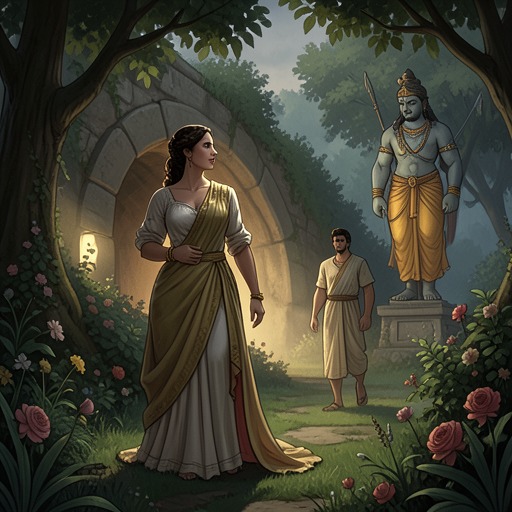
Sambuvaraiyar’s daughter
Ponniyin SelvanSambuvaraiyar’s daughter, also known as Manimekalai, is a spirited young woman whose private longing for Vallavarayan Vandhiyathevan grows amid household pressure and political suspicion. At Kadambur Palace she appears to rule with imperious authority, yet decisions about her marriage are being made around her; her liveliness and command cannot simply free her from family expectations. Her brief encounters with Vandhiyathevan turn a teasing subject into an attachment she struggles to declare openly.
Identity and Household
The daughter of Kadambur Sambuvaraiyar, Manimekalai has been cherished by her parents and her brother Kandamaaran since childhood. The narrative presents her as lively and accustomed to pleasure: until a disruption four months earlier, her life had seemed a continuous celebration of song, dance, and playful interludes. At the time of the story, she is said to rule Kadambur Palace with a “rod of iron.” This description makes her look commanding, but it also contrasts with the limited influence she has over the marriage her elders now demand.
That demand marks a sharp break in her settled world. Her family has begun insisting that she marry despite her objections, and her efforts to change their minds have made no difference. The lively authority she exercises inside the palace does not translate into authority over her own future. Her resistance is therefore both a personal refusal and a response to being treated as though the decision has already been made.
Kandamaaran’s Matchmaking
Kandamaaran has helped create the romantic idea against which Manimekalai’s own feelings develop. During the last two or three years of his military service, he repeatedly returned with stories about his friend Vallavarayan Vandhiyathevan. He praised Vandhiyathevan’s courage, intelligence, appearance, martial skill, and strategic ability, and proposed him as a suitable husband for his sister. Kandamaaran even presented the match as a way to restrain her spirited nature, imagining that Vandhiyathevan would provide the firm hand she supposedly needed.
Manimekalai answered these speeches with annoyance rather than open agreement. She mocked the idealized portrait and challenged her brother to invite the man home so that she could test his vaunted virtues herself. Their exchanges let her contest Kandamaaran’s authority while keeping her interest at a playful distance. Once she has actually seen Vandhiyathevan, however, that distance becomes difficult to maintain: what began as an argument about her brother’s extravagant praise becomes a feeling she cannot dismiss as mere teasing.
Rejection of Madhuranthakan and the Palace Visit
The proposed alternative, Madhuranthakan, provokes an especially firm refusal. Manimekalai resents what she sees as the arrogance of Thanjavur’s royal ladies, who assume their superiority in fashion and culture and look down on women from other fiefdoms. She will not accept marriage to Madhuranthakan even for the prospect of a throne. Her objection is not only that she does not want him; the proposed match would also place her within a courtly world whose disdain she already finds intolerable.
Her opinion hardens when she hears that Nandhini’s closed palanquin at Kadambur had carried Madhuranthakan rather than the queen. The report turns her initial surprise into disgust: she interprets his concealed arrival as cowardice and rejects the thought of marrying someone who, as she sees it, has entered disguised in another person’s covered conveyance. Her refusal is consequently tied to her judgment of his conduct as well as to her lack of desire for him.
Vandhiyathevan’s arrival at Kadambur coincides with Madhuranthakan’s, but the two men leave radically different impressions. Overcome by shyness, Manimekalai hides among the women instead of meeting Vandhiyathevan face to face. She catches only brief glimpses, yet his face, smiling eyes, features, voice, and scattered words remain vivid in her memory. She later conveys covertly to Kandamaaran that her heart belongs to Vandhiyathevan, even though she has seen him for only a few moments. Her attachment is founded on scant acquaintance, a contrast that makes both its intensity and her reluctance to speak plainly important to her characterization.
Vigilance, Concealment, and Recognition
When the royal party is expected, Manimekalai closely supervises the rooms assigned to Aditha Karikalan and his companions. She is particularly watchful of Nandhini’s arrival and inspects Nandhini’s chambers herself. Her attention to the visitors is not merely ceremonial: she thinks about the temperaments and changing loyalties of the men around Karikalan, including Parthibendran, and remembers that Vandhiyathevan once belonged to Karikalan’s circle. She calls him a traitor in her thoughts, while still wishing he could have come as a visitor. That combination of accusation and lingering desire reveals a conflict her earlier teasing could not resolve.
In Nandhini’s chamber, a mirror briefly gives Manimekalai an unexpected sight. After assessing her own reflection, she notices Vandhiyathevan’s face close beside hers in the glass. The appearance lasts only an instant; when she looks again, only her own reflection remains. The encounter makes visible how readily her attention returns to him, but it does not establish that he was physically present in the room.
Later, Vandhiyathevan is in the chamber after entering through a hole. Manimekalai stands gazing at him while he considers how to get free. A distant voice calls to her, asking whether she had sent for the speaker. She dismisses the interruption, bolts the hole from inside, and gestures for Vandhiyathevan to follow her farther into the room. Rather than simply accept his account, she turns back and asks whether Chandramathi really called him, as he had claimed. Her questions show her attraction alongside a practical suspicion: she is willing to protect his presence for the moment, but she still tests the explanation he has given.
Confession and Narrative Role
Nandhini eventually names what Manimekalai has been unable to say directly: that the man she loves is Vallavarayan Vandhiyathevan. Manimekalai confirms it and marvels at Nandhini’s ability to guess. Nandhini then challenges her concealment, asking why she has not told Kandamaaran, why she allows Madhuranthakan to entertain marriage prospects, and why she has drawn Karikalan and Nandhini into what Nandhini considers an unnecessary undertaking. The exchange brings the separate strands of Manimekalai’s predicament together: her unspoken love, the unwanted marriage, and the political company assembled at Kadambur.
Manimekalai’s story in these scenes is less a completed romance than a tension between what she feels and what she can openly choose. Her household treats marriage as an obligation; her brother’s praise first supplies an imagined suitor, while her own fleeting sight of Vandhiyathevan makes the attachment personal. Yet the word “traitor” remains attached to him in her thoughts, and her questions about his story show that attraction has not erased doubt. The contrast between her commanding manner in the palace and her shyness before Vandhiyathevan gives her character its central unsettled quality: she can direct rooms and challenge her brother, but she has not yet found a direct way to speak or act upon the desire that matters most to her.