Secret Passage Beneath the Palace Sculpture Hall
Ponniyin SelvanThe Secret Passage Beneath the Palace Sculpture Hall turns the palace’s sculptural display into working architecture: a hidden route passes beneath a colossal representation of Raavanan and opens through a small door into the royal garden. Concealed so thoroughly that the statue appears to be only a monument, the passage is first associated with conspirators moving through the palace’s underground spaces, then becomes the way Mandhakini and Poonguzhali vanish from the palace without leaving an obvious trail.
Concealed Entrance and Construction
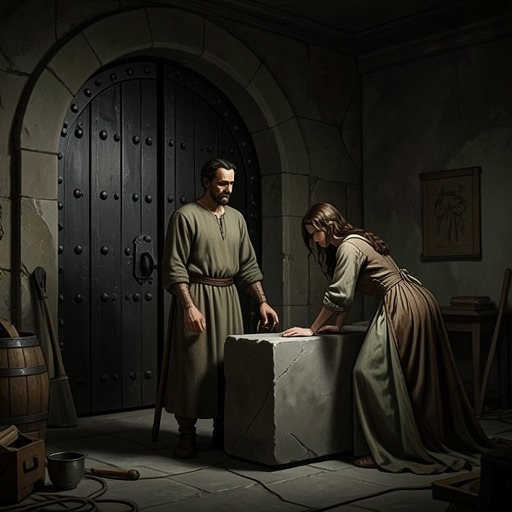
The passage’s most striking feature is how its exit is disguised. Its underground route ends beneath the imposing figure of the ten-headed Raavanan, who holds aloft Mount Kailaiyangiri with his twenty hands. Siva Peruman and Parvathi Devi sit at the summit. The base of the sculpted mountain caves inward even as Raavanan’s hands support it; the passage rises through the gap between two of his limbs and emerges into the sculpture chamber. The opening is hidden in the dark space between the demon king’s heads and limbs and the mountain above, so that the statue itself conceals the way through.
The approach is as difficult to read as the entrance. Mandhakini follows a staircase down a few steps and then along a tunnel that seems to stretch on without end. At its far end, a sheer wall appears to block the way. By touch she finds steps, climbs, and discovers that the space above them is still cramped: her head meets the ceiling, and she has to sidle through a gap between the ceiling and the final step. Only after working through this constriction does she reach the statue’s hollow and understand where the passage has brought her. The concealed route’s bends and tight clearances make its architecture a barrier to casual discovery as well as a means of access.
The Sculpture Chamber and Garden Exit
The chamber disguises the passage within a much larger sculptural landscape. Mandhakini recognizes a figure of Sibi Chakravarthy, who gave flesh from his own body to save a dove, and a monumental Siva Peruman with the River Ganga flowing through his hair. The sculptural scene continues through Bhageeradhan, credited with bringing the river to earth, and Agasthiyar, whose overturned vessel releases a stream that grows into the Kaveri River. The stone river winds past rocky ground, cliffs, wooded copses, and shrines before meeting a high wall at the ocean. The chamber’s arrangement makes the secret opening part of a broad, detailed representation rather than an isolated doorway.
After locating the way out, Mandhakini tests a wall and opens a small door into the royal garden. The palace rises just beyond it, its alcoves and balconies visible from the garden. A storm has damaged the surrounding undergrowth and trees, but she waits until nightfall before leaving the sculpture chamber, wary that someone might see her or that an armed pursuer might return. The passage therefore provides a concealed connection between the chamber and garden, while the garden’s proximity to the palace makes the hidden route consequential to movement around the royal complex.
Use and Concealment
The passage is connected with the movements of Ravidasan and Soman Saambavan. Mandhakini watches them emerge from an underground entrance and climb to an upper balcony, where they conceal themselves behind columns and peer into the palace interior. Ravidasan no longer holds his torch; Saambavan has a spear, which passes to his companion and is aimed toward a chamber. Mandhakini’s alarm eases when the spear is lowered and the men disappear. Their actions show that the palace’s hidden approaches can be used to reach positions from which its rooms may be watched, even as the passage’s concealed construction makes the route difficult to identify from outside.
After the men leave, Mandhakini tries to open the underground access but cannot. She had been too far away when the hatch was opened to learn how it worked, and her keen eyesight cannot make up for that distance. Instead, she waits for a likely return. Soman Saambavan comes back carrying a dimmer torch and repeatedly looks into dark corners; when an eerie cry frightens him into running through the cavern, Mandhakini takes the opportunity to descend and continue along the passage. The route’s darkness and confusing direction unsettle its pursuer, while Mandhakini’s familiarity with the concealed way lets her proceed.
Escape and Narrative Significance
The passage serves again when Poonguzhali recognizes the concealed hollow beneath Raavanan’s statue. She recalls that her aunt had tried to close the opening earlier that evening, an attempt others had thwarted because they misunderstood her purpose. Mandhakini signals Poonguzhali to follow, folds herself through the narrow gap, and descends with her lamp. Poonguzhali follows, bending and twisting through the exit; her agility helps her avoid striking her head on the low roof. As both women disappear down the route, the last of the lamp light vanishes and darkness returns to the sculpture chamber.
The next morning, Kundhavai, Vanathi, and Malayaman’s daughter discover that Mandhakini and Poonguzhali are missing. A search through the palace, royal gardens, and sculpture chamber finds neither woman, and those searching cannot determine how or why they disappeared. The passage explains how an escape could leave no visible trace: its entrance is hidden inside a monumental sculpture, its route is subterranean, and its garden door is small and concealed in a wall. Its significance lies not only in secrecy but in the reversal it enables: a palace space designed to display royal imagery also hides a route beyond the reach of an ordinary search.