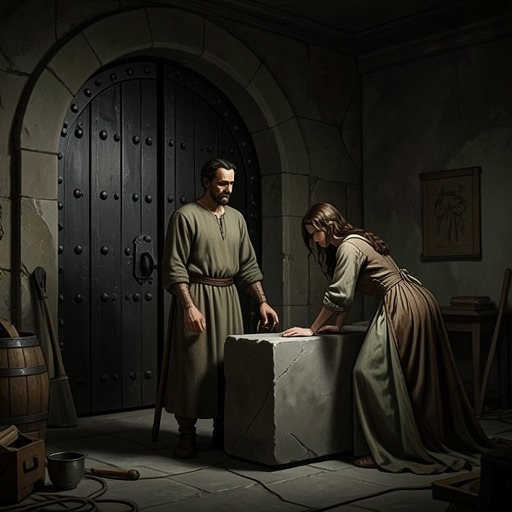
Secret passage from the treasure vault to the Chozha palace
Ponniyin SelvanThe Secret passage from the treasure vault to the Chozha palace is a concealed route that carries Ravidasan and Soman Saambavan from a subterranean cavern toward the royal palace, close enough to let them observe movement near Sundara Chozha’s sickbed. Known to only a handful before Ravidasan reveals it, the passage offers the conspirators a covert way toward their target; Mandhakini’s unseen pursuit, however, makes the route a place where their secrecy begins to fail.
Setting and access
The passage lies beyond the visible chambers of the treasure vault, at the far end of a cavern where Ravidasan and Soman Saambavan walk beside a high, apparently impassable wall. No door or ordinary path is visible there. A small window, or palagani, admits light from above, and Ravidasan climbs the sheer wall by finding knobs and protrusions. From the window he looks out and checks the area beyond; he tells Soman that the view gives them a way to gauge movement around Sundara Chozha’s sickbed. The opening thus offers more than an escape from the cavern: it provides a vantage point on the palace approaches and their traffic.
The window is not the passage itself. Ravidasan demonstrates a separate concealed entrance below. He presses his foot against a circular stone, takes hold of a square block, and pushes; a passage creaks open beneath them. The mechanism depends on a specific sequence of pressure and leverage, rather than on an obvious door or handle. Its position within a cavern that already appears to have no exit makes the hidden route especially difficult to detect without prior knowledge.
Secrecy and intended use
Ravidasan presents the route as closely guarded knowledge. He says that Periya Pazhuvettarayar and Pazhuvoor Ilaiya Rani know of it, and that Soman has now joined their small circle. Ravidasan’s instruction that Soman observe how the entrance opens makes the discovery a transfer of operational knowledge, not merely a demonstration of a curiosity. The concealed mechanism gives the conspirators a route they can use while keeping its existence from people moving through the visible palace spaces.
Their need for secrecy is tied to a planned attack on Sundara Chozha. Ravidasan insists that they wait until Friday night, when the emperor’s consort is expected to leave him briefly for a pilgrimage to the Durga Parameswari shrine. He warns that acting at another time could ruin their plans, and describes the intended night as the moment when Sundara Chozha’s lineage will face annihilation. In that context, the passage’s proximity to the sickbed is strategically consequential: it links their concealed starting place to the area around the person they intend to reach, although the evidence does not establish precisely where the passage ends or whether the conspirators complete their journey through it.
The route is also constrained by conditions outside its mechanism. Earlier, when Ravidasan is asked why he must return to open the vault, he acknowledges that another way out of the cavern exists, but says it cannot be used that day because the Vettaaru is in full spate. He orders the thaathi to go and return after a naazhigai. The exchange establishes that an alternative exit is known but temporarily unusable; it does not identify that exit with the passage opened later. Against that immediate obstacle, the hidden palace route becomes a distinct way through the underground space, while the conspirators’ timetable remains governed by the need to wait for a carefully chosen night.
Discovery and exposure
Mandhakini follows Ravidasan and Soman without their knowledge, hiding behind large columns and keeping pace as they cross the vault. When they open the concealed entrance and descend, the torchlight gradually disappears into the passage. Mandhakini reaches the gaping opening and puts a foot on a step, but then withdraws rather than follow them below. The scene makes her presence a decisive counterpoint to the passage’s secrecy: the conspirators believe themselves unobserved, yet someone has witnessed both their movement and the route’s entrance.
Instead of descending after them, Mandhakini climbs the wall by the same handholds Ravidasan used and reaches the palagani. From that elevated opening she sees the garden along the wall and, beyond it, the sprawling palace complex. The shift from the dark opening below to the view outside gives her another means of understanding the danger: the underground route belongs to a larger royal setting in which people dear to her live. She realizes that they are in grave peril from the men moving through the passage. Her response reveals the threat the route carries beyond simple concealment: it places conspirators within reach of the palace and of those Mandhakini is determined to protect.
Narrative and architectural significance
The passage operates as a concealed connection between the vault’s enclosed darkness and the inhabited royal complex. Its design makes passage depend on knowledge: Ravidasan knows where to climb, where to look, and which stones to move; Soman must be taught; Mandhakini sees the opened way but chooses not to enter it. The same architecture therefore separates people according to what they know and what they risk doing with that knowledge.
Its function changes with each character’s relation to it. For Ravidasan, it is a practical instrument in a conspiracy and a means of approaching the emperor’s sickbed without using a visible route. For Soman, it is newly disclosed access that he is expected to remember. For Mandhakini, it is evidence of an imminent danger, confirmed by the sight of the palace and the knowledge that her loved ones are inside. The passage does not itself resolve the threat, and the conspirators’ planned attack remains prospective in this scene. Its immediate consequence is instead an uneven contest of secrecy: Ravidasan opens a route meant to hide his movement, while Mandhakini discovers enough to recognize the danger and the lives at stake.