Thanjavur
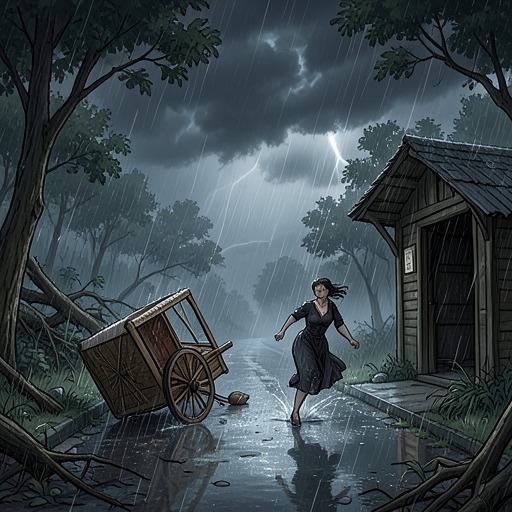
Ponniyin SelvanThanjavur, also called Thanjai, is the Chozha capital in which the royal household and central government confront a succession struggle, failing security, and the consequences of a devastating storm. Its fort gates, palace, and nearby ministerial residence shape the action: entry is restricted, private movements invite suspicion, and disputes over access become disputes over who may approach the emperor and speak for the kingdom.
Capital and dynastic ambitions
Thanjavur is presented as the seat of royal authority and as the destination around which competing ambitions gather. Kandamaran tells his sister Manimekalai that her family has chosen a future brighter than marrying Vandhiyathevan: she might marry Madhuranthakan, already married to Chinna Pazhuvettarayar’s daughter, and become consort to the future king of Thanjavur. In this prospect, the city’s throne promises not only rank for a bride but also the possibility that her son might inherit the kingdom. Manimekalai rejects the proposed marriage, but the proposal shows how marriage is imagined as a route into the capital’s political order.
The prospect of Thanjavur’s throne also changes how nobles assess their loyalties. At Kadambur, Sambuvaraiyar’s hostility toward Aditha Karikalan gives way, when he believes his daughter Manimekalai may have caught the crown prince’s interest, to thoughts of her becoming queen in Thanjavur. He pictures her future son as heir and himself as the grandfather of a crown prince. These hopes arise away from the city, but they make its throne the measure of status and a prize around which changing allegiances can coalesce.
Fort, palace, and restricted access
The fort marks a boundary between ordinary people and royal authority. Poonguzhali argues that people of her standing cannot even pass the gates of Thanjavur Fort, much less enter the emperor’s presence. Her answer is characteristically defiant: if the gates will not open, she will break them, or climb over the high walls. The exchange presents access as more than a matter of physical distance. The fort’s defenses embody the social barriers that determine who is admitted to the political center.
The boundary is also vulnerable to secret movement. Vandhiyathevan challenges Kandamaran to explain his alleged escort duty through a secret passage from the fort into Pazhuvettarayar’s palace, asking whom he met in the vault. The charge is made during a public dispute, not presented as a neutral account; its force comes from threatening to expose clandestine dealings inside the capital’s guarded spaces. The palace and its hidden routes make the city’s security inseparable from the political suspicions surrounding its leading families.
The fort’s outer walls also become part of the dispute over Kandamaran’s stabbing. Manimekalai repeats her brother’s claim that Vandhiyathevan stabbed him and left him by the walls of Thanjavur. Vandhiyathevan denies it: he says he carried the grievously wounded Kandamaran on his back to Sendhan Amudhan’s home for treatment. The opposing accounts turn a place on the city’s edge into contested evidence—one man’s supposed crime in Kandamaran’s telling, and an act of rescue in Vandhiyathevan’s.
Government and the problem of security
For several days, Aniruddhar has been living in the capital, and his residence draws an almost continuous procession. Government officials, lords and chiefs, generals, foreign ambassadors, mercantile representatives, temple officials, and scholars arrive seeking an audience. The breadth of this traffic reflects the reach of the chief minister’s office, but it also creates a vulnerability: people claim appointments, display his insignia, and move through the crowded environs of a house situated next to the royal palace.
Aniruddhar has no personal regiment or battalion, and his retinue is small. Even so, Chinna Pazhuvettarayar complains that security has grown lax since the minister came to Thanjavur. The complaint expands from the minister’s visitors to the safety of the palace complex itself, where crowds gather around both the royal household and Aniruddhar’s residence. The chief minister’s accessibility, a sign of his administrative importance, is thus recast by his opponents as a danger to the emperor.
The dispute worsens after a confrontation between newcomers to the city and the Velakkara Regiment threatens to become a massacre. According to the accusations brought before Sundara Chozhar, Chinna Pazhuvettarayar intervenes in time, calms both sides, and prevents the crowds from turning the quarrel into a riot. The same account accuses Aniruddhar of abducting a woman from Kodikkarai with the use of Pazhuvettarayar’s palanquin and men. This is presented as a charge, not an established finding; its political effect is to implicate the Pazhuvettarayar family in an affair that could damage its reputation as well as the minister’s.
Palace crisis and royal response
The disappearance of Mandhakini makes the palace grounds a further point of danger and uncertainty. After Chinna Pazhuvettarayar rides into the street and the rival crowds disperse, Poonguzhali and Azhwarkkadiyaan discover that Mandhakini is missing. Their search in the immediate vicinity fails. Aniruddhar suspects she may have entered the gardens of Pazhuvettarayar’s palace and asks whether she could have escaped by a secret passage; he arranges for sentries to be posted outside the fort as well. The possibility of an unseen exit makes the palace’s enclosed spaces part of the larger security crisis.
When Aniruddhar reaches the royal chambers, he explains his delay by referring to the work of receiving and compiling reports about the storm and attempting to arrange repairs. Sundara Chozhar, already distressed by the city’s turmoil, confronts him with the charges of lax security and abduction, then voices a deeper grievance: he has been kept in the dark about events affecting his family and kingdom. He has heard that Arulmozhi Varman survived and is safe in the Buddhist monastery at Nagapattinam, yet cannot understand why his son did not return to him or why no one informed him sooner. In the palace, failures of communication become personal anguish as well as a crisis of government.
The emperor’s response eventually turns from recrimination toward action. He decides that Aniruddhar should serve as his envoy and escort to bring Sembian Maadevi to Thanjavur, while Aniruddhar sends his disciple to Nagapattinam. Sundara Chozhar also orders arrangements to bring Periya Pazhuvettarayar and Nandhini to him, and says that Aditha Karikalan should be included so that the unsettled issues may be resolved. The plan is delayed by flood-swollen rivers, but the emperor insists that a few more days can be endured after so many years of delay. He also directs Aniruddhar to attend to flood relief, acknowledging that the rulers have become absorbed in their own disputes while their subjects suffer.
Narrative significance
Thanjavur’s importance lies in the contrast between its concentration of authority and the uncertainty within its walls. The capital attracts petitions and visitors from across the realm, yet its gates restrict access; the royal palace is protected, yet secret passages and an unexplained disappearance expose its vulnerabilities. Its throne inspires marriage schemes and political realignments, while the emperor himself is left feeling isolated from events unfolding around him.
The city’s crisis is therefore both spatial and political. Crowds gather outside the palace, officials contest the meaning of security, and the royal family struggles to obtain trustworthy news. When Sundara Chozhar finally directs attention toward flood relief, the narrative widens beyond dynastic rivalry: the capital’s rulers must answer not only for who may inherit power, but also for the people enduring the storm’s consequences.