The tailless stuffed monkey
Ponniyin SelvanThe tailless stuffed monkey is a hunting trophy in Kadambur Palace whose apparent lifelessness becomes an unlikely advantage to Vallavarayan Vandhiyathevan. It serves first as cover for his hiding place, then as a source of alarm and confusion, and finally as a physical obstruction that lets him interfere with the conspirators’ movement through the secret passage. Its importance comes from the repeated gap between what the object is—a stuffed animal—and what people think it might be doing.
A Trophy Mistaken for a Presence
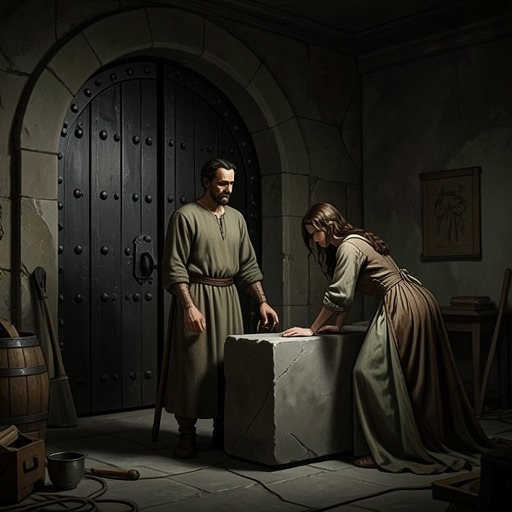
The monkey stands near the entrance to a concealed passage, opposite a mirror. When a maid believes it has moved, the woman with her first jokes that the figure may be welcoming them; the maid answers that she is being mocked. Their exchange makes the trophy more than background decoration: in the dim, uncertain space, its reflected image can be confused with movement. The woman suggests that what appeared to move may have been the monkey’s face in the mirror, then attributes the effect to a lamp’s shadow. The maid remains unsure whether she saw the monkey or a stuffed owl glaring down at them.
The brief alarm matters because Vallavarayan Vandhiyathevan is concealed behind the monkey. After the two women withdraw through the secret entryway, he emerges, sneezing as he expels dust and grit from his nostrils. He has been close enough to hear their conversation, including their uncertainty about a face in the mirror and one seen in dreams. The trophy has therefore protected him not by making him invisible in itself, but by providing a hiding place in a room where its own ambiguous appearance has already unsettled the people who enter.
Cover, Eavesdropping, and Near Discovery
Vallavarayan Vandhiyathevan addresses the stuffed monkey as a loyal friend and thanks it for performing its task. His imagined conversation acknowledges the narrowness of his escape: the maid had compared him to the trophy, and he had considered bursting from hiding before his self-control stopped him. He recognizes that discovery might not have been disastrous, since he has more or less guessed the women’s identities, but he has also heard their private conversation. The animal’s usefulness is thus practical and informational. It shields his body while placing him within earshot of speech that he would otherwise have missed.
He hides behind it again when footsteps approach through the passage. At first he wonders whether the person might be Azhwarkkadiyaan; the number and sound of the approaching steps instead suggest a group, perhaps Idumbankaari and his companions. Vallavarayan Vandhiyathevan regrets having left the entrance open, then sees Idumbankaari pause at the first stair, keeping the opening from closing. As the elephant-head entrance shifts and a lamp appears, the hidden man remains concealed behind the trophy. What had seemed a stable piece of furniture is now his cover during a passageway crowded with people and mechanisms that could expose him.
The Trophy as an Obstruction
The monkey’s role changes abruptly when a bat flies through the room. The stuffed animal crashes onto Idumbankaari, who loses his balance under the impact, staggers to his knees, and stumbles down two more steps. Startled and uncertain what struck him, he screams and waves his arms. Once he realizes that the attacker is a stuffed animal, he regains his composure and stands it upright. The sequence turns an inert trophy into a material force: it cannot move by itself, but its weight and position on the stairs can upset a man and interrupt the passage.
From above, Vallavarayan Vandhiyathevan has deliberately thrust the monkey at Idumbankaari while the servant is looking at the bat. He then pushes the servant from behind, preventing him from identifying his assailant, and shoves the monkey headfirst down the opening. Idumbankaari explains the incident to the approaching Ravidasan as a stuffed animal falling on him while he opened the secret door. Now, he says, the monkey bars the way, neither sliding down nor pushing up, and he must find a means of disposing of it. The conspirators’ advance is delayed by the very object that had concealed the intruder among them.
Narrative Function
With the monkey placed in the passage and the immediate task complete, Vallavarayan Vandhiyathevan shifts the crocodile and scrambles toward the elephant head, twisting its tusks to open a smaller, rounded breach in the wall. The trophy does not itself provide his exit; it buys him an opportunity to act while the conspirators confront an obstruction and cannot readily see who caused it. Its contribution is brief but decisive within the sequence: it enables concealment, becomes a decoy, and then blocks the route below.
The women’s earlier fear that the monkey had moved anticipates its later fall, but the apparent animation has a human cause. The episode repeatedly makes perception unreliable without making the object supernatural: shadow and reflection account for the women’s first alarm, while Vallavarayan Vandhiyathevan’s deliberate force accounts for the impact on Idumbankaari. As a stuffed hunting trophy, the monkey is normally a display of a captured animal; in this encounter, its conspicuous body instead alters the movement and attention of people passing through the palace. Its usefulness lies precisely in that double status: it is unmistakably an object, yet its shape, placement, and weight let it act as disguise, decoy, and obstacle.