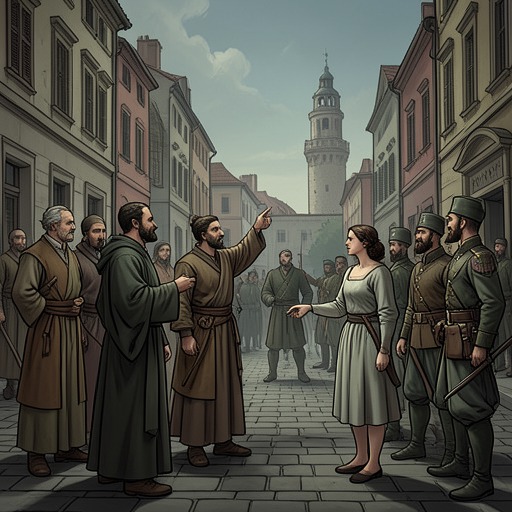
Thirukkural maxim on weapons hidden in folded hands
Ponniyin SelvanThe Thirukkural maxim on weapons hidden in folded hands gives a name to the danger of trusting an enemy’s show of submission. Its force at the Battle of Thakkolam lies in the gap between knowing the warning and acting on it: Rajadithyar is reminded of the maxim only after Boodhugan has exploited precisely the mercy it counsels him to distrust. The saying thus functions both as an ethical caution and as the key to a fatal reversal in the battle’s course.
The maxim and its warning
The maxim warns that outwardly folded hands do not prove peaceful intent. In the passage, that danger extends beyond a deferential gesture to include tears: an enemy may use both apparent humility and visible grief to soften another person’s judgment. The poem’s paired images make deception difficult to detect because the signs that ordinarily invite trust become instruments of concealment.
The narrator presents the warning as an established poetic lesson, describing it as counsel from Thamizhagam’s greatest poet. Its authority is not abstract in this scene. The account explicitly connects the maxim to the conduct Rajadithyar is witnessing, making the poem an interpretive guide to the action rather than a detached saying inserted for ornament. The reader can recognize the pattern even as the commander fails, briefly, to respond to it.
The battle and the opening for deception
The maxim becomes consequential during a ten-day war in which soldiers’ bodies and dead elephants lie across the field. The Chozha side has suffered heavily, but the enemy’s losses are greater. Rajadithyar’s presence has repeatedly strengthened his troops: wherever he rides on his elephant, Jayalakshmi, the sight of their commander heartens exhausted men, and he arrives when a formation falters or a regiment’s flag falls. The account attributes the Chozha army’s renewed fighting strength to this visible bond between commander and soldiers.
Boodhugan, the Ganga king serving under Kannara Thevan, recognizes the importance of Rajadithyar’s presence and devises a treacherous ruse. He raises a white flag from his elephant, lifts both hands in surrender, and cries for mercy as he moves directly into Rajadithyar’s path. The performance brings him close to the commander; the narrator suggests that seeing Rajadithyar’s howdah may have given Boodhugan the idea. A plea that seems to mark the end of danger instead carries the enemy within reach.
Rajadithyar’s mercy and the concealed attack
Rajadithyar does not immediately treat the surrender as genuine or false. He blows his conch to signal his personal bodyguards to leave, then gestures for Boodhugan’s elephant to draw alongside his own. He wants to determine whether the Rettai Mandalam Chakravarthy himself seeks surrender or whether Boodhugan has broken away from his overlord. The decision to create space for this distinction also removes the protection of the bodyguards who might have guarded against an attack.
As Boodhugan approaches with his hands still folded, Rajadithyar sees his glistening eyes and feels his heart soften. Boodhugan then explains that he had recognized the changing fortunes of the war, urged Kannara Thevan to surrender, and left his ruler after that advice was rejected. Rajadithyar is not persuaded by the explanation: he denounces Boodhugan and orders him to return. Yet in the moment of approach, the display of submission and tears has already altered the commander’s response. The narrator says the maxim’s words have slipped Rajadithyar’s memory; the episode makes that lapse the hinge between a possible act of mercy and the danger Boodhugan has prepared.
Boodhugan acts before the exchange can end. He draws a cunningly concealed bow, releases a poisoned arrow, and strikes Rajadithyar in the heart. The weapon is not literally shown hidden in folded hands: the passage specifies a concealed bow and separately describes Boodhugan’s clasped, deferential gesture. The maxim’s relevance is therefore in the deception that brings the assassin close, not in a claim that the bow itself was held in his palms. Its warning nevertheless fits the attack exactly: the appearance of surrender disguises an intention to kill.
Narrative function and consequence
The episode turns the maxim into dramatic irony. The narrator supplies the proverb as the explanation for how Rajadithyar should have read Boodhugan’s posture, then shows that compassion and the practical need to assess a surrender keep the commander from applying it in time. The warning is remembered at the instant the narrative reveals its cost. Because the reader is told that Boodhugan’s plot was understood only much later, the passage also frames the attack as a deception whose full design outlasts the moment of impact.
The maxim does not simply condemn mercy. Rajadithyar’s willingness to hear a plea is presented as an expression of the feeling that makes him beloved and strengthens his soldiers. The tragedy arises because Boodhugan turns that humane response into tactical advantage. The saying therefore marks the peril of mistaking a performance of vulnerability for proof of good faith, while the battle shows the terrible cost when a ruler’s compassion is met with calculated violence.