29 Porchester Terrace
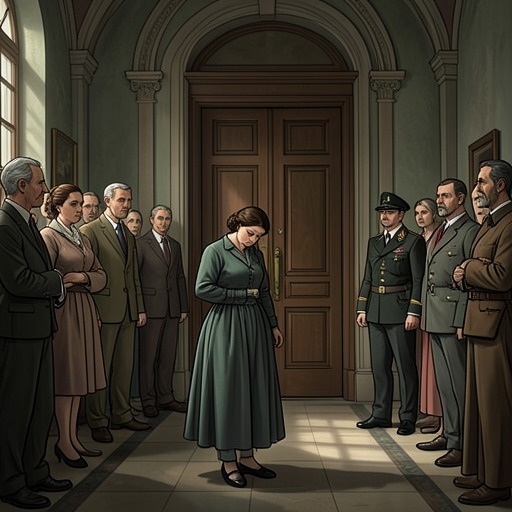
Poor Things29 Porchester Terrace enters the narrative not through a sustained description of its exterior or a catalogue of events inside it, but through memory and comparison. Bella Baxter names Porchester Terrace among the places associated with experiences she would rather forget; Godwin Baxter, in turn, uses the house as one possible example of a familiar British domestic arrangement. The location therefore becomes a point where personal suffering meets a wider account of how class and gender organize everyday life.
Place in Bella’s Recollection
When Godwin tells Bella not to discard painful experience, he names Manchester, Lausanne, and Porchester Terrace as places whose memories could enlarge her understanding if she could approach them with intelligent interest. Bella resists that proposal. Her recollections do not arrive as a coherent education: she remembers painful hands from scrubbing clothes in freezing water, the repeated piano practice imposed by a teacher, the blow that cracked her skull, and the labor of memorizing Fénelon’s Télémaque. To her, these belong to different worlds, joined only by pain. Porchester Terrace is thus one element in a difficult personal history, but the account does not specify which of these particular experiences occurred there.
That distinction matters. The place is named as part of Bella’s past, but the narrative does not turn the address into a fully mapped setting with a sequence of described rooms or encounters. Its force comes instead from the contrast between Bella’s wish to forget and Godwin’s insistence that remembering can make experience intelligible. Porchester Terrace participates in that argument as one of the names through which a scattered history can be considered, without being reduced to a single episode.
The House as a Social Diagram
Godwin opens the front of his doll’s house and asks Bella to look across its floors. He describes an arrangement that could belong to Porchester Terrace or to his own house: servants occupy the basement and attics, where rooms are smallest, coldest, and most crowded, while their bodily warmth helps keep employers on the central floors comfortable. The model makes domestic space legible as a hierarchy. Comfort in the middle of the house is connected to the conditions borne by people relegated above and below it.
The miniature’s two girls sharpen the comparison. In the kitchen, a scullery-maid scrubs and mangles laundry; in the parlour, a girl sits at a piano, practicing Beethoven’s Für Elise. Change the second girl’s clothes and hairstyle, Godwin suggests, and she might resemble the first, yet their assigned positions are not interchangeable. One may be overworked and deprived of hot water if those above her are cruel or ungenerous. The other is trained to perform flawlessly so that she may attract a wealthy husband and serve as a social ornament and mother of his children. Bella identifies what the two share: other people use them, and neither is permitted to decide her own life.
Labor, Gender, and the Address
The comparison gives Porchester Terrace significance beyond the private recollection attached to its name. Godwin’s explanation locates household hardship within a social order that praises thrift and competition, even when those principles leave a servant meanly treated and her condition unremarked. The house does not merely shelter its inhabitants; its floors distribute warmth, space, work, and authority unevenly. Domestic comfort is shown to depend on labor that can be kept out of sight, while the education of a well-born girl prepares her for a different but still constrained use by others.
The two female dolls also unsettle any simple distinction between respectable upbringing and servitude. Laundry work and piano lessons look like separate worlds, just as Bella’s memories initially seem unrelated. Godwin’s model reveals a structural connection without claiming that the women endure identical lives: both are shaped by expectations imposed on them, though their class positions determine the form those expectations take. In that sense, Bella’s recognition turns the house into an instrument of analysis. The address belongs to a personal past, but the domestic pattern associated with it helps her name a shared condition.
Memory and the Victorian Setting
Bella’s account also complicates the boundary between recollection and the story told about her. Godwin invents a history of South American married cousins who die in a train crash, leaving an amnesiac daughter called Bella Baxter; this fiction supplies a cover for sheltering the runaway wife of an English baronet and general. Porchester Terrace appears elsewhere among the experiences Bella is urged to remember, but the evidence does not identify it as part of that invented explanation or give a complete account of her life there. Its placement among remembered places therefore contributes to the book’s uncertainty about how personal history is narrated and recovered.
In her later judgment of the book, Bella says that it records some actual events during a dismal era while also calling it saturated with Victorianism. She condemns the period’s ornamental public buildings and connects their expense to profits extracted from the stunted lives of people, including women and children working long hours in filthy factories. That critique is not a direct architectural description of 29 Porchester Terrace; rather, it places the address within a narrative preoccupied with the material inequalities that Victorian respectability could conceal. The house’s remembered name and its miniature counterpart together make domestic space a way of seeing the social order: what appears orderly from the central rooms rests on unequal labor, restricted choices, and lives arranged for someone else’s benefit.