Anarchism
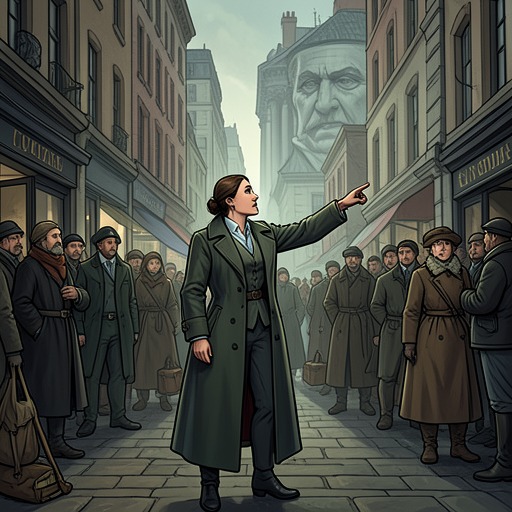
Poor ThingsIn Poor Things, anarchism enters as a political choice offered to Bella Baxter by Harry Astley: oppose domination through violent revolt, or seek change through nonviolence, mutual aid, and personal example. Astley’s lesson links both alternatives to a bleak account of class power and state coercion, while Bella’s resistance to his categories leaves the argument unresolved rather than turning her into a disciple.
Astley’s Political Framework
Astley presents political transformation as a problem of power and its reproduction. He accepts the warning that groups which seize authority through violence tend to preserve themselves through further violence, becoming a new tyranny. The question is therefore not simply who should rule, but whether any movement that takes power can escape the structures it opposes.
His larger account of society supplies the material context for that question. In his view, the education of prosperous children teaches moral rules that conflict with the adult world they enter: schools train pupils to disguise their thoughts while celebrating conquerors, and public life rewards property, financial speculation, and military aggression. He argues that historical narratives also conceal the costs of power, presenting conquest as beneficial to the conquered and the seizure of church lands as compatible with public good, even though those institutions had supplied hospitals, schools, and shelter.
Astley applies the same suspicion to industrial poverty. After the Napoleonic Wars, unemployment and hunger prompted fears of revolution. He recounts Robert Owen’s proposal that businesses earning more than five per cent devote the excess to workers’ food, housing, and schooling, then contrasts it with Malthusian arguments that improving poor people’s living conditions would increase their numbers. Astley describes military barracks, police forces, prisons, and deliberately grim poorhouses as instruments that helped contain the poor. This is his indictment of how the industrial order is maintained, not a neutral account of policy or an anarchist programme in itself.
Violent Anarchism and Its Contradictions
Astley describes violent anarchists as rejecting both aspiring rulers and those already in power. Since workers in agriculture, mining, factories, and transport sustain society, he says, they should retain what they produce, abandon money and exchange goods by barter, and use explosives to deter those who refuse to join them but still seek to command them. Bella enthusiastically assents to this proposition, briefly sharing the force of its rejection of imposed authority.
Astley immediately complicates that approval. He agrees that the police and army can be more terroristic than their opponents, but warns that a movement built on violence risks establishing another tyranny. He also points out that control over food and fuel warehouses gives the middle classes power regardless of who produced the goods. The result is a critique of both official coercion and revolutionary violence: opposing the state does not, by itself, resolve who controls resources or prevent a new ruling group from emerging.
Pacifist Anarchism and Mutual Aid
Astley identifies peaceful anarchism as the alternative he wants Bella to choose. Its proponents, as he describes them, seek change by improving themselves and inviting others to follow, rather than by fighting. They give away money and live either on gifts or on the work of their own hands. He invokes Buddha, Jesus, Saint Francis, Prince Kropotkin, Count Leo Tolstoï, and Thoreau as examples associated with this path.
The strategy is ethically consistent but socially exposed. Astley says that pacifists may refuse taxes because they believe the money funds armies and weapons, yet ordinary adherents can be imprisoned and flogged; celebrated figures, by contrast, may be protected by their admirers. His instruction that Bella should become a pacifist anarchist when she enters politics is thus both a recommendation and a warning about unequal consequences. He predicts that people will love her, while his account makes clear that the movement’s vulnerability depends partly on who its adherents are.
Bella’s Resistance and Practical Commitments
Bella does not simply accept Astley’s diagnosis or his preferred solution. Earlier, she rejects his division of people into the innocent, the complacently optimistic, and the cynical, insisting that another kind must exist because she is no longer innocent yet hates both Astley’s and Dr. Hooker’s outlooks. Her response places a limit on Astley’s authority as a teacher: she wants to know what he knows, but does not agree that clear sight must end in cynicism or be contained by his political categories.
Her later plans give that independence practical form. With Astley and Archibald McCandless, she discusses medical training and says she wants to help girls, mothers, and prostitutes, as well as teach women effective methods of contraception. The advice to keep that intention private until she is qualified shows how reform must negotiate professional and public constraints; it does not establish that Bella adopts an anarchist identity. In A Loving Economy, she also argues that commercial contraception can distract people from forms of physical tenderness, writing, "Cuddling is like milk. It can, and should, nourish our health from birth to death." Her views connect bodily autonomy and care to a broader challenge to social convention, while remaining distinct from Astley’s prescribed political allegiance.
Significance
Anarchism in the novel is less a settled doctrine than a contested answer to the persistence of domination. Astley’s contrast exposes the danger that revolutionary means may reproduce the violence they oppose, while his endorsement of peaceful practice draws attention to mutual aid and the personal costs of resisting state power. Bella’s refusal to choose between innocence and cynicism keeps that debate open: she takes social suffering seriously without allowing Astley’s certainty to dictate what political or ethical action must become.