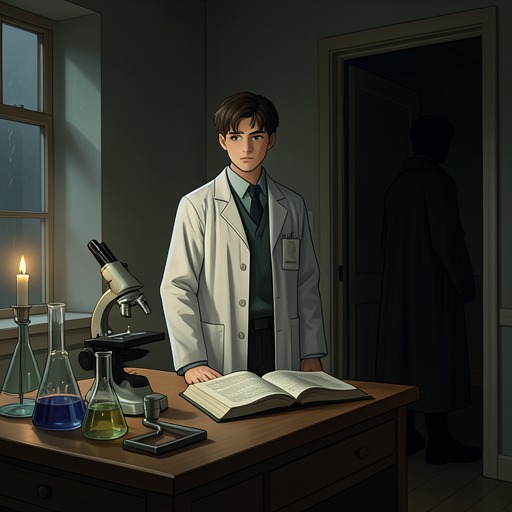
Baxter alters Mopsy and Flopsy, then restores them
Poor ThingsGodwin Baxter’s alteration of Mopsy and Flopsy turns a private garden demonstration into a revelation of his extraordinary bodily powers and their ethical limits. The rabbits’ unnaturally exact divisions and altered anatomy show that Baxter can remake living bodies, while his promise to restore them leaves the consequences of his experiment unresolved in the scene.
The Garden Demonstration
After inviting Archibald McCandless to his home for the first time, Baxter leads him through a tall, gloomy terrace house in Park Circus and down to a walled garden. Baxter’s household dogs—a Newfoundland, two Saint Bernards, an Alsatian, and an Afghan hound—have greeted them noisily in the lobby. Beyond them, the garden contains a wooden doocot and pigeons, vegetable plots, a lawn, and rabbit hutches. Baxter steps over a low fence and asks McCandless to examine two tame rabbits.
The first rabbit is black from nose to waist and white from waist to tail; the second reverses the pattern at an equally clean boundary. McCandless considers whether either might be a natural freak, but recognizes that two animals with precisely opposite markings cannot plausibly result from selective breeding. The startling symmetry makes the rabbits’ appearance evidence of deliberate intervention.
Altered Bodies and Baxter’s Admission
Examination reveals that the changes extend beneath the fur. One rabbit has male genitals and female nipples; the other has female genitals and almost imperceptible nipples. Each also has a small ridge beneath the point where its color changes: one body contracts slightly toward the tail, while the other expands. McCandless concludes that the rabbits are works of art rather than natural oddities, and sets down the one he is holding with care.
Baxter explains that Mopsy and Flopsy were ordinary, happy rabbits before he put them to sleep and they woke in their altered state. He judges the act shabby because they are no longer interested in procreation, which they had previously enjoyed. He says he will put them back together as they were the following day. The account establishes both the deliberate, reversible nature of the experiment and its immediate cost to the animals; the scene reports Baxter’s intention to restore them, not the restoration itself.
Power and Restraint
McCandless responds with awe, admiration, and pity, and asks how Baxter accomplished the transformation. Baxter downplays the feat, but his answer broadens its implications: he says he could replace the diseased hearts of rich people with healthy hearts taken from poorer people and make a great deal of money. He declines to do so, saying he already has all the money he needs and would be unkind to lead millionaires into that temptation.
The contrast between the rabbits’ precise reconstruction and Baxter’s casual account of possible heart replacement makes the garden scene a demonstration of power rather than a mere curiosity. His experiment has altered the animals’ bodies and behavior, yet he frames his ability to intervene in human bodies through the question of whether to exploit it. The rabbits’ promised restoration offers a limit to the damage, while Baxter’s remarks leave the wider reach of his methods—and the inequalities they could involve—plainly in view.