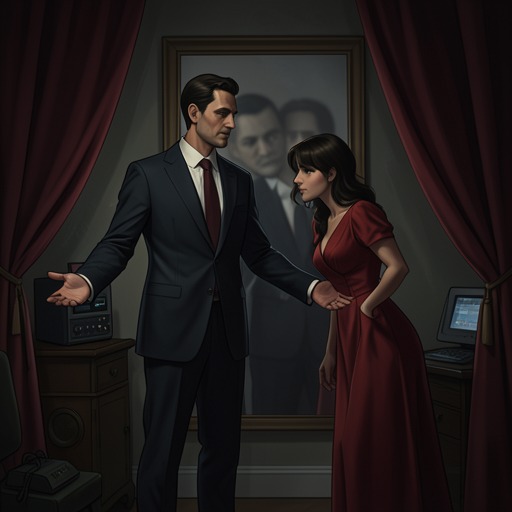
Bella Baxter—Duncan Wedderburn relationship
Poor ThingsBella Baxter and Duncan Wedderburn’s relationship is a secret affair that overturns the roles each expects it to follow. Wedderburn elopes with Bella expecting to marry her and establish a conventional life together; Bella, though affectionate and willing to travel with him, refuses that future. Their shared journey through Europe and the Mediterranean ends in Paris, where Wedderburn leaves for Glasgow and Bella gives him money for the fare. The relationship exposes the distance between his romantic self-image and Bella’s independent understanding of love, obligation, and departure.
The Elopement and Its Discovery
Wedderburn’s connection with Bella first reaches Archibald McCandless through Godwin Baxter, who reports that Bella is waiting to elope with him. Baxter describes Wedderburn as a polished but unscrupulous lawyer whose earlier practice involved seducing women of the servant class and whose gambling losses and sexual affairs were financed by fees for dubious legal work. This is Baxter’s hostile assessment, but it establishes the reputation against which Bella’s decision is measured. Baxter tells McCandless that Bella now loves Wedderburn, making the proposed elopement a direct challenge to McCandless’s hopes as well as to Baxter’s wish not to interfere with her choice.
Baxter’s account also complicates the idea that the affair begins with a sudden escape. Wedderburn had visited the house to bring copies of Baxter’s will for signature. Bella welcomed him warmly; he responded coolly and condescendingly, hurting her. Baxter left to fetch the payment for Wedderburn’s bill. When he returned a few minutes later, Bella was chatting brightly again, and he thought Wedderburn’s involvement had ended. Only later did Bella tell him that Wedderburn had been secretly visiting her bedroom for the previous three nights. His signal was an imitation owl-hoot after the servants had retired; her reply was a lit candle in the window, followed by a ladder and his ascent to her room. She planned to elope with him that night.
The discovery prompts McCandless to fear what might have happened between the pair. Baxter reassures him that he has no reason to dread the physical consequences, explaining that he had noticed Bella’s romantic nature during their world tour and had paid a highly qualified woman in Vienna to teach her contraception. Baxter says Wedderburn also understands its practice. His response shows that he distinguishes Bella’s sexual choices from a crisis requiring paternal intervention, even while he fears the character of the man she has chosen.
A Confession That Becomes Courtship
Baxter says he did not warn Bella against Wedderburn because he had only learned of Wedderburn’s past from Bella herself that morning. As Bella tells it, Wedderburn disclosed his own betrayals and debaucheries to her in an extended confession. He presented his love for her as a transforming force that had made him a new man and would keep him from abandoning her. Bella was not convinced by his promise, but she considered that nobody had ever abandoned her before and that the change might do her good. She also reasoned that wicked people needed love as much as good people and might be better at loving. The account gives her compassion without making her credulous: she recognizes the uncertainty of Wedderburn’s pledge yet chooses to take the risk.
Wedderburn’s later letter to Baxter recasts this beginning as a reversal of his own expectations. He admits that he had viewed himself as a guilty libertine who had taken a respectable young woman from her home and guardian. He compares his affair to the story of Faust, casting himself as the respectable man divided between a noble self and a destructive appetite. In the same theatrical analogy, however, he claims that Bella was Faust and Baxter was Satan, while he himself had been cast as the innocent Gretchen. The melodramatic blame-shifting sits beside his confession that he had told Bella his past fully and frankly. His letter thus presents the relationship through a self-defending, changeable account rather than a neutral record.
The Journey and Wedderburn’s Failed Expectation
Wedderburn says that he eloped with Bella and travelled with her through Europe and around the Mediterranean, presenting themselves as husband and wife despite not being married. He insists in his letter that he expected marriage, not financial gain. To facilitate what he imagined as their honeymoon, he obtained a passport that named them as husband and wife and planned to have a civil contract signed on the journey. He expected Baxter might provide a modest continuing allowance that would let him support Bella in the style she had enjoyed at Baxter’s home; he denies that this expectation motivated his decision to marry her.
His plan was unusually concrete. He had arranged to break the London train journey at Kilmarnock, where a registrar was to receive the couple at his home and marry them. Before they reached Crossmyloof, however, Bella told him that she could not marry him because she was engaged to someone else. Wedderburn initially tried to understand this engagement as belonging to the past. Bella clarified that it lay in the future. When he asked where that left him, she answered that he was with her in the present and embraced him. He then bribed the guard to secure a private first-class carriage. The train stopped at stations including Kilmarnock, Dumfries, Carlisle, Leeds, and those north of Watford Junction, but Wedderburn says he registered only its movement and pauses during what he calls their journey of passion. The contrast is decisive: he treats the trip as a honeymoon leading toward marriage, while Bella’s refusal makes clear that intimacy does not promise him that future.
Separation in Paris and the Relationship’s Reversal
The relationship ends in Paris when Wedderburn, weary of Bella, decides he must return to Glasgow and work. His account follows a visit to a priest, to whom he confesses his sins and asks for advice about a telegram associated with the Sacred Heart. The priest tells him either to marry Bella and return to his mother or to leave Bella and return to his mother, and recommends that he take instruction in the Catholic faith once back in Glasgow. Wedderburn describes emerging into sunlight with the feeling that a burden had lifted; Baxter interprets this as the moment Wedderburn finally realizes that he is tired of Bella.
Back at the hotel, Wedderburn tells Bella that he is leaving for Glasgow and cannot take her unless she returns as his wife. Bella cheerfully accepts the separation and says she wants to see more of Paris. As she packs his belongings, Wedderburn asks whether that is all. Bella explains that the money she has taken from his funds is all that remains, but offers to give him more if he needs it. She unstitches the lining of her travelling coat, removes £500 in Bank of England notes, and gives them to him as payment for the pleasure he gave her. She says he deserves more, but that this is all she has, and explains that God gave her the money because he knew something like this would happen. Wedderburn had expected to make Bella his bride; in the end, Bella supplies the fare for his departure and remains in Paris.
Narrative Significance
The relationship is presented through competing accounts: Baxter’s alarmed report of the impending elopement, Bella’s explanation of why she accepts Wedderburn’s confession, and Wedderburn’s retrospective letter, in which he alternately condemns himself and casts himself as a victim of a plot. The changing accounts make the couple’s unequal expectations part of the relationship’s meaning. Wedderburn tries to turn confession into proof of reform and travel into a route to marriage; Bella hears his history, recognizes that his promise may fail, and still chooses companionship without surrendering her future to him.
The conclusion reverses the familiar pattern in which the woman is left dependent on the departing lover. Bella does not plead for marriage or follow Wedderburn back to Glasgow. She stays in Paris, gives him the money for his journey, and frames the payment as an acknowledgment of what their time together meant to her. Her generosity does not erase the instability of the affair, but it makes the separation her own decision as well as his. Their parting therefore closes Wedderburn’s imagined courtship while preserving Bella’s authority over what the relationship was and when it ended.