Bella Baxter’s creation
Poor ThingsBella Baxter’s creation is the concealed act at the center of her extraordinary origin: Godwin Baxter preserves the body of a woman who drowned in the River Clyde and joins it to the thinking part of her unborn child. The revelation turns what first appears to be an inexplicable new life into a deliberate medical experiment, rooted not only in Baxter’s research but in the social disposal of the poor, the dead, and those whose lives institutions cannot accommodate.
The drowned woman
A contemporary record dates the recovery of an unidentified pregnant woman’s body from the Clyde to 18 February 1881. Godwin Baxter, acting as police surgeon, certified death by drowning. The record describes a woman about twenty-five years old, five feet ten and three-quarter inches tall, with dark brown curling hair, blue eyes, a fair complexion, and hands unused to rough work. She was well dressed, but nobody claimed her body after it was advertised.
Baxter’s later account supplies the circumstances behind that official description. George Geddes worked for the Glasgow Humane Society, lived rent-free on Glasgow Green, and was responsible for recovering bodies from the river and saving people when possible. Bodies that could not be revived were kept in a small morgue attached to his dwelling for examination by a police surgeon; when the surgeon was unavailable, Geddes called Baxter. Bodies left unclaimed could pass from the morgue to dissecting rooms and laboratories, a transfer Baxter had arranged before.
Geddes saw the young woman climb onto the parapet of the suspension bridge near his home. Unlike people who entered the water feet first, she dived like a swimmer, but exhaled rather than drawing breath; she did not surface alive. A reticule strap had been tied to her wrist, and the bag was filled with stones. The deliberate preparation suggested to Baxter a wish not merely to die but to remain unidentified. Her fashionable clothes had empty pockets, with neat holes cut into the linings and into the places in her lingerie where wealthier women might have their names or initials sewn. Pressure grooves on a finger showed that wedding and engagement rings had been removed. Baxter found her pregnant, and Archibald McCandless inferred that the child might have belonged either to a husband she hated or to a lover who had abandoned her. The account establishes the clues, not which possibility was true.
Baxter’s decision
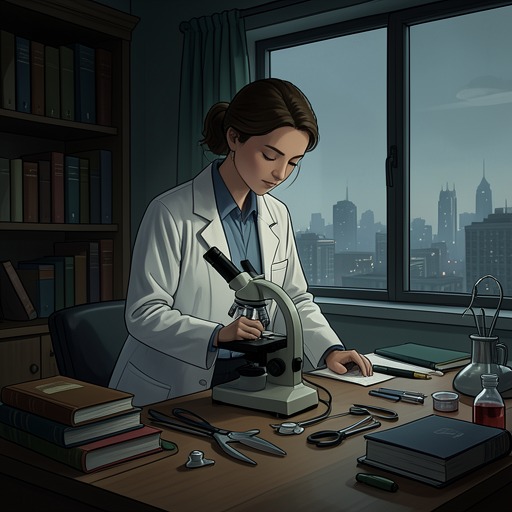
The body was still fresh when Baxter examined it: rigor mortis had not set in, and it had hardly cooled. He cleared water from the woman’s lungs and removed the fetus from her womb. He believed that electrical stimulation could have brought the woman herself back to conscious life, but chose not to do so. In his reasoning, the woman had rejected her life so completely that revival might force her into institutions that treated suicide as lunacy or crime: madhouses, reformatories, or jails. Instead, he kept her body alive at a purely cellular level. When the body remained unclaimed, he took it to his father’s laboratory.
Baxter describes this decision against a wider account of death and medical neglect. He says that hundreds of young women drowned themselves each year under the pressure of poverty and prejudice. He also points to infants born with severe conditions that meant they could not survive without artificial help, or could not survive at all. Some, he says, had no digestive tract and would starve after the umbilical cord was cut unless someone acted first. Doctors could not openly perform or order such acts, though Baxter says they happened; meanwhile, poor parents in Glasgow, a city he identifies with exceptionally high infant mortality, might not be able to afford a coffin, funeral, and grave for each dead child. Even unchristened infants, he observes, were consigned by Catholics to limbo. He calls the medical profession the practical destination of that limbo: the place where abandoned bodies and lives accumulated.
The making of Bella
Baxter says that he had spent years planning to unite a discarded body with a discarded brain drawn from this social and medical remainder. In this case, he used the thinking part of the fetus already carried by the woman. When Archibald McCandless later asked whether Baxter could have saved the child, Baxter answered that he had saved its thinking part and that the woman’s body had already contained a compatible brain. Bella’s creation therefore depends on a transfer between lives rather than the return of the drowned woman’s former consciousness. Baxter links the new person to the surviving body, but identifies the child’s thinking part as the basis of the life he made.
The method also gives the story’s apparent miracle a material and institutional history. The river supplies a body; the reticule’s stones and the removed rings mark an attempt to disappear; the unclaimed corpse moves through a morgue and into a laboratory; and Baxter’s electrical and surgical knowledge makes a new life possible. Neither the body nor the fetus is treated as an abstract symbol in his account: each has been exposed to the practical systems that determine which lives are rescued, mourned, hidden, or put to use. Baxter’s experiment reverses the usual passage from the morgue to dissection by turning remains into the conditions of a new person.
Revelation and significance
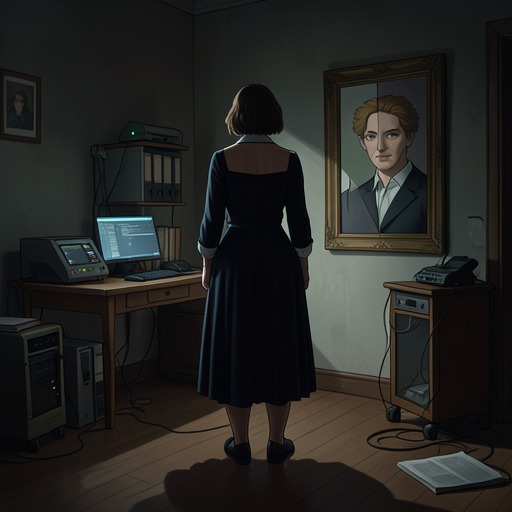
Baxter tells Archibald McCandless about the creation after the events that first brought him into contact with Bella. The account reaches its decisive clarification when McCandless asks how advanced the pregnancy was and whether the child could have been saved. Baxter confirms that it was at least nine months and explains that the child’s thinking part became the basis of Bella. This retrospective disclosure makes the earlier description of Bella asleep newly charged: Baxter recognizes in her resting face the sorrowful woman whose body had lain before him, while also insisting that he did not know the life she had abandoned. Bella’s origin is disclosed, but the drowned woman’s history, name, and reason for removing her rings remain unresolved.
The creation joins scientific ambition to a problem of consent and responsibility. Baxter refuses to restore the drowned woman to consciousness because he imagines the institutional suffering that might follow, yet he preserves her body for an experiment she could not authorize. His act offers neither a simple rescue nor a simple return: it prevents the body from becoming only an unclaimed corpse, but creates a person through a medical decision made on behalf of two lives. Bella’s beginning thus bears the marks of both material possibility and social failure. The life Baxter makes is inseparable from the prior death, the child whose thinking part he saves, and the unequal conditions that left both without ordinary protection.