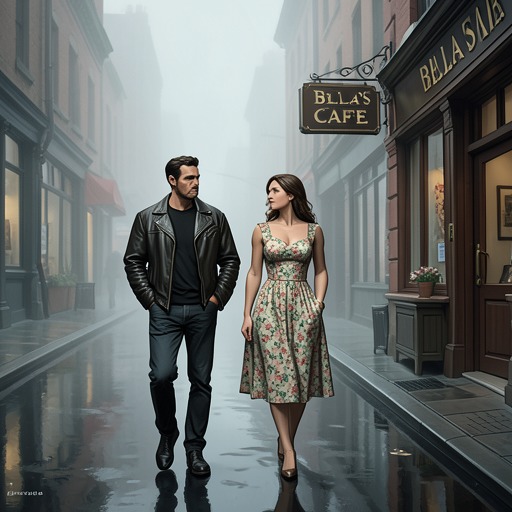
Bella and McCandless share an intimate moment by the fountain
Poor ThingsBella and Archibald McCandless share an intimate moment by the fountain after a long separation, but the encounter soon moves from the public promenade to a secluded path. Bella takes the initiative, drawing McCandless into a breathless physical embrace that leaves him both helpless and exhilarated. Their meeting also reveals how far Bella’s travels and sexual experience have carried her from the young woman McCandless remembers, while her candid explanation of her boundaries unsettles conventional assumptions about intimacy, gender, and reproduction.
The polluted city and the fountain
The reunion unfolds in a Glasgow transformed by a fortnight of hot, calm, cloudless weather. With neither rain nor breeze to clear the industrial smoke and gases, a gritty haze hangs over the valley, films the surroundings, and irritates the narrator’s eyes and nostrils. During an evening walk beside the Kelvin River, McCandless sees paper-mill effluent churn over a weir in heaps of filthy green froth. The polluted water flows through West End Park, hiding the river beneath it. The scene makes the city’s environmental damage physically present before the encounter shifts to a more formal public setting.
McCandless goes to the Loch Katrine Memorial Fountain hoping for fresher air. Its rising and falling jets provide a contrast to the stagnant-looking effluent, while well-dressed adults and children parade around it. Among the crowd, he tries to remember the color of Bella’s eyes but instead recalls the distinctive sound of her speech. The fountain thus becomes the threshold of the meeting: a public place where his anticipation and memory give way to the startling reality of seeing her again.
A startling reunion
Bella appears beside Godwin Baxter, dressed in crimson silk and sky-blue velvet, with a purple hat, white gloves, and a parasol whose yellow canopy and green fringe complete the vivid impression. McCandless has not seen Baxter for seventy weeks. Baxter’s heavy outdoor clothes reflect his unusual loss of body heat, but the more consequential change is in his expression: his aghast eyes and settled gloom suggest to McCandless an absence of something essential, and seem to make visible a need McCandless fears he cannot satisfy. Baxter acknowledges him without hostility, while Bella greets him eagerly and offers her hand.
The greeting recalls their earlier intimacy, but Bella’s manner makes clear that she has changed. She playfully calls McCandless her first love after a boyhood sweetheart and presents herself as a woman of the world, listing the nationalities and regions of men and women who have kissed her hand and other parts. Her account makes the gulf between her remembered self and her present experience part of the reunion itself. She then tells Baxter to sit on a crowded bench and assigns five accompanying children to watch over him, instructing them to stare back at anyone who stares at him. She gives each child a large gobstopper before drawing McCandless away. The playful arrangement leaves Baxter under their protection while Bella controls the pace and direction of her meeting with McCandless.
The encounter in the shrubbery
Bella leads McCandless past the duck pond and abruptly turns onto a narrow path through shrubs. At a bend, she snaps her parasol shut, throws it into a rhododendron bush, and pulls him beneath the surrounding leaves. After releasing him, she removes her right glove, smiles, and licks her lips. The quick movement from promenade to concealment gives the encounter a decisive change of setting: the public reunion becomes a private physical encounter on Bella’s terms.
She presses her bare palm over McCandless’s mouth, blocks his nostrils, and wraps her other arm around his neck. Both gasp for breath. With her eyes closed, she turns her head from side to side and repeats his nickname in a deliberately tangled sequence of phrases. McCandless is initially too astonished to resist; then his response reverses. What first makes him feel as helpless as a doll becomes, in his account, a sweetness he does not wish to escape. He struggles not against suffocation but against an intensity of pleasure he finds difficult to bear. A moment later Bella lets him go, dazed, and retrieves her glove from a branch.
The scene’s force lies in that change from apparent helplessness to willing surrender. Bella’s gesture is physically forceful, but McCandless describes his own sensation shifting from shock to desire; the account does not present the encounter as a conventional courtship or as an exchange initiated by him. Its breath, pressure, and sudden release make the emotional turn bodily before either character explains it. The glove, abandoned in the bush during the embrace and put back on afterward, marks the brief interruption in Bella’s composed public appearance.
Bella’s account of intimacy and its limits
After contented sighs, Bella tells McCandless she has had no opportunity to repeat the act since leaving the ship from America two weeks earlier, because Baxter has not left her alone with anyone except himself. She asks whether McCandless enjoyed what they did. He nods, and she teases him that he enjoyed it less than she did, adding that men seem more convincing when they act foolishly out of misery. The exchange gives the episode a conversational aftermath rather than allowing the physical encounter to stand as an unspoken secret.
McCandless asks whether she has done the same thing with many men. Bella answers that she has done it around the world, mostly in the Pacific. On the boat from Nagasaki, she says, she met two petty officers devoted to each other and sometimes did it six times a day with each of them. Her matter-of-fact disclosure supplies a concrete measure of the experience behind her earlier claim to have become a woman of the world; it also places McCandless within a history that began before their reunion and extends well beyond him.
Asked whether she has gone further with men, Bella distinguishes the encounter from acts that could make babies. She says she wants fun, not babies, and that she goes further only with women she likes the look of. She recalls that a woman she met in San Francisco ran away because the possibility of going beyond kissing hands and faces frightened her, and observes that many men are shy too. Bella’s explanation is not simply a declaration of experience: it sets out her own boundary between pleasure and reproduction, and describes that boundary without adopting the embarrassment her listeners might expect. By the time the conversation ends, the meeting at the fountain has become a revealing encounter with a woman whose intimacy is self-directed, expansive, and candid about its limits.