Cellular suspended animation
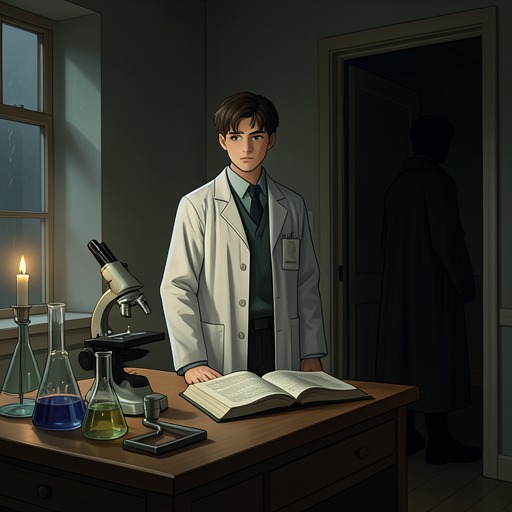
Poor ThingsCellular suspended animation is a technique for arresting a body’s life while keeping its cells viable, and it makes possible both Godwin Baxter’s experiments on rabbits and the creation of Bella. In the novel, this apparent suspension between life and death is not ethically neutral: it preserves a body for intervention, but also gives the experimenter power over what happens next and to whom.
Definition and Technical Basis
Godwin Baxter describes the method as stopping the body without ending life. Neural messages cease to pass; respiration, circulation, and digestion are completely suspended, while cellular vitality remains unimpaired. The distinction matters: this is not a technique for restoring someone who has died, but a way of keeping a body biologically viable in a radically arrested state.
The discovery belongs to Sir Colin Baxter. Godwin tells Archibald McCandless that his father found this method superior to his earlier work, though he offers no technical account of how it operates. The novel instead establishes its effects through particular bodies and outcomes. Its scientific plausibility is conveyed through the measured description of bodily functions, while the practical details of the intervention remain partly withheld.
That emphasis on bodily measurement has a domestic counterpart in Godwin’s own routines. At meals, he prepares digestive juices by hand, keeps laboratory equipment on a sideboard, and records his pulse, respiration, temperature, and changes in his blood and lymphatic system every four hours. The chart reveals sudden, extreme fluctuations, including a neural episode comparable to a seizure that Archibald had not noticed. These observations do not explain the suspension technique, but they place it within a world where bodies are monitored, manipulated, and understood through instruments as well as outward appearance.
Experiments on Mopsy and Flopsy
Godwin demonstrates his power by handing Archibald two rabbits. Their coats are divided into precisely opposed black-and-white halves, with clean boundaries unlike natural markings. Examination reveals further alterations: one rabbit has male genitals and female nipples; the other has female genitals and almost imperceptible nipples. Beneath the fur, each has a slight ridge where its body narrows or expands. The exact symmetry makes the animals seem deliberately made rather than naturally unusual.
Godwin explains that Mopsy and Flopsy had been ordinary, contented rabbits before he put them to sleep. They woke with altered bodies and no longer showed interest in procreation, which they had previously enjoyed. He calls what he did shabby, not wonderful, and says he will put them back as they were the next day. The account establishes both the reach and the limit of the method: suspension enables a bodily transformation, while Godwin claims that the change can be reversed. The evidence records his promise of restoration, not its completion.
Archibald’s response to the rabbits shifts from close inspection to awe and pity. Their bodies are at once startlingly exact and terribly precious to him. The scene makes the animals more than a demonstration of technical skill: they are living creatures whose capacities and reproductive lives have been changed without their consent. Godwin’s remorse acknowledges that cost even as his experimental authority remains absolute.
The Preserved Body and Bella
The technique’s most consequential use begins with a drowned woman whose engagement rings have been removed. Godwin infers that she may have been carrying the child of a husband she hated or of a lover who abandoned her. He clears water from her lungs and removes the fetus from her womb. Although electrical stimulation might have returned her to self-conscious life, he decides not to revive her. He imagines that a woman who chose death would be forced into a madhouse, reformatory, or jail, since suicide is treated as lunacy or crime in the society he describes.
Instead, Godwin keeps the woman’s body alive at a cellular level. It is advertised, remains unclaimed, and is taken to Sir Colin’s laboratory. Godwin says that years of preparation had led him to unite a discarded body and a discarded brain in a new life. The brain is that of the nearly nine-month-old fetus taken from the woman’s body; their union produces Bella. Suspended animation is therefore the enabling interval between the woman’s drowning and Godwin’s intervention, preserving the body while making a radical reconstruction possible.
Godwin sets this experiment against the mortality and poverty of Glasgow. He describes young women drowning themselves amid social prejudice and poverty, and infants born with conditions that prevent survival without assistance. Some malformed infants die soon after birth; poor parents, he says, may be unable to afford a coffin, funeral, and grave. He also describes the medical profession as a kind of limbo for unchristened infants. These circumstances give his work a stated social and medical context, but do not settle its ethical status: the procedure answers suffering with a new life while making another person’s body the material of an experiment.
Ethics, Agency, and the Limits of Intervention
Godwin later calls himself a murderer. He argues that the living fetus should have been cared for as his foster child, and that placing its brain in the mother’s body deliberately shortened her life, taking years from its beginning rather than from its end. He connects the experiment to selfish greed and impatience, comparing its motive to the exploitation of children by elderly lechers. His accusation is directed at himself: scientific ability, he insists, does not by itself improve the world when selfish appetites determine its use.
He further says that without Sir Colin’s techniques, Bella would have been a normal infant and he might have enjoyed her company until she grew independent. Instead, he believes his sexual appetites used science to shape her into an object of desire for Duncan Wedderburn. The contrast between the rabbits and Bella is stark: with the rabbits, Godwin names a reversible alteration and promises to undo it; with Bella, the intervention determines the terms of a whole life. Cellular suspended animation thus marks a threshold of power, not a guarantee of care. It can preserve life for medical possibility, but the novel insists that the experimenter’s reasons, the subject’s prior wishes, and the social conditions surrounding the body remain part of the procedure’s moral meaning.