Communism
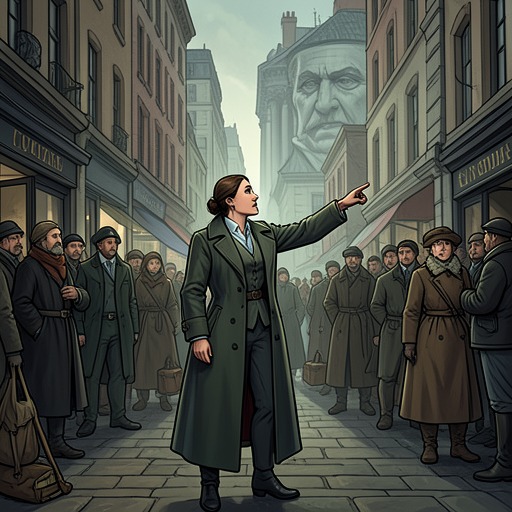
Poor ThingsCommunism, as described by Harry Astley to Bella Baxter, is a proposed transitional politics: people from every class would organize, wait for a severe financial crisis, take control of the country, secure everyone’s material needs, and then disband. Its promise of a government that abolishes the need for government is presented alongside a warning that power gained through violence may reproduce the tyranny it intends to end.
The proposed political sequence
Astley describes communists as forming a party drawn from every class, rather than limiting the movement to one social group. Their strategy is patient rather than immediately insurrectionary: they would work and wait until the country faced serious financial trouble, then overturn the existing order and govern for a limited period.
The temporary government has a defined purpose. It would continue until everybody had what they needed and was able to keep it; after that, the communists would disband because neither their party nor any further government would be necessary. The account therefore makes the transfer and redistribution of material security the condition for political authority to disappear. Communism is not described simply as replacing one permanent ruling class with another, but as aiming to make rule itself unnecessary.
Crisis, class power, and material need
The proposal appears within Astley’s broader account of how wealth and political power reinforce one another. He argues that Parliament is an alliance of powerful interests that protects its own wealth, and that elected socialists would be outmaneuvered, bribed, or reduced to insignificance. In this analysis, the parliamentary route cannot deliver structural change because the institution is already organized around the interests reformers would have to challenge.
Astley also describes a society in which poverty is managed through institutions that weaken and confine the poor. Recalling the unemployment and hunger that followed the Napoleonic Wars, he recounts Robert Owen’s proposal that businesses earning more than five per cent use the excess to improve workers’ food, housing, and schooling. Against this, he sets the Malthusian argument that feeding the poor would increase their numbers, and his account of barracks, police, jails, and deliberately grim poorhouses. These details do not specify a communist policy programme, but they establish the material conditions and coercive social order against which his account of communism is heard.
Reform, violence, and the problem of power
Communism is distinguished from parliamentary socialism by its expectation that a crisis will make the existing government vulnerable to overthrow. Yet the discussion does not present revolution as an uncomplicated solution. Astley agrees with the warning that groups which reach power through violence may perpetuate themselves through further violence and become a new tyranny. The danger shadows the communist proposal: a party that intends to dissolve after meeting people’s needs must still exercise authority in the interim, and the account offers no practical safeguard ensuring that it will relinquish that authority.
The nearby discussion of violent anarchists sharpens this contrast. They reject both those who hold power and those who seek it, and propose that workers keep what they produce, exchange by barter, and use explosives against those who try to command them. Bella Baxter enthusiastically approves both the communist plan and this anarchist defiance. The positions nevertheless remain distinct: Astley’s communists would temporarily take government, whereas the anarchists he describes oppose the possession of governing power altogether.
Bella Baxter’s response and the idea’s significance
Bella Baxter’s emphatic approval gives the proposal the force of an appealing possibility rather than a detached political definition. Astley’s account speaks to needs made stark elsewhere in his social critique: food, shelter, schooling, and the means to retain what people need. Her response registers the attraction of an order in which these necessities would no longer depend on the existing distribution of wealth and authority.
The idea remains unresolved in the conversation. Communism promises to end government once material security is universal, while its route to that end involves a party taking power amid crisis; Astley’s own warning about violent movements becoming tyrannies exposes the tension between those stages. The passage thus presents communism as both a radical answer to entrenched deprivation and a political project whose temporary authority may threaten its stated destination.