Cuff's Investigation Report
Poor ThingsCuff's Investigation Report is a copy of Sergeant Cuff's findings about Lady Blessington, commissioned by Godwin Baxter after Duncan Wedderburn claimed that Bella Baxter was the reincarnation of Victoria Blessington. Its significance lies in converting a contested personal history into a set of named witnesses and specific accounts: former servants describe the General's treatment of Dolly Perkins and Victoria, while the General himself admits to imprisoning Victoria in a coal-cellar. The report becomes both a potential legal weapon and the means by which Bella's concealed past is disclosed to her.
Commission and Purpose
Baxter says he employed Sergeant Cuff the previous month to investigate Lady Blessington, following the letter from Duncan Wedderburn that connected Bella Baxter to Victoria Blessington. The inquiry was therefore prompted by a claim about Bella's identity, but it turns toward the circumstances of Victoria's disappearance and the General's conduct before and after it.
The report names numerous people who, Baxter says, will testify against the General in court. Most are servants who resigned or were dismissed from his household soon after Lady Blessington disappeared. That pattern gives the investigation a particular evidentiary shape: people formerly dependent on the General are now potential witnesses to events inside his home. The solicitor, Mr. Grimes, immediately challenges their likely standing, warning that former servants have little credit in an English court and that allegations must survive skilful cross-examination. Baxter nevertheless insists these witnesses will be believed.
The Account of Dolly Perkins
One portion of the report concerns Dolly Perkins, who was sixteen and worked as the General's parlour-maid until the day before his wedding. According to the account Baxter reads, the General then rented her an apartment in a boarding-house near Seven Dials. He did not give his name to the landlady, Mrs. Gladys Moon, but she recognized him from his pictures in the Illustrated London News. She reported that he visited Dolly for two hours every Tuesday and also came on Fridays to pay the rent. The arrangement continued for four months.
Mrs. Moon's account then describes an abrupt abandonment. On one Friday, the General told her he would not return and that Dolly was no use to anyone; he urged the landlady to get rid of her lest she give his house a bad name. When Mrs. Moon spoke to Dolly, Dolly admitted she was penniless and pregnant, and was told to leave. The detail of the rent, the recurring visits, and the landlady's recognition of the General makes this more than an abstract accusation: the report sets out a sequence that could be tested through a witness.
The General denies that he fathered Dolly's child. He claims their encounters could not result in pregnancy and says Dolly tried to blackmail him for money by threatening to tell his wife. He also describes leaving her without a shilling. The report's account and the General's explanation thus put the question of responsibility directly in dispute; the report offers testimony, not a judicial finding.
Victoria's Confinement and Escape
The report is introduced amid Baxter's account that the General broke in on Victoria and a visitor, threw the visitor into the street, and locked his wife in a coal-cellar. The General confirms that he confined her there. He explains that he feared the servants would help her escape: the other rooms below had keys he did not know, and he regarded Victoria as too friendly with the household staff.
He says he spent three hours gathering Dr. Prickett and another doctor to certify Victoria, finding an asylum prepared to receive a pregnant woman he called a lunatic, and arranging a padded ambulance and three stout nurses to transport her. By the time he returned, she had escaped. These details show that the cellar confinement was part of a further plan to have Victoria certified and removed, not simply an isolated restriction on her movement.
The report supplies the servants' account of how that escape became possible. The former footman, Tim Blatchford, admits smashing the cellar lock with a poker. The former cook, Mrs. Blount, says the household had begged him to act because Victoria's sobs and frantic cries could be heard throughout the house. The servants feared she had gone into labour and that the confinement could cause the deaths of two. They report that Victoria emerged intact. The former housekeeper, Mrs. Munnery, then gave her clothing recovered from the street, cleaner than the garments stained with coal, and train fare to visit her father in Manchester.
Circulation, Disclosure, and Narrative Function
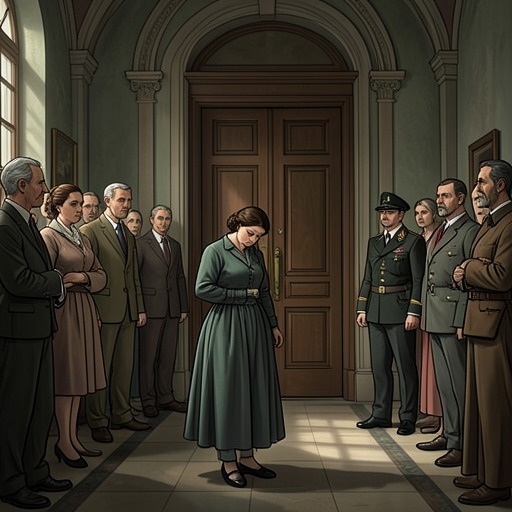
The report reaches the gathering as a document with an immediate practical purpose. Baxter gives a copy to the solicitor and asks him to take it to the St. Enoch's Hotel, discuss it privately with the General, and return the next day with their decision. While the solicitor studies that copy, Baxter summarizes the report aloud. The written evidence is thus circulated between people who may use it in a legal confrontation, even as its contents are spoken in front of Bella.
Bella asks to hear the details of her past, but Baxter directs his summary to the General rather than to her. The narration notes that Baxter would have been disturbed by the change in Bella's face and figure had he looked at her. The report consequently has a second effect beyond its intended case against the General: its revelations alter Bella as she listens. When the gathering looks toward her, old Mr. Hattersley moans in something like terror, while the General declares that Victoria is going mad again.
Cuff's findings do not settle every disputed claim, and the solicitor's warning makes their vulnerability in court explicit. Their force comes instead from the accumulation of particular testimony: a landlady's recollection, servants' accounts of the cellar, a broken lock, the risk of labour, and the practical help that enabled Victoria to leave. By gathering those details under one investigation, the report connects Bella's uncertain identity to the history the General would prefer to control.