Daily Express
Poor ThingsThe Daily Express is depicted as a mass-circulation newspaper able to turn a campaign against Victoria McCandless into both a public scandal and a commercial success. Its attacks fused claims about birth control, socialism, abortion, and national danger, while the resulting prosecution exposed serious weaknesses in the evidence behind its most consequential allegation. A later visit to McCandless’s clinic gives the paper a second role: not only an accuser, but an institution whose reporter encounters a subject who can answer the press on her own terms.
Campaign Against the Clinic
The immediate context was a book and a public argument over contraception. Victoria McCandless advertised A Loving Economy in major British newspapers, but it received only two favourable notices: one from Guy Aldred in an anarchist periodical and one in The New Age by the stone-carver and typographer Eric Gill. Clergymen from Christian churches condemned the book’s birth-control proposals. Birth-control advocates, meanwhile, objected to its claim that commercial contraceptives were unhealthy. The book therefore drew opposition from groups that disagreed with one another, though for different reasons.
The narrative says Beaverbrook took a hint from the churches and used a campaign against McCandless’s clinic to increase the Daily Express’s circulation. The newspaper did not confine its attack to the medical merits of her proposals. It presented her ideas as a threat to the character of boys and parents, casting the alleged social effects of birth control in emotionally charged terms. Two days after one such article, it published another piece that described her contraceptive method as a danger to the nation and linked her politically to John Maclean, pacifism, and Bolshevism. In this account, private medical practice was made to stand for a much wider set of feared political and demographic changes.
A further article called the clinic a socialist charity concealing the teaching of abortion. The Daily Express alleged that McCandless had spent decades secretly instructing poor women to defy nature, Christianity, and the law. This was the most serious charge in the campaign, but the distinction between a printed accusation and established fact becomes central to what followed: the newspaper’s claim was not itself proof that McCandless had performed abortions.
Allegations and Prosecution
The Daily Express produced two former clinic employees who swore that McCandless had trained women to perform abortions on one another. Their testimony led to a public prosecution. The case, however, failed or did not completely succeed. It emerged that the two former employees had been bribed to some extent by the newspaper, and that they had intellectual disabilities. The account does not treat those facts as a simple technical setback: they undermine the credibility of witnesses whose statements had helped turn the paper’s allegations into legal proceedings.
During cross-examination, the procurator fiscal Campbell Hogg tried to make the witnesses’ intellectual disabilities tell against McCandless by asking whether she had trained many intellectually disabled women to assist her. McCandless answered that she had trained as many as she could. The exchange left the prosecution’s attempt to discredit her entangled with the very charge it was pressing: her work with women whom other institutions might exclude could be presented as evidence against her, even as the newspaper’s own witnesses and methods came under scrutiny.
The paper’s campaign thus had consequences beyond its articles. It helped bring McCandless before a court, but the proceedings did not validate the claim that she had performed abortions. The narrative also records that the newspaper had no proof of that allegation. The gap between an accusation’s reach and its evidential support is especially striking because the campaign was described as commercially successful: the scandal could enlarge circulation even where the prosecution could not establish the charge as reported.
The Later Reporter
Two years later, the Daily Express sent another reporter to investigate McCandless, perhaps hoping for firmer evidence of illegal abortions. The resulting piece was instead a brief character sketch, apparently because nearly everyone who still remembered her thought she was dead. The reporter found that local children called her the Dog Lady: she walked in West End Park with dogs of different sizes, including some with bandages. This detail shifted the focus from the previous campaign’s lurid national claims to the ordinary, visible signs of her local life and work.
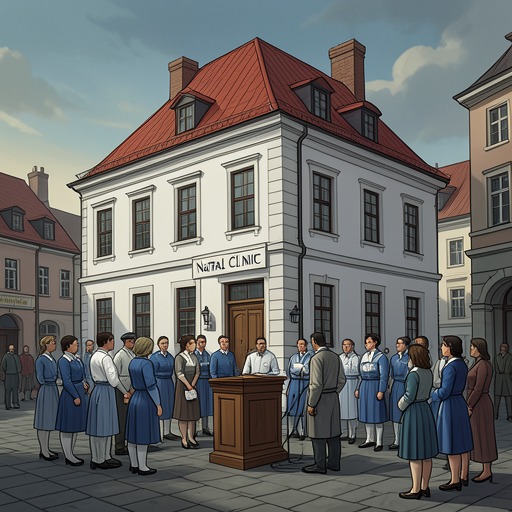
The route into the clinic and its rooms supplied a portrait unlike the newspaper’s earlier accusations. The entrance was in a back lane; rhubarb grew beside the path. The waiting room held heavy mid-Victorian furniture, especially a large horsehair-covered sofa, and its walls displayed old posters for the Scottish Workers’ Republican Party. A padlocked box with a slot invited patients to contribute what they could afford and directed anyone who was hungry to speak to McCandless rather than steal. The waiting patients included very poor and elderly people, as well as children with animals; only one pregnant woman was present when the reporter visited.
In the surgery, which was a large gas-lit kitchen, soup simmered on the range and animals rested in the corners. McCandless sat at a table covered with books, papers, and medical instruments. The scene did not confirm the earlier abortion charge. Instead, it placed medical care, poverty, food, animals, and political affiliation in the same working space, giving the reporter concrete observations where the earlier campaign had relied on sweeping allegations.
An Uneasy Exchange with the Press
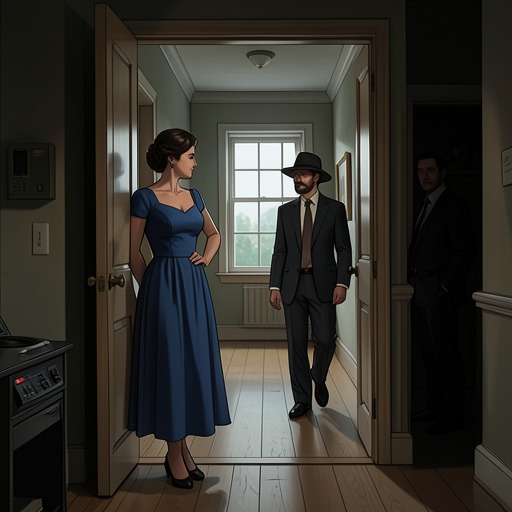
When the reporter sat opposite McCandless, she immediately identified him as a newspaper reporter and asked whether he worked for the Daily Express. The question registers her awareness of the paper’s prior pursuit of her; the encounter begins not with the reporter controlling the interview, but with the subject recognizing the institution at the door. The narrative does not establish that this later article repaired the damage of the earlier campaign, and it describes the piece as short rather than as a substantial reassessment.
Asked to give a message to British youth, McCandless offered a brisk answer in exchange for five pounds and required payment first. She then handed the reporter a small hardbound copy of A Loving Economy from the pile beside her and ushered him out. The exchange turns an interview into a transaction and sends the reporter away with the book that had helped provoke the newspaper’s campaign. It does not make the newspaper and McCandless equal in power: the Daily Express could mobilize a mass readership and help trigger a prosecution, while she controlled only the terms of this brief encounter. But she does use that limited control to redirect the requested message toward her own work.
The account identifies this article as the only record of McCandless between 1925 and 1941 apart from her name and address in a street directory. The Daily Express therefore becomes an important, if compromised, recorder of her later public presence. Its first campaign amplified allegations that did not amount to proof; its later reporter preserved a detailed glimpse of her clinic and her direct response to the newspaper. Together, those roles make the paper part of the story’s conflict over who gets to describe McCandless: the institution that frames her as a national threat, or the observations and encounter that show the local conditions of her work.