Domestic dog
Poor ThingsDomestic dog life in Poor Things is both intimate and practical: the Dogs share Godwin Baxter’s household, accompany Bella Baxter / Victoria McCandless through her life, and eventually become part of her work as a doctor. They are not merely a domestic backdrop. Their growls and gentle tugs mark a boundary that human desire cannot cross, while their presence later links care for animals with care for people.
The household pack
When Bella Baxter / Victoria McCandless returns to Glasgow after leaving her husband, she arrives at 18 Park Circus, the house of the big Dogs. Godwin Baxter welcomes her without questioning her account or circumstances. He takes her to his mother, Mrs. Dinwiddie, and asks that she be treated as his sister while she rests and finds a home of her own. In this household, the Dogs are part of the setting into which she is received: the home is remembered not just by its address, but as the house of the big Dogs.
The pack is also present at the sharpest point of her longing for Godwin. Unable to sleep because she wants to make him love her, she takes a candle and enters his bedroom naked. Dogs on the floor snarl jealously, and more lie heaped beside him on the bed and over his feet, growling as she approaches. Godwin tells her he has no room for her. The scene makes the Dogs’ physical closeness to him unmistakable, but it does not turn them into aggressors: Bella knows they will not bite.
The next morning, after Godwin explains that an inherited illness will eventually make him gravely ill, she insists that she will become a doctor and cure him. His answer is practical rather than romantic. At a click of his tongue, two Dogs gently nip her calves between their great jaws and tug her towards the door. Their action ends the encounter and enforces his refusal without injuring her. In the pattern of the scene, the Dogs are at once companions gathered around Godwin and the means by which Bella is escorted away from a closeness he will not permit.
Companions on the road
Godwin’s last instructions return the Dogs to the centre of family life. As he becomes seriously ill, Archibald McCandless gives him an injection that briefly restores his awareness. Godwin then asks Archibald and Bella to take the Dogs for their Sunday walks. He maps out possible excursions in detail: along the canal bank to Bowling and the Lang Crags above Dumbarton, or up the River Clyde towards Rutherglen and Cambuslang, with routes over the Cathkin Braes and back towards Glasgow. He names stepping stones, lochs, hills and other places to visit, imagining the couple and the Dogs moving through the surrounding countryside.
These directions turn a routine walk into a final act of handing on. Godwin asks them to enjoy the scenery for him, describing the landscapes around Glasgow as glorious and saying that people would do more to improve the city if they loved it enough. The Dogs are not given a speech or an independent account of the journey; instead, they are included in the practical future he pictures for the couple. Walking them becomes one of the ways Archibald and Bella can carry on a bond with Godwin after his death.
The Dog Lady
Years later, the Dogs have become inseparable from Bella Baxter / Victoria McCandless’s reputation. A Daily Express reporter, sent to seek further evidence of illegal abortions, finds that many people who remember Dr. Vic believe she is dead. Local children call her the Dog Lady because she walks through West End Park accompanied by dogs of many sizes, some bandaged. The nickname reduces her to an eccentric public image, but the details behind it show animals woven into her everyday rounds.
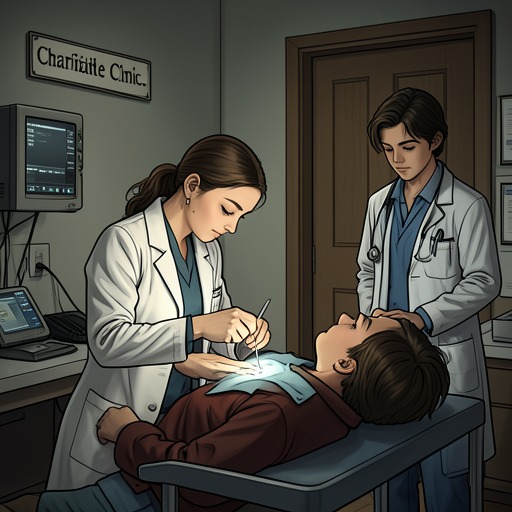
The clinic itself reflects that entanglement. Its waiting room has heavy, old-fashioned furniture, including a large horsehair-covered sofa, and its visitors include children with animals, mostly dogs. In the gas-lit kitchen where the reporter finds the doctor, animals recline in the corners while books, papers and medical instruments cover the table. The room brings veterinary work into the same working space as human medicine rather than keeping the two kinds of patient neatly apart.
Asked whether her veterinary work has reduced her human patients, she agrees that it has, adding that the human animal is prone to silly prejudices. She rejects the idea that she prefers Dogs to people: she still feels tenderness towards her own species, but people with sick animals now avoid her less than sick human patients do. The exchange makes the Dogs more than a prop for her eccentricity. Their presence helps define a practice in which care crosses the boundary between human and animal, even as the prejudice she describes shapes who will seek that care.
The last dog
In her final letter, Bella Baxter / Victoria McCandless anticipates a cerebral haemorrhage and says she is winding down the clinic, founded fifty-six years earlier. Her patients have dwindled to some children’s pets and two elderly hypochondriacs. She has found homes for all her Dogs except Archie, a Newfoundland. Archie has a home waiting, but, she writes, he will not be led away until Nell Todd comes to find her using the basement key Bella has given her.
This last arrangement gives Archie a distinct place among the Dogs: he is the one Bella expects to remain with her at the end, and the one she imagines as a source of physical warmth. She had preferred a warm, steady man at the last, she writes, but the only one in her life had died thirty-five years earlier; Archie, she says, will provide the steadiness she needs. The contrast does not erase her attachment to human beings or her tenderness towards Dogs. It gives that attachment a concrete final form: as the clinic closes and the other Dogs are placed in homes, Archie is to stay beside her until Nell arrives.