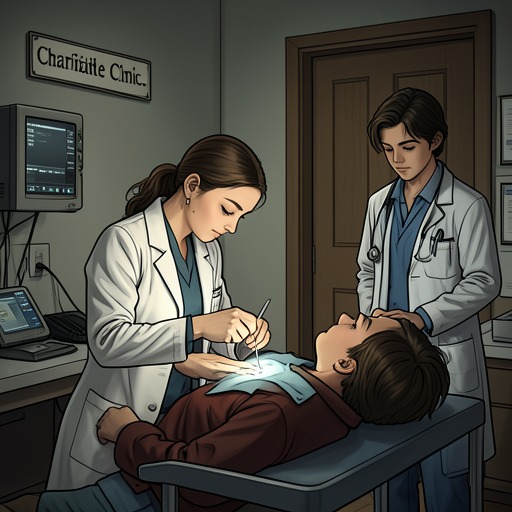
Duke Street Hospital
Poor ThingsDuke Street Hospital is the Glasgow institution where Bella resumes her nursing training after her honeymoon. The book gives little description of its buildings or daily operations, but makes the hospital important as a site where Bella’s medical education meets the limits of conventional hospital hierarchy—and where the practical experience behind her later work begins to take shape.
A Place in Bella’s Medical Training
Before Bella enters medical college, Godwin Baxter proposes a practical route into medicine: she could train as a nurse in the charity wards of an east Glasgow infirmary, and, if she proved herself under its discipline, he would arrange for her to assist him as a theatre nurse. He argues that lectures would mean more to her after such work than they did to students who relied on memorization. The account does not identify that proposed infirmary by name, so it cannot be assumed to be Duke Street Hospital.
The later account does name Duke Street: after returning from their honeymoon, Bella resumes her nurse’s training there while Archibald McCandless returns to doctoring at the Royal Infirmary. Their intended careers remain out of reach, and they continue their work while visiting Baxter at his bedside each evening. The hospital thus marks not the completion of Bella’s professional education but a stage of apprenticeship, undertaken alongside the work and responsibilities of her married life.
Nursing and Institutional Hierarchy
The narrative places Bella’s training within a wider critique of how hospitals organize medical work. Baxter maintains that public hospitals have often served the interests of doctors who treat poor patients while wealthier people obtain private care. He contrasts that system with the private surgical practice of his father, Sir Colin Baxter, who sterilized instruments and his operating theatre at a time when hospital authorities were ignoring or rejecting aseptic methods. These are Baxter’s polemical claims, presented through McCandless’s recollection rather than as a neutral institutional history.
Baxter also argues that nursing, more than medicine’s cultivated bedside manner, represents the true practice of healing. His view of professional hierarchy is sharpened by the military model associated with Florence Nightingale’s nursing service: doctors stand as superior officers, matrons and sisters as sergeant-majors, and ordinary nurses as private soldiers. In this arrangement, lower-ranking nurses seldom speak to their superiors unless instructed, and much of their intelligence goes unused. The book does not establish that every detail of this model describes Duke Street specifically, but Bella’s training there unfolds against this broader account of hospital authority.
Bella’s Response and Baxter’s Advice
Bella’s experience as a trainee nurse brings her into conflict with the restrictions Baxter describes. She becomes angry at aspects of the nursing system, while Baxter cautions her not to challenge the institution before she has understood how it works. He urges her to use her intelligence to devise better practices, and he points out weaknesses in her proposals not to stop reform but to make it workable. The advice treats institutional knowledge as a tool: Bella is to learn the system closely enough to change it rather than simply submit to it or oppose it without preparation.
That approach connects her hospital training to her earlier clinical experience. After returning from abroad, Bella had served as receptionist and assistant at Baxter’s small veterinary clinic, where he taught her to stitch wounds and she helped treat sick animals brought to their back door. Baxter sees this practical skill as evidence against excluding women from intricate medical work. His proposed progression from nursing to theatre assistance and, eventually, medical qualification extends the same principle: competence should be built through practice, not withheld because of gender.
Significance
Duke Street Hospital is a brief but consequential setting in the book’s account of professional formation. Bella’s return to training there places her inside an institution whose routines can educate her while also constraining the intelligence and authority of nurses. The contrast helps define the reforming purpose of her later medical work: the hospital is not simply a backdrop to her career, but part of the system she must understand in order to serve patients and contest the limits imposed on those who care for them.