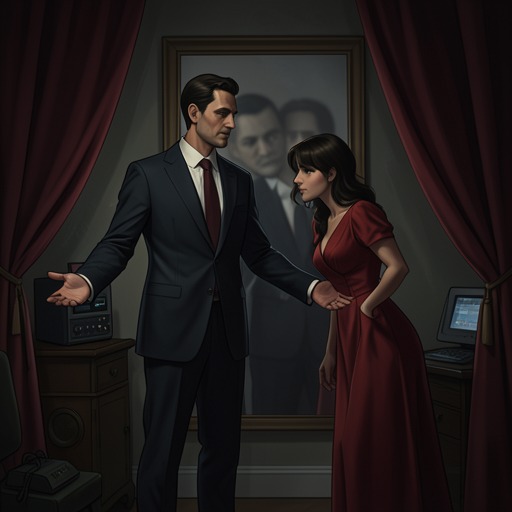
Duncan Wedderburn
Poor ThingsDuncan Wedderburn is a lawyer whose elopement with Bella Baxter turns a supposed romantic adventure into a journey governed by gambling, money, and competing ideas of marriage. Described by Godwin Baxter as a plausible seducer who lives by dubious legal fees and an inherited fortune, Duncan emerges in Bella’s account as both an object of experiment and a companion she tries to care for. His fortunes rise and fall with the betting table; when they finally part, his apparent theatrics have become real enough to keep him in an asylum, where Bella continues to visit.
Identity and introduction
Duncan enters the story at the moment when Archibald McCandless expects to marry Bella. Godwin tells McCandless that Bella is upstairs, waiting to elope with Duncan, and identifies him as the worst possible partner. His portrait is sharply moralized: Duncan is handsome, smooth, well-groomed, plausible, and unscrupulous, a lawyer who had specialized in seducing women of the servant class until the previous week. Godwin also accuses him of laziness, explaining that an inheritance from a wealthy aunt has freed him from the need to work honestly. His income, in this account, comes from gambling and sexual adventures, alongside improperly high fees for legally questionable work.
That account frames Duncan as a practiced exploiter, but it is not the only perspective the book gives. Bella later says that she had not considered him before seducing him, and that he had not considered her. Her account makes their affair begin less as a courtship than as an experiment in desire. The contrast matters: the same man appears first through Godwin’s protective warning to McCandless, and later through Bella’s frank description of her own initiative and changing interests.
Bella, elopement, and the journey
After Bella’s engagement to McCandless, she wonders whether the intense feeling associated with his kiss depends on him specifically or might be produced by another man. She chooses Duncan to find out. He is, Bella says, conventionally minded and devoted to his mother; marriage had not occurred to him before they became lovers, but it did so immediately afterward. Bella, meanwhile, does not understand that his proposed elopement is to include marriage. She treats it as a pleasurable experiment and as a way of testing her attachment to McCandless. Godwin warns her that both men will suffer, and asks her to be gentle with Duncan because he has a weak head.
Duncan’s later insistence on their marital bond sits uneasily beside Bella’s initial understanding. During their travels he tells her that, in God’s eyes, she is his lawful wedded wife. Bella answers that God will let her leave whenever she chooses. The disagreement exposes two different claims to authority: Duncan appeals to marriage as binding, while Bella refuses to let that institution decide her freedom of movement. Their relationship is neither a simple rescue nor a stable romance; it is shaped by Bella’s experiments and decisions as much as by Duncan’s demands.
Gambling, money, and the break with Bella
The journey soon becomes inseparable from Duncan’s gambling. At the casino he begins shifting his bets between black and red, and later insists that his wins came from reason rather than luck. He presents himself as able to calculate his way to a fortune, even as his behavior becomes increasingly captive to the game. Bella describes coaxing him away from his obsession with gold and helping him sleep on a bearskin hearth-rug. While he sleeps, she takes and hides four hundred friedrichs d’or from the pile on the bed. When he wakes, he counts the remainder into orderly heaps without noticing what is missing.
The hidden money gives Bella leverage when Duncan wants to return to the betting shop. She proposes a wager of her own: she will lend him five hundred of his remaining money, and if he returns richer she will give it back and marry him; if he loses, they will need it to leave. He agrees, loses everything, and comes back to the hotel penniless. Bella’s account then moves quickly through another failed attempt to recover his losses. While she waits in a ladies’ waiting-room with the luggage, Duncan slips away for one last bet and loses again. She decides that they will need to travel on the money she has kept, and tells him to wait while she finds funds.
In Paris, Duncan blames Bella for breaking his run of luck by taking the five hundred friedrichs d’or. His accusations inflate the money he believes he would have won into an imagined future: charity, church donations, a London townhouse, a Mediterranean yacht, a Scottish grouse moor, and even a mansion in the Kingdom of Heaven. He says that he no longer wants to marry her, yet claims that poverty chains him to her. Bella answers by cutting open the lining of her coat and producing five hundred pounds in Clydesdale and North of Scotland banknotes. She offers him the money so he can return to Glasgow and be free of her. Instead of accepting the offered escape calmly, he tries to swallow the notes and then attempts to throw himself from a window before rushing toward the stairs. Millie Cronquebil’s staff restrain him and give him brandy; they eventually get him onto a train to Calais. Bella refuses Millie’s suggestion that she keep most of the money, calling it Duncan’s reward for the marriages they have enjoyed. She resolves to earn her own living, something she says she has never done before.
Other ties and later life
Duncan’s connection to Godwin is practical as well as intimate: Bella calls him God’s legal friend, and he sometimes takes her to the theatre because Godwin has a horror of crowds. Those outings belong to the earlier period in which Bella is learning through instruments, books, and experience. They also complicate Godwin’s later portrayal of Duncan as simply a predatory stranger. He is part of the household’s wider orbit before becoming Bella’s lover, even if Godwin does not regard him as a close friend.
Bella’s retrospective account gives their separation an afterlife. She visits Duncan once a month in the lunatic asylum and finds him bright and cheerful, greeting her with a mischievous wink and a knowing grin. She believes his insanity began as a pretense meant to evade imprisonment for embezzling clients’ funds, but says that it has become real. That explanation remains Bella’s judgment rather than an independently verified account, and the book leaves the boundary between calculated performance and genuine collapse unresolved. During one visit, Duncan asks after her husband; when Bella tells him that Archibald McCandless died in 1911, Duncan clarifies that he means her other husband, Godwin, whom he names in a grotesque, grandiose phrase.
Narrative role and significance
Duncan is presented through sharply different acts of narration: Godwin’s warning to McCandless, Bella’s travel account, and Bella’s later visits to the asylum. These accounts do not cancel one another. His exploitation of women and questionable legal work coexist with moments when Bella tends to him, shelters money from his gambling, and eventually offers him a way to leave. In turn, his language of luck, marriage, and imagined wealth repeatedly turns his choices into forces he claims are beyond his control.
His story also reverses the conventional elopement plot. The journey does not culminate in a secure marriage or a lasting union: Bella treats the affair as a test, Duncan’s gambling overtakes their plans, and she ultimately sends him back toward Glasgow with money while choosing to support herself. Later, she visits him without returning to the relationship. The comic contrast between his extravagant visions of riches and his actual pennilessness gives way to the more unsettled contrast between his performed madness and his eventual confinement. Duncan remains a figure through whom the book tests how far appetite, self-justification, and emotional dependence can be separated from responsibility.