Episodes from the Early Life of a Scottish Public Health Officer
Poor ThingsThe 1909 volume titled Episodes from the Early Life of a Scottish Public Health Officer is the fragile documentary object around which Poor Things builds its dispute over history and invention. Printed as Archibald McCandless’s account, it survives in the narrative as a single, unusually illustrated copy, accompanied by a widow’s letter that calls the book false. Michael Donnelly rescues both from a law-office discard; an editor later reprints the volume, reframes the letter and reports that the unique original has gone missing. Its physical history is therefore inseparable from the question of whether McCandless’s story should be read as fiction or testimony.
Discovery and physical form
The volume first comes to light among old legal files set out for municipal destruction. Michael Donnelly asks the law firm that discarded them for permission to take the papers, is refused, and learns that the firm considers preserving client records a breach of legal confidentiality. He leaves the heap in place but has already pocketed a sealed packet marked for a McCandless descendant to open after August 1974. A later hand has crossed out the instruction and added that there are no surviving descendants. The packet has been torn open at one end; inside, the book and letter have been put back carelessly, with the letter crumpled rather than folded. Donnelly examines them during a tea break at the People’s Palace.
The book is a small, 7¼-by-4½-inch volume bound in black cloth, with a grotesque ornament stamped on its covers and a sentimental verse scribbled on the flyleaf. Its title page identifies it as Episodes from the Early Life of a Scottish Public Health Officer, by Archibald McCandless, M.D., with etchings by William Strang. Robert MacLehose & Company published it for the author in Glasgow in 1909. The chapter-one heading, which sketches McCandless’s parents, university struggles, a rejected financial proposal, his first microscope and an equal intelligence, signals the autobiographical account inside. The editor later says the reproduced text stays as close as possible to McCandless’s original, while the Strang etchings and other illustrative devices are reproduced photographically.
A book challenged by its companion letter
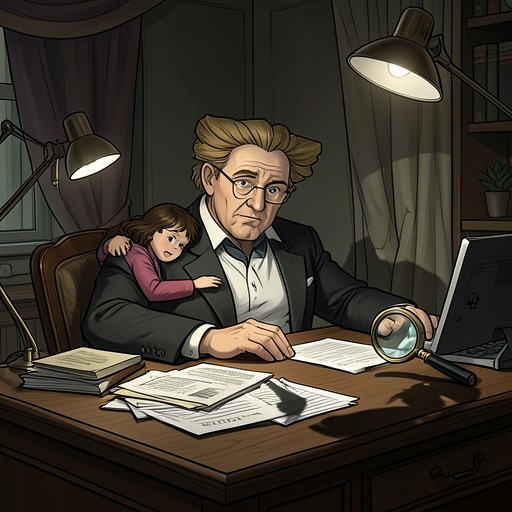
The illustrations first make the volume seem puzzling to Donnelly. They are all portraits, and the frontispiece shows a man who does not look to him like a wealthy doctor. Strang, a Scottish artist born in Dumbarton who studied under Legros at the Slade School of Art in London, was known especially for his engravings and book illustration. Paying him to etch pictures for a privately printed book suggests means beyond those of most public-health officers, sharpening the discrepancy Donnelly sees between the author’s apparent circumstances and his portrait.
More unsettling still is the accompanying letter from the widow identified as Bella Baxter / Victoria McCandless, M.D. She says the book is full of lies, explains that she burned the original manuscript, and says she would have destroyed the surviving volume too, had it not been almost the only evidence that her late husband existed. She also insists that the book was printed and bound in a single copy, at considerable expense, and that she does not want anyone living to connect it with her. The letter thus attacks the account while simultaneously making the remaining copy more consequential: the evidence of the book’s existence is also evidence of an attempt to suppress it.
Editing, retitling and competing readings
Donnelly lends the volume to an editor in 1990, believing it a lost masterpiece and agreeing to its publication on the condition that the editor control the editing. The editor promises not to alter McCandless’s actual text, but does replace the lengthy original chapter headings with shorter titles. The third chapter, for example, is reduced from a heading listing Sir Colin’s discovery, the arresting of a life, the queer rabbits and other episodes to the concise title The Quarrel. The editor also insists on renaming the whole book Poor Things, a phrase repeatedly applied to characters in the story.
The placement of the widow’s letter is another editorial decision with interpretive consequences. Donnelly would prefer it as an introduction, but the editor prints it as an epilogue so readers will not encounter its accusation before the story. Afterward, the editor reads it as the letter of a disturbed woman trying to conceal the truth about her beginnings. The same document can therefore function either as a warning that discredits the narrative or as a defensive attempt to obscure it; where it appears in the book influences which reading takes hold first.
Donnelly and the editor disagree more broadly about what kind of work the volume is. Donnelly sees a blackly comic fiction in which real experiences and historical facts have been woven; the editor sees a loving portrait of an eccentric, intelligent man, recorded by a friend and opened out through other people’s letters into a picture of society. To support the historical reading, the editor reports six months of research in archives and libraries in Glasgow, Edinburgh and London, and presents the book as a tissue of facts. The object’s uncertain status is not resolved simply by its documentary appearance: the book, its companion letter and the editor’s claims all compete to establish what counts as evidence.
Loss and afterlife
The volume’s evidentiary role is complicated by its disappearance during production. Donnelly doubts the editor’s evidence because official copies of certificates and newspaper reports have not been obtained. The editor replies that making a photocopy for the publisher and returning the original would have added at least £300 to production costs. The book was also required by a photographic specialist to make plates for the Strang etchings and facsimiles of Bella’s letter. Somewhere among the editor, publisher, typesetter and photographer, the unique first edition is mislaid. Donnelly blames the editor for its loss, and their relationship becomes less friendly.
That disappearance makes the volume’s earlier material details newly charged. It had been recovered from files marked for destruction, preserved despite a warning about confidentiality, and printed only once according to the widow’s letter; now the sole copy itself cannot be found. The published text and its reproduced illustrations carry the account forward, but they cannot restore the original object. In Poor Things, the book’s survival and loss form a parallel archive story: every act of rescue, editing or reproduction preserves some evidence while altering the conditions under which it can be trusted.