Fabian Society
Poor ThingsThe Fabian Society is a political organization associated in Poor Things with gradual reform and with Victoria McCandless’s work in public health, women’s suffrage, and socialism. Its place in her life shifts from a setting for political meetings and a publisher of her reformist writing to an organization she breaks with over the First World War. The novel does not provide a formal account of the Society’s structure or a complete statement of its policies; instead, it presents the organization through Victoria’s involvement and the disputes that define it.
Political role and reformist alliances
Victoria’s account associates the Fabian Society with a programme of practical social reform. She describes Fabians as considering trade unions and the British Labour Party allies, alongside any honest Liberal or Tory public servant seeking a decent minimum wage, sanitary housing, proper working conditions, and the vote for every British adult. This formulation places political cooperation around specific improvements rather than party identity alone. It is Victoria’s explanation of Fabian commitments, not a comprehensive account of the Society’s official platform.
That reformist setting also helps explain why her politics could combine professional public-health work with campaigns for political rights. Her husband, Archibald McCandless, is described as a Liberal, while Victoria’s affiliations included the Fabians and, later, opponents of the war. The distinction between their politics did not prevent their shared public work, but it gave her political life a direction distinct from his.
Victoria McCandless and the Society
The Society forms part of Victoria’s continuing public and private life. After marrying Archibald, she attends its meetings in London; these are identified as the exception to the couple’s otherwise uninterrupted habit of sleeping together. The brief domestic detail places political commitment inside the rhythms of their marriage rather than treating it as a detached public identity.
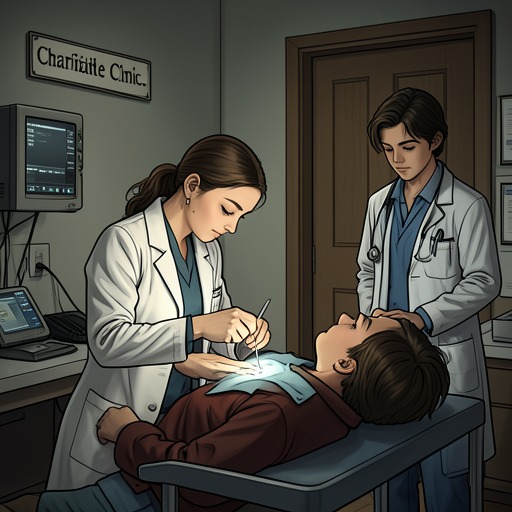
Her association was also practical and professional. Victoria’s medical ambitions developed into work for women, children, and mothers, and she later managed the Godwin Baxter Natal Clinic. The Society published her public-health pamphlet in 1899, connecting its publishing activity to her attempts to make medical knowledge and health reform matters of public concern. In her wider career, she promoted female suffrage and was invited to speak in European capitals; her clinic, pamphlets, and suffrage work together made her a public figure, although the account does not attribute all of those activities to the Society.
Public health and medical reform
Victoria’s arguments about medicine show what Fabian publishing could bring into public discussion. In her 1899 pamphlet Against Horizontalism, she challenged the routine placing of patients flat and argued that childbirth was not a disease. She advocated birthing stools and a squatting posture, while also criticizing the assumption that patients should accept medical authority without understanding their own bodies. The pamphlet treated “horizontalism” as both a bodily practice and a wider habit of deference to professional authority.
Her proposals extended beyond the clinic. Victoria wanted children to learn basic nursing in primary school and basic medical training in secondary school. She argued that ordinary people should understand how doctors could help, how to care for one another, and why damaging housing and working conditions should not be tolerated. Contemporary journal reactions portrayed this educational programme as politically radical, but the proposals themselves joined health education to collective knowledge and material reform.
The Society’s later publication of her work did not mean that it endorsed everything she argued. In 1920, Victoria issued A Loving Economy: A Mother’s Recipe for the End of All National and Class Warfare at her own expense under the imprint of the Godwin Baxter Peace Press. That pamphlet drew denunciation from Christian clergy and criticism from advocates of birth control, including over its view that commercial contraceptives were unhealthy. The distinction between this self-published work and the Society’s publication of her 1899 pamphlet matters: the evidence records separate ventures, not a Fabian endorsement of the later book.
The First World War and the break
The sharpest conflict between Victoria and the Fabian Society followed the outbreak of the First World War in 1914. She was shocked by the war and wanted working people and soldiers to end it through a strike. After her two youngest sons joined the army and were killed at the Somme, she broke with the Fabians over what she called their lukewarm tolerance of the killing. The break marks a limit to the political alliance she had earlier described: reformist cooperation no longer sufficed when she believed the organization tolerated mass death.
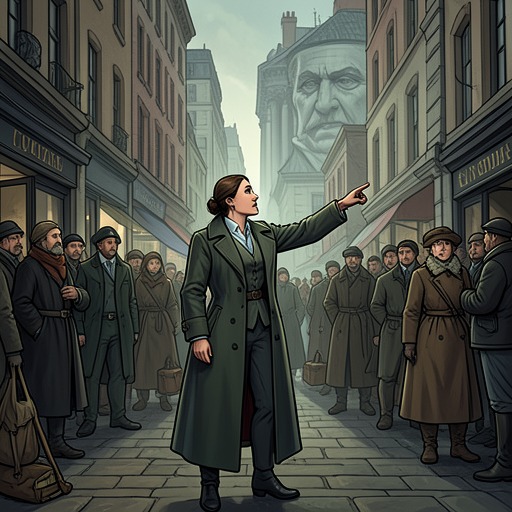
Victoria then appeared on platforms with anti-war socialists, including John Maclean, while quarrelling with her eldest son, Baxter McCandless, who supported the war effort from his desk in the Department of Imperial Statistics. Her political opposition to the war thus involved both a rupture with the Society and a painful conflict within her family. The novel does not supply a detailed account of the Fabian Society’s internal debates; it shows the split through Victoria’s refusal to accept what she regarded as inadequate opposition to the carnage.
Significance in the narrative
The Fabian Society links Victoria’s individual reforms to organized political life. Through it, the narrative connects her medical writing and suffrage activism with a reformist world that sought better wages, working conditions, housing, and political representation. Yet the later rupture prevents the Society from serving as a simple emblem of progress: in Victoria’s account, a movement committed to social improvement could still fail her when the stakes became war and the deaths of her sons.
The organization’s role is therefore defined less by institutional description than by changing association. It provides a venue for Victoria’s meetings and publishes her public-health argument; later, its response to war becomes the ground on which she parts company with it. That contrast makes the Fabian Society a measure of both the reach and the limits of gradual reform in her political life.