General Sir Aubrey de la Pole Blessington
Poor ThingsGeneral Sir Aubrey de la Pole Blessington is a celebrated soldier and politician whose carefully guarded authority collapses when he confronts his estranged wife, Bella Baxter. His military record and public standing contrast with his attempt to claim control over Bella’s identity and sexuality, while the story’s layered accounts leave his heroic reputation under question.
Identity and Public Reputation
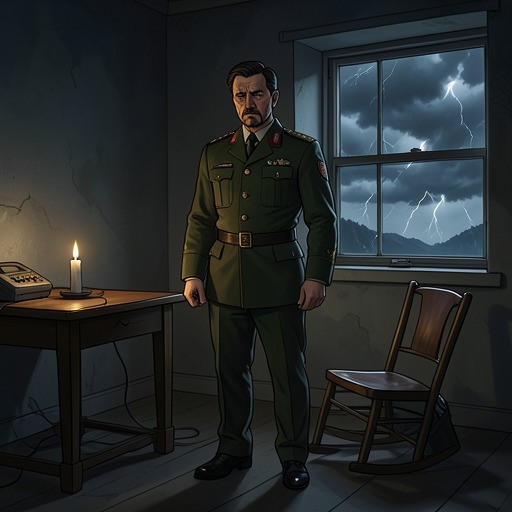
Known to newspaper readers as Thunderbolt Blessington, General Sir Aubrey de la Pole Blessington is a Liberal M.P. for Manchester North, a seat he has held since 1878. He is the thirteenth baronet in his line, and his biographical entry records a career spanning military command, colonial administration, and public office. Born in Simla in 1827, he was educated at Rugby, Heidelberg, and Sandhurst; his father was a general and governor of the Andaman and Nicobar Islands. He married Victoria Hattersley, daughter of Manchester locomotive manufacturer Blaydon Hattersley.
The record presents him as a soldier repeatedly wounded in campaigns and rewarded with decorations. It lists service on the eastern frontier of the Cape of Good Hope and in an expedition against the Swazanji, followed by the Crimean War, where he was wounded twice and received the Crimean War medal with three clasps, the Order of Medjidie, and the Turkish War Medal. During the Indian Mutiny he served with a pursuing column in central India and was present at several battles and assaults. He later served with the British expeditionary force to China, including its entry into Peking and the storming of the Summer Palace. His subsequent appointments included governorships of Norfolk Island, Patagonia, and Jamaica, command of a Burmese punitive expedition, service in the suppression of a revolt in northwestern Canada, and a post in the Ashanti War.
That official record sits beside a later decline in his historical standing. The narrator observes that newspapers once treated him as a figure comparable in popularity to Sir Garnet Wolseley and General Gordon, but later accounts reassigned his most important actions to unnamed officers. Although an 1883 edition of Who’s Who preserves an extensive biography, later editions omit him. His reputation thus appears both immense and precarious: the public celebrates the decorated commander, then allows his achievements to disappear from view.
Marriage and the Claim to Bella
General Sir Aubrey de la Pole Blessington married twenty-four-year-old Victoria Hattersley three years before his death. The marriage is obscured in public records: accounts of his funeral and obituaries do not mention his widow, and neither a legal separation nor her death is recorded. The later revelation that Bella Baxter was his wife makes this silence part of the mystery surrounding her past.
When he encounters Bella during her travels, a woman recognizes her as Lady Blessington, recalling a meeting at Cowes aboard the Prince of Wales’ yacht. Bella answers that most people call her Bell Baxter when she is not with Duncan Wedderburn. The exchange makes clear that Bella’s current name and the identity attached to her marriage do not align, though Bella herself does not acknowledge the past the stranger assumes she shares.
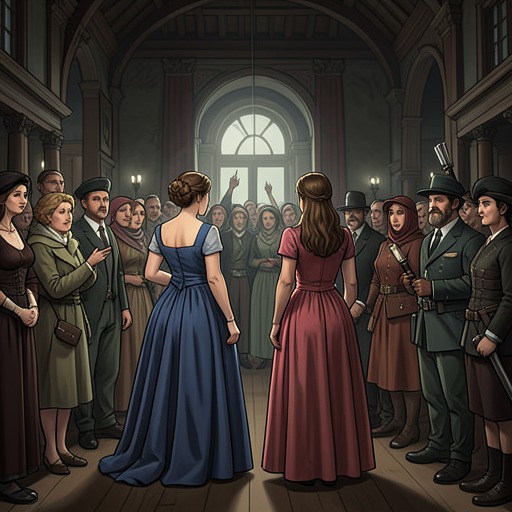
The General later arrives at a gathering with Blaydon Hattersley and declares that Bella is his lawfully wedded wife, Victoria Blessington, formerly Victoria Hattersley. Hattersley reaches toward her as his daughter, while the General insists on his claim as husband. Bella studies both men with interest but says she cannot remember either of them. Archibald McCandless understands the collision as a meeting of incompatible histories: Bella is unknowingly seeing the father associated with her brain and the grandfather associated with her body. Her lack of recognition does not settle the truth of her identity; instead, it makes the General’s demand that she remember and submit impossible to separate from the story’s account of her unusual origins.
Control, Sexuality, and Confrontation
The General frames Bella’s departure as a failure of wifely duty and her account of drowning, morgues, and memory loss as a fabricated excuse. He accuses her of living with Godwin Baxter and Duncan Wedderburn to satisfy what he calls an insane appetite for sex, then demands that she be released to him. His speech attempts to turn a disputed past into a prosecution: he claims the authority to define Bella’s memory, conduct, and marital obligations.
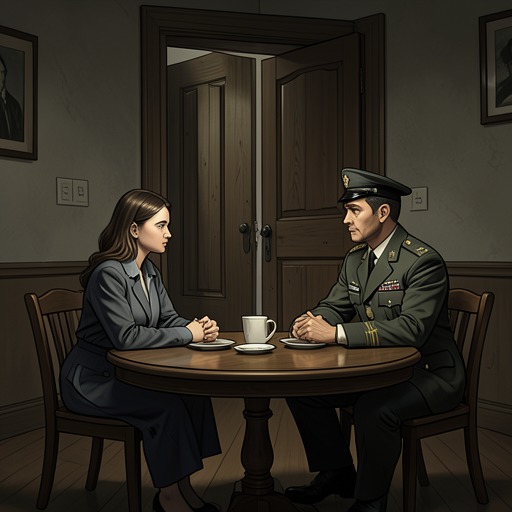
Dr. Prickett’s account gives that conflict a more specific history. Before the wedding, General Sir Aubrey de la Pole Blessington had asked him for scientific and hygienic advice about a husband’s sexual duties. Prickett says he recommended intercourse in limited doses and advised that amorous relations cease once pregnancy was detected. He describes Bella, then Lady Blessington, as wanting to share her husband’s bed every night, including during the eighth month of pregnancy, and says she cried when refused. Bella responds with tears and the simple judgment that the woman needed cuddling. The contrast is sharp: Prickett medicalizes and regulates desire, while Bella identifies an unmet need for affection. The General’s own account of marital propriety is further undermined by Bella’s later recollection of him as a masked customer in the Dungeon Suite of the Hôtel de Notre-Dame in Paris, where he had paid sex workers for encounters and had been known as Monsieur Spankybot.
The confrontation turns physical when the General takes a revolver from his pocket, points it at Godwin Baxter, and orders McCandless to sit down. He threatens to shoot Baxter in the groin if he moves and has chloroform ready for Bella. Prickett handles the bottle and cloth reluctantly. Bella is not chloroformed, but she loses consciousness; Baxter and McCandless attend to her, treating her wound with morphine, iodine, and gauze. Their attention to her takes precedence over the armed man trying to control the room.
When Bella regains consciousness, she recognizes the General from Paris and publicly mocks his sexual performance, his dealings with prostitutes, and his supposed purity as a husband. Her words break the hold his formal authority had exerted over the gathering. The General turns pale, staggers, and has to be helped toward the door by Prickett and Grimes. Hattersley follows in a dazed state, still rejecting Bella as his daughter. The scene does not produce reconciliation or a settled legal resolution; it exposes the violence and hypocrisy beneath the General’s claims.
Death and Narrative Significance
After the confrontation, Baxter expects the General to agree to a discreet legal separation, since a public divorce could damage the career of a woman doctor beginning work in Scotland. Bella and McCandless, he says, cannot marry while the General remains alive, so a private understanding would have to serve until his natural death. The expectation is overturned almost immediately: newspapers report that General Sir Aubrey de la Pole Blessington has been found dead on the floor of the gun-room at his country house, Hogsnorton, in the Loamshire Downs.
The revolver in his hand and the bullet’s path through his brain rule out an accident. The coroner concludes that he died while the balance of his mind was disturbed, allowing a Church of England burial but not a state funeral. The Times suggests political disappointment may have driven him to what it calls a Roman end, and implies that Gladstone was to blame. An earlier account dates his death to 27 December 1883 and likewise identifies it as suicide. These public explanations do not resolve the personal crisis that precedes his death; the reported political account sits uneasily beside his failed attempt to recover command over Bella.
General Sir Aubrey de la Pole Blessington is therefore presented through competing records: the decorated commander whose deeds are later credited to others, the husband omitted from accounts of his own funeral, and the armed man who cannot make Bella accept his version of her past. His authority depends on official titles, military honors, medical testimony, and marital law, yet each proves incomplete in the face of Bella’s memory, refusal, or inability to remember. The contrast between public commemoration and private conduct makes his downfall more than the end of a career: it reveals how the power to name a woman’s identity does not guarantee the power to command her.