General Sir Aubrey de la Pole Blessington—Dolly Perkins
Poor ThingsThe relationship between General Sir Aubrey de la Pole Blessington and Dolly Perkins is presented as a secret sexual affair that ends in her abandonment when she is pregnant and penniless. Its significance lies not only in the General’s conduct but in the way the episode makes private exploitation visible: Dolly’s case reaches his household, where his wife is ready to help, and the General uses servants to remove her. The account is delivered to the General by Godwin Baxter, while Bella Baxter’s response exposes the moral contrast between his treatment of Dolly and his condemnation of his wife’s desire for affection.
The affair and its arrangement
Dolly was sixteen and employed as the General’s parlour-maid until the day before his wedding. According to Godwin Baxter’s account, on that day the General arranged an apartment for her in a boarding-house near Seven Dials, concealing his identity from the landlady, Mrs. Gladys Moon. She recognized him from his pictures in the Illustrated London News. The arrangement placed Dolly outside the household while allowing the General to continue visiting her without publicly acknowledging their connection.
Mrs. Moon reportedly saw the General visit Dolly every Tuesday afternoon for two hours, and on Fridays when he paid the rent. The visits continued for four months. The regularity matters: this was not described as a single encounter but as an ongoing arrangement in which the General controlled the accommodation and its cost. He then told Mrs. Moon that he would not return, described Dolly as a threat to his household’s reputation, and demanded that she be removed. Mrs. Moon spoke with Dolly, who admitted that she was penniless and pregnant; the landlady then told her to leave.
Competing accounts and the General’s defence
The General denies that he fathered Dolly’s child. He insists that his sexual encounters with her could not have caused a pregnancy, and claims that she tried to blackmail him by threatening to tell his wife he was the father unless he paid her. His account casts Dolly as manipulative and presents his refusal to help as a response to extortion. The report, by contrast, records that she had no money and was pregnant when she was turned out. It does not independently settle the question of paternity or confirm the General’s allegation, leaving his self-defence beside the reported sequence of visits, pregnancy, and eviction.
Bella challenges the moral logic beneath his defence. She contrasts the hours he spent with Dolly with his limited willingness to warm his wife through affection, and asks whether he could sincerely regard his wife as mad for wanting more closeness from him. The General rejects Bella’s suggestion that he hugged Dolly. His insistence on that distinction does not answer the broader charge: his conduct toward Dolly and his treatment of his wife are both being judged against his claim to uphold the sanctity of marriage.
Dr. Prickett gives voice to the social double standard in a stammering explanation of the General’s position. In his account, powerful men are expected to satisfy their animal nature with women outside marriage while preserving the purity of the marital home. The speech falters when it reaches Dolly’s treatment, registering the strain between that justification and the harm it attempts to excuse. The General tells the doctor not to cry and maintains that he has done nothing of which he is ashamed.
Dolly’s appeal at the household
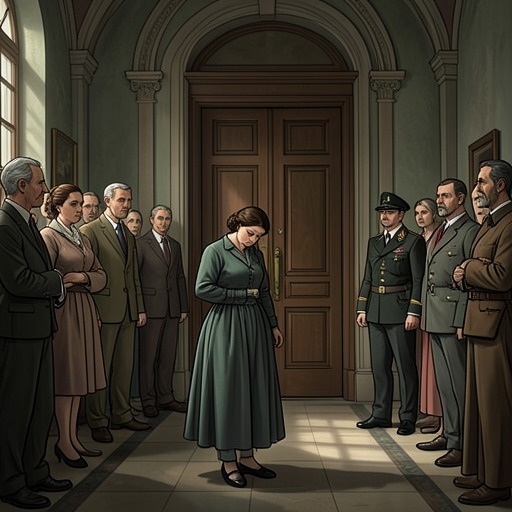
Godwin Baxter’s account then moves to 16 February 1880. Dolly entered 19 Porchester Terrace through the servants’ entrance, exhausted, ragged, penniless, and hungry. The cook, Mrs. Blount, gave her tea, food, and a chair before returning to work. When Mrs. Blount noticed that the chair was empty, Dolly had gone upstairs to the drawing-room, where she confronted Lady Blessington and told her story. Lady Blessington was about to give her money when the General entered.
The General called in his footmen, who thrust Dolly into the street. With the help of his manservant, he took his wife upstairs; he corrects Baxter’s description of this as dragging, saying that she had fainted and was carried. Once Lady Blessington recovered, the General locked her in her bedroom. She responded by throwing a purse and jewellery from the window toward Dolly, followed by every small valuable within reach. A crowd of poorer people had gathered outside despite the snow. Dolly’s appeal thus brings the private arrangement into public view, while the objects thrown from the window turn the household’s resources into an attempted act of aid.
Narrative significance
The episode reaches the reader as a report Baxter summarizes to the General, not as a direct account from Dolly. Baxter addresses the General rather than Bella, even though the story changes Bella’s expression and bearing. That arrangement places the General’s rebuttals alongside Baxter’s account and makes the contest over whose version will be heard part of the scene. Dolly’s own statements are relayed through others; the reader encounters her through Mrs. Moon’s report, the household’s account, and the General’s accusations.
Bella nevertheless gives Dolly’s situation a clear place in the moral argument. Her comparison connects the General’s hidden visits to Dolly with his public judgment of his wife, while Dr. Prickett’s explanation reveals the gendered rule by which male sexual appetite is excused and women bear its consequences. The account ends, in the supplied passage, with the crowd gathered and Lady Blessington throwing valuables down to Dolly. The relationship’s consequences have moved beyond secrecy: Dolly is abandoned, the General’s household is divided, and his conduct is being examined in front of Bella and a solicitor.