Godwin Baxter—Sir Colin Baxter father-son relationship
Poor ThingsThe father-son relationship between Godwin Baxter and Sir Colin Baxter was built around medicine: Sir Colin gave his son an unusual education in anatomy and physiology, taught him to understand his own body, and made him his closest assistant. That intimacy did not amount to an ordinary family life. Godwin grew up without a mother, siblings, or other children around him, and learned only late what mothers did. Sir Colin’s care gave him knowledge and material security, but also made scientific observation the principal language through which father and son related.
Family Background and Uncertain Origins
Godwin was Sir Colin’s only son. His father was a celebrated surgeon and the first medical man to be knighted by Queen Victoria. Although their appearances were sharply contrasted, Godwin inherited Sir Colin’s surname, received a private education, and was left a small fortune. The account of his birth was less settled. Hospital gossip claimed that Sir Colin had fathered him late in life by a domestic servant; stories about Godwin’s mother variously placed her in an asylum or imagined her serving silently in Sir Colin’s household. These claims were hearsay, not a confirmed family history.
Godwin later gave a more specific account of his origins. He said that Sir Colin had trained a nurse as an anaesthetist and worked closely with her; she died after Godwin was born. Godwin had no memory of her, and nothing she owned remained in the family houses. Sir Colin spoke of her only once during Godwin’s adolescence, describing her as exceptionally intelligent and teachable. Godwin understood that his father had been drawn to her abilities rather than to female beauty. The contrast between this personal account and the surrounding rumors leaves his mother’s life largely absent from the narrative, even as her work and death define the beginning of his own.
An Education in the Body
Sir Colin educated Godwin at home and limited instruction to subjects that interested him. He was a severe rationalist: poetry, fiction, history, philosophy, and the Bible were excluded as unprovable. Godwin therefore encountered neither a broad literary education nor the everyday presence of other families. He had no siblings and did not play with other children; he was twelve before he understood what mothers did, having assumed that they were a lesser kind of nurse specializing in small people.
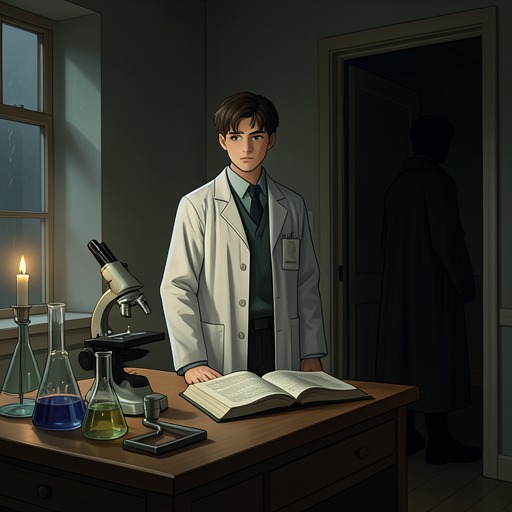
His formal lessons were mathematics, anatomy, and chemistry. Medical observation also governed the household routine. Each morning and evening, Sir Colin recorded Godwin’s temperature and pulse, collected blood and urine samples, and analyzed them. By six, Godwin was performing these procedures himself. A chemical imbalance meant that his system required alternating doses of iodine and sugar, whose effects he had to monitor with precision. The routine made his body both the object of paternal care and an early field of scientific practice.
When Godwin asked where he came from, Sir Colin answered with diagrams, models, and pathological specimens, using them to teach him how he had been made. Godwin remembered enjoying these lessons. They helped him admire his internal organization and preserve his self-respect after he learned how others reacted to his appearance. In place of a family story rooted in his mother or a religious account of creation, his father offered anatomical explanation. The lesson supplied an understanding of his body, though not a wider knowledge of kinship or social life.
Care, Affection, and Isolation
Godwin did not describe his childhood as cruel. He considered himself adequately loved, but said that the warmth and affection he needed came from Sir Colin’s dogs, of which his father kept several. This recollection complicates the picture of a household organized around measurement: Godwin’s account allows for affection, while showing that animals supplied a form of companionship missing from contact with other children and families.
Sir Colin’s influence also continued through his professional standing. Godwin entered medical study after his father’s death, carrying the advantage of a famous name, private education, and money. At the same time, the habits and limits of his upbringing remained visible: Godwin’s scientific interests were closely tied to his father’s work, and his knowledge of human bodies did not spare him the social isolation created by his appearance and voice.
Inheritance and Medical Work
Godwin described his own research as a refinement of Sir Colin’s techniques. The answer pointed back to the father’s authority, but also revealed an important tension: Godwin’s work remained defined by an inheritance whose full nature he did not explain at first. In his student years he was regarded as a brilliant student outside hospital practice. His unusual appearance and voice frightened patients and offended staff, and he did not graduate; instead, he continued as a research assistant. His famous father helped secure him unusual latitude, since he paid his fees, inconvenienced few people, and attracted little scrutiny.
The inheritance was not only institutional. Godwin said he had been Sir Colin’s most trusted helper and had learned through practice what many lecturers taught as theory. Yet their shared medical world had sharply restricted his contact with patients: in Sir Colin’s operating theatre, Godwin touched only anaesthetized people. Later, surgeons valued his assistance in emergencies involving celebrated patients, in part because his hands and head seemed less disfiguring to the public than theirs. The distinction is stark: Sir Colin had trained and trusted him, but the work available to Godwin often kept him out of sight or denied patients the choice to meet him.
The Father’s Legacy
Godwin’s professional disappointments expose the double edge of Sir Colin’s legacy. He had imagined becoming a kindly, popular healer, but his position in the medical world did not bring the admiring human response he hoped for. His father’s training made him technically capable and deeply knowledgeable; it could not overcome the restrictions that kept him from ordinary practice. Godwin recalled that only unconscious or very poor patients were permitted to be touched by him, and that assistance to surgeons operating on public figures was valued partly because those patients never saw him.
Even so, Godwin did not end his account of his life with a simple indictment of his father. He said he had nothing to complain about in the present, and connected his happiness to Bella Baxter’s smile. That remark shifts the measure of his life away from Sir Colin’s standards of surgical knowledge and professional authority. His father gave him the means to understand the body and a lasting medical inheritance; the later prospect of being welcomed by another person offered a different kind of recognition, one that the father-son bond and its clinical routines had not supplied.