Love, Desire, and Idealization
Poor ThingsLove, desire, and idealization in Poor Things are not simply private feelings: they shape how characters imagine intimacy, misread one another, and negotiate dependence. Godwin Baxter’s youthful fantasy of reciprocal admiration is answered, but not fulfilled in the way he once imagined, by Bella Baxter’s affection; Archibald McCandless’s devotion turns her into an ideal, while Duncan Wedderburn’s account of their journey exposes the gap between his romantic self-image and his helplessness.
The Ideal of Reciprocal Love
Godwin Baxter traces his longing for love to a childhood sense of emotional absence. Although Sir Colin Baxter, the nurses, and the household dogs gave him attention, he says that he wanted more than care: he imagined a stranger who would need and admire him as much as he needed and admired her. He remembers a persistent inner emptiness, which he describes as woman-shaped, and says that it intensified with puberty. His account makes desire less a simple appetite than a wish for recognition from a particular person.
The imagined beloved takes form in Ophelia, whose image Godwin finds in Lamb’s Tales from Shakespeare. He is captivated not just by her appearance but by the expression that seems to promise loving wonder. In his fantasy, Ophelia recognizes the future healer he hopes to become. He recasts the tragedy around her as a public-health crisis: a Scottish doctor could isolate the carriers of the disease, improve the water supply and plumbing, and save her. The fantasy joins romantic rescue to professional ambition, making love depend on the imagined admiration of someone whose needs he can meet.
A paid sexual encounter arranged by Sir Colin could not answer that longing, Godwin explains, because it would be an arrangement imposed by his father rather than a bond formed through mutual need. He describes a desire in which bodily excitement and prolonged mental stimulation are inseparable. The distinction exposes the limits of treating sex as a service or mechanical satisfaction: what he seeks is the beloved’s expression of admiration, not simply access to a body.
Recognition and the Engagement
Godwin’s longing for an admiring beloved is altered by the life he builds with Bella. He recalls that, as a medical student and trusted assistant to Sir Colin, he was exceptionally able, but the patients he touched were anaesthetized or too poor to refuse treatment. Surgeons valued his help in emergencies, yet their celebrity patients never saw him. The work could confirm his skill without giving him the loving recognition he had imagined. Bella’s response to his body changes that pattern: from the moment she opens her eyes, his hands bring her food, drink, sweets, flowers, toys, and picture-books. He initially has the servants wear black woollen mittens while washing and dressing her, then recognizes that the precaution is unnecessary. To Bella, his hands are ordinary and necessary parts of their shared life; a stranger’s hands, by contrast, still excite her. Her acceptance does not reproduce his fantasy of a woman who needs and admires him as a future healer, but it gives their attachment a practical intimacy grounded in care.
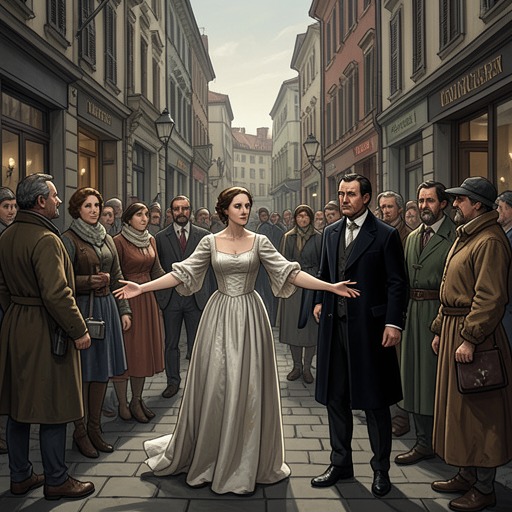
When Bella announces that she will marry Archibald McCandless, Godwin experiences the decision as a threatened loss. He says that he has lived with and for her for nearly three years and had hoped this would never end; her romances on their world tour had seemed bearable because he believed they would pass. Bella answers that she is not abandoning him: she and Archibald are poor and can continue living with Godwin, turn his father’s old operating theatre into a drawing-room, and share meals with him. Her reassurance is affectionate, but it also marks a boundary. She says that she is romantic and wants sex, but not from Godwin, because he cannot stop treating her like a child, while she cannot treat him as one. Marriage to Archibald offers a relationship in which she can act on her desire and, as she puts it, treat her husband as she chooses.
Archibald acknowledges that Bella describes his feelings accurately. Though he has tried to be dour and independent, he says that he has worshipped and longed for her since Godwin introduced them, seeing in her the acme of womanly perfection and wishing to spare her even the smallest inconvenience. His devotion is therefore both care and idealization: he offers himself as wholly available to her, while the perfection he sees in her exceeds any ordinary, reciprocal courtship. Bella distinguishes their physical relationship from her bond with Godwin by likening Archibald’s kisses to the force of Godwin’s yells, an image that makes the two men’s forms of intimacy sharply different. Godwin does not refuse the marriage; he promises to help them do what they want, but asks that they not see each other for a fortnight so he can prepare himself for losing Bella. His plea exposes the cost of the arrangement he has just accepted: Bella intends to keep him close, but he fears that marriage will change the terms of their shared life.
Desire, Dependence, and the Journey
Duncan Wedderburn’s account of his affair with Bella turns romantic pursuit into a story of physical dependence. Before leaving London, he anticipates that their days together might leave him too exhausted to desire her at night. He tries to make that happen by driving Bella through trains, riverboats, cabs, hotels, theatres, museums, racecourses, and casinos, covering four countries in a week. The plan fails: she enjoys the pace, and he repeatedly falls asleep only to wake and find himself making love to her. His account presents desire as a force that defeats his attempts to manage it, even as he casts himself as the one directing their travels.
The reversal becomes literal in Venice, where Duncan collapses and rolls down the steps of San Giorgio Maggiore into the lagoon. After he thinks he is drowning, he wakes in bed beside Bella, seasick aboard a Mediterranean ship. She declares herself his doctor and orders him to rest, except when they are together. From then until he escapes, he describes himself as her helpless plaything; lying prone during the day is what gradually restores some of his strength. The episode overturns the confident role of lover and adventurer: Bella controls the pace, while Duncan’s body registers the cost.
Even in this state, Duncan reads Bella’s care as evidence of kindness and remains emotionally dependent on her. When she raises his head to feed him, he says that tears of gratitude roll down his cheeks. At ports, she guides him into British banks, explains that he is unwell, and steers his hand as he signs cheques or money orders. Their passage down the Bosphorus, lying side by side and holding hands, gives his account a tender image of intimacy, but it sits beside his dependence on her for food, movement, and financial transactions. Bella praises his sexual prowess in extravagant terms; Duncan, still weakened, continues to beg her to marry him. His own narrative thus reveals the gap between the idealized romance he clings to and the unequal, bodily reality of their journey, a gap that even the events in Gibraltar have not yet made him recognize.
Narrative Irony and Idealization
The theme emerges through accounts that expose more than their speakers intend. Godwin Baxter recounts his youthful longing with the measured precision of a doctor, translating romantic fantasy into medical and public-health terms; that precision cannot make his imagined Ophelia reciprocal, and his later attachment to Bella meets a boundary he must accept. Duncan Wedderburn, by contrast, narrates his journey in extravagant declarations of devotion and self-mockery, yet the practical details he supplies—being fed, guided through banks, and left too weak to do more than lie prone—undercut his pose as the lover in control. The contrast makes idealization not merely a mistaken view of another person but a revealing form of self-description: each man’s account gives Bella a role in his own emotional story, while her stated desires and choices repeatedly exceed that role.