Malthusianism
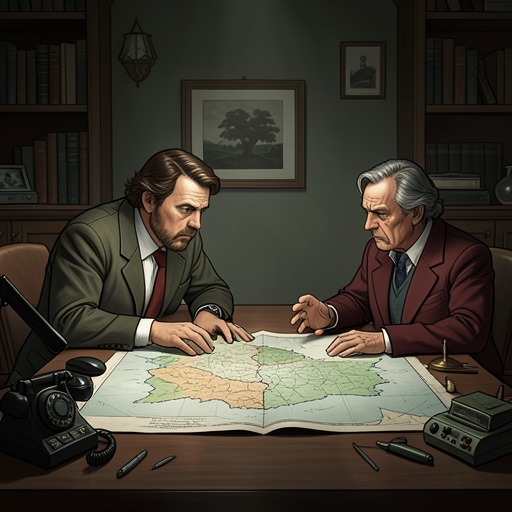
Poor ThingsMalthusianism in Poor Things is less a detached economic theory than a hard-edged creed voiced by Harry Astley: the poor cannot be helped without making their numbers grow, and the suffering that follows is treated as a grim necessity. Through Astley’s arguments and Bella Baxter’s resistance, the novel tests the consequences of accepting that logic. Poverty appears not as a natural balance to be endured, but as a social arrangement defended by arguments that make the suffering of the vulnerable seem unavoidable.
Astley’s faith
Harry Astley calls himself a Malthusiast and describes his position as a new faith rather than a religion. As he distinguishes it, religion has congregations, preachers, prayers, hymns, buildings, codes, or rituals; his Malthusian faith requires none of them. Its force lies instead in a claim about how society works. Astley presents the writings of Malthus, Darwin, and Winwood Reade as evidence for his bleak account, lending the doctrine the authority of a general explanation of life rather than the form of a church or political programme.
That distinction also sharpens the novel’s irony. Astley rejects conventional religious belief, yet speaks of Malthus in the language of a gospel. The faith has no formal congregation, but it does offer a way to interpret every apparent effort at reform: feeding the poor, he argues, only increases their numbers and therefore cannot remove poverty. What looks like compassion becomes, in this scheme, an intervention that worsens the problem. His reasoning turns pessimism into a comprehensive account of social life, one that can excuse inaction by presenting it as knowledge.
Poverty, population, and social policy
Astley’s most consequential argument concerns unemployment after the Napoleonic Wars. He recalls that the end of the war left many people unemployed and hungry, alarming the government enough to convene a parliamentary committee. Robert Owen proposed that businesses earning profits above five per cent use the surplus to improve workers’ food, housing, and schooling rather than undercut competitors. Astley then counters that Malthusians had shown that better feeding would make the poor reproduce more. Within his account, poverty, hunger, and disease do not merely accompany political unrest: they weaken the desperately poor and reduce their numbers, making revolution less likely.
He connects that logic to the institutions used to contain poverty. Astley names military barracks beside industrial cities, a strong police force, large new jails, and poorhouses where children are separated from parents and husbands from wives. He describes the poorhouses as deliberately grim enough that people with some self-respect might spend their last money on cheap gin and die outdoors rather than enter them. His argument is not that these conditions are humane; their severity is part of the point. He presents coercion, destitution, and institutional confinement as mechanisms through which an industrial society preserves its order while leaving the poor hungry and vulnerable.
The story gives this reasoning a further historical dimension. Astley argues that industrial growth benefited from the economic consequences of war: heavier taxes oppressed the poor, while government purchasing created demand for uniforms, boots, guns, and shipping. Factory growth, cheap labour by women and children, and increased profits then supported investment in transport, warships, and empire. This history belongs to Astley’s wider case that apparent national progress can rest on exploitation. His Malthusian outlook therefore sits alongside an account of political economy in which poverty is not an accidental blemish on prosperity but part of the system that produces and protects it.
The doctrine in everyday life
Astley extends his social criticism beyond population and unemployment. In his account of education, poor children learn to beg, lie, and steal as means of survival, while prosperous parents teach children moral rules and then send them to schools that reward concealment and admiration for conquerors. He links this education to a society where the rich use legislation to take homes and livelihoods from the poor, profit from stock-market gambling, and enjoy leisure while others labour. The argument echoes his Malthusian attack on explanations that treat deprivation as the fault of those who endure it: institutions shape conduct, then conventional morality obscures that shaping.
His discussion of women’s lives likewise places class and bodily experience within a structure of unequal power. Astley describes wealthy wives as ornaments and sources of private pleasure whose children are cared for by servants, while women in weaving sheds suffer a different form of confinement through exhausting labour. These are not identical conditions, but his comparison insists that privilege does not necessarily give women control over their lives. The novel’s attention to pregnancy, medical treatment, and women’s work makes reproductive questions part of its account of social conditions, rather than an issue that can be separated from class or access to care.
This wider critique should not be mistaken for a simple endorsement of Astley’s conclusions. His analysis can expose the cruelties hidden by comfortable moral language, but he uses it to argue that cruelty will never end because the healthy live by trampling the weak. Bella rejects that conclusion. She hears his account because she needs to understand the facts he possesses, yet refuses to accept that knowledge of suffering obliges her to become cynical. Her resistance distinguishes diagnosis from surrender: recognizing how a system works does not prove that people must continue to live by its rules.
Bella’s resistance and reproductive choice
The disagreement becomes explicit when Astley predicts that Bella will turn into a modern half-baked optimist who wants to abolish both wealth and poverty by sharing the world’s goods equally. Bella calls that proposal common sense. The exchange places her between Astley’s cynicism and the complacent optimism he condemns. She has learned that social suffering is real, but she does not accept his argument that reform is impossible. Malthusianism thus becomes a personal and ethical conflict as much as an explanation of population: it tests whether awareness of structural injustice leads to resignation or action.
Bella’s later medical ambitions give that opposition practical form. She wants to help girls, mothers, and prostitutes, and intends to teach women effective contraceptive methods. Godwin Baxter advises her to keep that intention private until she can practise medicine, while leaving the timing of any public advocacy to her. Her plans place reproductive knowledge in the hands of women who need it and counter a framework that treats poor people’s fertility as a reason to deny them resources. The novel does not present this work as a complete answer to poverty; it shows instead that care, education, and bodily autonomy can be pursued without accepting the claim that helping people must make their lives worse.
The later reception of Bella’s book, A Loving Economy, reveals the continuing conflict around those ideas. Clergymen denounce its birth-control proposals, while advocates of birth control object to its criticism of commercial contraceptives as unhealthy. Speaking as Dr. Victoria, Bella argues that such products focus users on the genitals and distract from affection; she presents cuddling as nourishment throughout life and marriage as one form of intimacy rather than a separate, rare commodity. The response shows that reproductive politics is not reducible to a single division between supporters and opponents of birth control. Bella challenges both religious condemnation and the commercial framing of sexual life, extending the novel’s concern from whether people should have children to the conditions and forms of intimacy through which life is lived.
Narrative significance
Malthusianism gives Astley a powerful explanatory vocabulary, but the story keeps that vocabulary attached to a speaker whose certainty is contested. His argument identifies real links between hunger, labour, institutions, and political power; its danger lies in turning those observations into a justification for treating suffering as permanent. Bella’s refusal to accept that conclusion prevents his pessimism from becoming the novel’s final word. The doctrine matters not only because it describes a social order, but because it offers a choice about how to respond to that order: defend its cruelties as unavoidable, or use knowledge of them to imagine and practise forms of care.