Rabbits
Poor ThingsRabbits in Poor Things occupy an uneasy space between household companions and experimental subjects. Their appearances range from quiet domestic scenes to the unnerving spectacle of bodies deliberately altered by Godwin Baxter. Through Mopsy and Flopsy in particular, the rabbits make visible both Baxter’s extraordinary technical power and the moral cost of exercising it on living creatures.
Identity and Appearance
Rabbits live in the garden behind Godwin Baxter’s tall, gloomy house in Park Circus. The garden is enclosed by high walls and divided between a paved area with a wooden dovecot and pigeon loft, vegetable plots, and a small lawn ringed by a low fence. Hutches stand on the lawn, where rabbits graze. When Archibald McCandless visits, Godwin invites him across the fence to examine two animals. They are tame enough to be lifted and handled: Godwin cradles one and strokes it on his sleeve while McCandless inspects the other.
The first rabbit’s coat is divided into black and white with an unnaturally straight boundary at the waist; the second has the inverse pattern. McCandless initially considers whether either might be a natural freak, but the symmetry between them makes that explanation untenable. On closer examination, the differences prove to be more than markings. One animal has male genitals and female nipples; the other has female genitals and scarcely perceptible nipples. Beneath the line where the fur changes colour, one body narrows slightly and the other expands. Their appearance points to deliberate intervention: the rabbits are not simply unusual animals but bodies reshaped by an experiment.
Baxter’s Experiment and Its Cost
Godwin explains that Mopsy and Flopsy had been ordinary, happy rabbits before he put them to sleep. They woke with their bodies changed. He describes the experiment not as a triumph but as something shabby: the two animals are no longer interested in procreation, an activity they had previously enjoyed. He tells McCandless that he intends to put them back together as they were the following day. The promise establishes that the transformation is, in his account, reversible; the available episodes do not confirm whether or when he carries out the restoration.
The rabbits expose a contradiction in Godwin’s scientific identity. His hands can produce changes that seem to McCandless almost beyond belief, yet Godwin himself presents the work as a violation of the animals’ former lives, not an uncomplicated achievement. Their tameness intensifies that tension. They do not resist or explain what has happened to them, while the people around them inspect, interpret, and handle their altered bodies. McCandless responds by setting down the rabbit carefully, regarding it as precious and looking at Godwin with awe and pity. The scene makes the animal’s vulnerability part of the encounter with scientific power, rather than treating the experiment as a merely clever display.
Animals in the Household and Bella’s Work
Rabbits belong to a busy domestic world at 18 Park Circus. When McCandless first enters the drawing room, he sees two rabbits drinking milk from a saucer in the room beyond, near Godwin’s housekeeper and her grandson. One is pure black and the other pure white. The detail recalls the strikingly divided coats of Mopsy and Flopsy, but McCandless checks himself from drawing a fantastic conclusion. In a house crowded with dogs, cats, specimens, toys, instruments, flowers, and books, the rabbits are at once part of ordinary household life and a reminder of Godwin’s unsettling work with animal bodies.
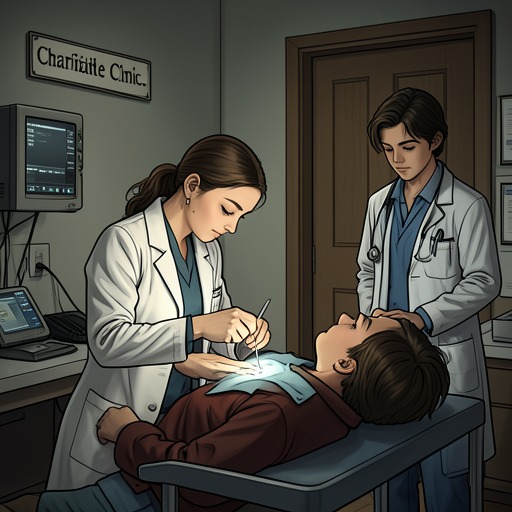
Godwin later tells McCandless that, after returning from abroad, he started a small veterinary clinic because he expected Bella Baxter to need more than toys to occupy her. He offered free treatment to sick animals brought to the back door. Bella served as receptionist and assistant, welcomed strangers, and helped mend the patients; Godwin taught her to stitch wounds, and he describes her as a fine clinician in both roles. This account makes the rabbits part of a wider pattern of animal care in the household. The animals are not only objects of experimentation: sick creatures receive treatment without charge, and Bella acquires practical medical skill by helping them.
Rabbits in Bella’s Imagination
Bella’s idea of God, as she recounts it to Dr. Hooker and Harry Astley, includes everything from everyday objects and bodily processes to animals and their surroundings. She names her white rabbit Flopsy and the hutch it lives in among the things that make up the whole. In her account, movement is what keeps the whole stirring and producing new forms. Her example of life’s transformations ranges from dead dogs becoming maggots and daisies to the growth of a baby from reproductive cells. The rabbit is thus part of an expansive picture of interdependence, not an isolated emblem: Flopsy and the hutch belong to the same world of material things and processes.
During her travels with Duncan Wedderburn, Bella recalls waking to the sound of wind in a eucalyptus tree. For a time she imagines the familiar household morning: rain refreshing the lettuces for Mopsy and Flopsy, breakfast at home, and a visit to the hospital to mend sick animals. The peaceful domestic scene persists in her mind even after she recognizes that she is away from home. Remembered rabbits help give that imagined morning its particular texture, linking the animals to routine, food, and the work of caring for other creatures. The passage also sets the rabbits’ home garden and clinic against Bella’s life on the road without suggesting that her longing is simply for the animals alone.
In a postscript to a letter, Bella asks that the cats and dogs be stroked and patted and that Mopsy and Flopsy be kissed for her. The request extends her affection across distance through small acts of care. Across the novel, the rabbits therefore remain more than specimens in Godwin’s house: Mopsy and Flopsy bear the physical consequences of his experiment, while Bella’s memories and messages place them within a network of domestic attachment and humane attention.