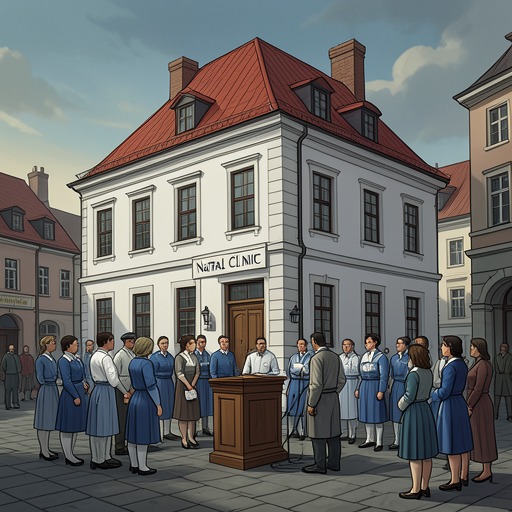
The removal of Victoria from the Natal Clinic
Poor ThingsThe removal of Victoria from the Natal Clinic in 1920 ended her leadership of the institution she had helped establish, but not the work itself. After a campaign of hostile publicity weakened the clinic’s managing committee, it dismissed her and transferred the clinic to Oakbank Hospital; Victoria then continued a reduced version of the service in the basement of her home.
Background and institutional purpose
Victoria and Archibald McCandless opened the Godwin Baxter Natal Clinic in 1890, placing all of Godwin Baxter’s money into its supporting fund. Its original managing committee included Sir Patrick Geddes and Principal John Caird of Glasgow University. The transfer two decades later therefore involved more than a change of employer: the institution’s founding resources and governance gave way as its leadership capitulated to public pressure.
The clinic’s medical outlook was shaped by Godwin Baxter’s criticism of established practice. He condemned public hospitals as places where doctors practised on poor patients while wealthier patients obtained private treatment, and he praised Sir Colin Baxter for sterilizing instruments and operating theatres when aseptic medicine was still being ignored or denounced. Baxter also argued that nursing was central to healing and that medical training should begin with practical work. These views supplied a wider context for a clinic whose work Victoria would continue even after the institution itself passed out of her control.
Publicity and the unresolved verdict
The pressure on the clinic followed controversy over Victoria’s book, A Loving Economy. Church leaders denounced its proposals on birth control, while the book also angered birth-control advocates by criticizing commercial contraceptives as unhealthy. Victoria advertised it in major British newspapers, but it received only two favourable notices, one from Guy Aldred in an anarchist periodical and another in The New Age by Eric Gill.
Beaverbrook took a hint from the churches and used a campaign in the Daily Express to enlarge the paper’s circulation while attacking Victoria and her work. One article represented her teaching as a threat to boys and parents. The publicity formed the immediate climate in which the clinic’s committee later yielded to the storm of adverse coverage; the account does not describe a change in Victoria’s medical practice as the reason for her dismissal.
The campaign also came after Victoria’s prosecution. A Scottish jury returned a verdict of not proven: she was not struck off the British medical register, but she was not declared guiltless either. That equivocal outcome left her legally registered without giving her the clear vindication that might have protected the clinic from the subsequent publicity campaign.
The transfer in 1920
By 1920, the clinic’s original committee members had been replaced by people described as weaker, who bowed before the unfriendly publicity. They sacked Victoria and gave the clinic to Oakbank Hospital as an out-patients department. The change shifted the institution from the control of its founder and her colleagues into a hospital department, while ending Victoria’s formal position there.
The removal was compounded by Victoria’s financial circumstances. She had spent her savings printing, distributing, and advertising A Loving Economy, leaving 18 Park Circus as her only remaining property. The clinic’s transfer therefore coincided with the exhaustion of the resources she had put into public advocacy and institutional work.
Continuation at 18 Park Circus
Victoria did not abandon the clinic’s work when the committee dismissed her. By then all of Godwin Baxter’s old servants were dead. She let the upper rooms of 18 Park Circus to university students and withdrew to the basement, where she continued to operate on a much smaller scale.
She still called this reduced operation the Godwin Baxter Natal Clinic. The name preserved the founding institution’s identity even as its former committee, funding arrangements, and formal place within the hospital system had disappeared. Her continuation in the basement makes the removal a reversal rather than a complete closure: Victoria lost the clinic as an institution but retained a limited setting in which to carry on its work.
Significance
The episode sets institutional vulnerability against personal persistence. The committee’s decision shows how hostile publicity could redirect a medical institution even after a Scottish jury had returned a verdict that did not remove Victoria from the register. Yet the ending is not simply her expulsion: with her savings spent and the clinic transferred, she continued the service from the only property she had left. The movement from a funded institution to a basement practice measures both the force of the campaign and the limits it imposed on her work.