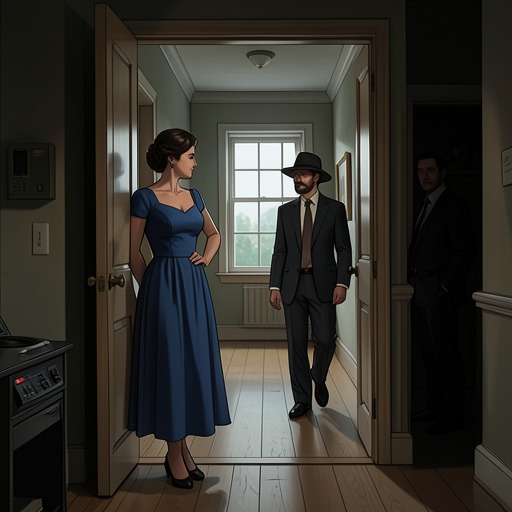
Victoria Blessington's diagnosis of erotomania
Poor ThingsVictoria Blessington’s diagnosis of erotomania becomes the focus of a confrontation over who has authority to name a woman’s desire. Dr. Prickett identifies the illness, but his account turns Victoria’s wish for physical closeness with her husband into evidence of disorder; Godwin Baxter questions the beliefs that make such a judgment seem medical, while Bella Baxter responds with sympathy for the woman the diagnosis describes.
Naming the Illness
The diagnosis is spoken aloud only after Bella warns General Sir Aubrey de la Pole Blessington that hints will not suffice: his doctor has whispered the suspected name that morning in church, and, unless it is stated plainly, the matter will be discussed before a Scottish jury. The General tells Dr. Prickett to say it, and the doctor mutters that the illness is erotomania. The name therefore arrives not as a private clinical finding but as an assertion made under the pressure of possible public scrutiny.
When Bella asks what the diagnosis means, Godwin Baxter gives her a pointedly simple explanation: the General believes she loved him too much. Dr. Prickett’s fuller account specifies what he regards as excessive. He says Victoria wanted to sleep in her husband’s bedroom and share his bed every night. He further claims that, during her eighth month of pregnancy, she still wanted to lie with the General all night and sobbed and wailed when he refused. These details establish the conduct that the doctor interprets as illness; they do not, by themselves, settle whether his interpretation is sound.
Medical Authority and Marital Duty
Dr. Prickett presents his advice to the General as scientific and hygienic instruction given before the wedding. He says that he described a husband’s duties and warned that excessive sexual intercourse enfeebles body and brain, while rationally limited intercourse is beneficial. In his account, the husband should allow half an hour of intimacy nightly during the honeymoon and once or twice weekly thereafter, ending amorous contact when pregnancy is detected. This schedule makes the doctor’s view of Victoria’s desire legible as a breach of regulated marital conduct.
The account also exposes a sharp contradiction in that regulation. Dr. Prickett calls Victoria deranged for wanting continued intimacy while pregnant, but his own rules give the doctor and husband authority to define the acceptable frequency and timing of sex. When the General describes female touch as arousing uncontrollable, diabolical lust in men, Bella answers that she thinks she could break him over her knee if he treated her roughly. Her reply refuses the image of women as the dangerous, helpless cause of male appetite. Bella’s tears at the report of Victoria’s distress lead her to describe the need beneath it as a need for cuddling, not as proof of moral or sexual excess.
The Disputed Meaning of Desire
Dr. Prickett broadens his case into a claim about women generally: he says no normal, healthy, good, or sane woman wants sexual contact for pleasure, and he invokes Lucretius and De Rerum Natura to characterize women who move their hips as debauched. He then limits his claim to refined and respectable women, implicitly excluding the vulgar mass from the standard he presents as normal. Godwin Baxter rejects this creed as false both to nature and to human experience. He traces it to Athenian homosexuals who regarded women as existing to produce men, and to celibate Christian priests who treated sexual pleasure as the origin of sin and women as its source. He speculates that the increased size and number of boys’ boarding schools may have helped produce a professional class unfamiliar with women’s reality.
That argument changes the status of the diagnosis without disproving every detail in the doctor’s story. The scene sets Prickett’s confident medical vocabulary against Baxter’s account of the cultural history shaping its assumptions. What is presented as a defect in Victoria may instead reveal how narrowly the surrounding men define respectable female desire. The narrative leaves the reader with testimony, competing explanations, and no independent clinical account by Victoria herself.
The Proposed Treatment and Its Limits
Asked directly whether Victoria agreed to a clitoridectomy, Dr. Prickett says she not only agreed but begged for it. He claims she hated her rages and her desire for contact with her husband, and that she eagerly took the sedatives he administered. When he judged the drugs useless, he told her he could cure her only by cutting out what he called the centre of her nervous excitement. According to him, she begged him to act at once, but he insisted they wait until after the child was born.
Prickett’s story makes the diagnosis consequential: it is linked to sedative treatment and to a proposed operation on Victoria’s body. Yet the evidence remains his recollection, delivered while defending his own conduct. He tells Bella that Victoria regarded his visits as the pleasantest part of her week and did not flee home because she feared his treatment. Bella shakes her head without speaking when he apologizes that she remembers none of it. Her failure to recognize the account does not establish what happened, but it keeps the doctor’s confident reconstruction from becoming an uncontested voice for Victoria.
Significance
The diagnosis functions both as a medical label and as a struggle over interpretation. Dr. Prickett and General Sir Aubrey de la Pole Blessington describe intimacy as a duty bounded by male advice and female restraint; Baxter challenges the assumptions beneath that model, and Bella gives emotional weight to the possibility that Victoria wanted comfort as well as sexual contact. The proposed clitoridectomy shows how an account of excessive desire could authorize invasive bodily control. The episode’s central uncertainty is not simply whether Victoria was ill, but whose description of her desire can be trusted when the person diagnosed is unable, or in this scene unwilling, to confirm the story told about her.