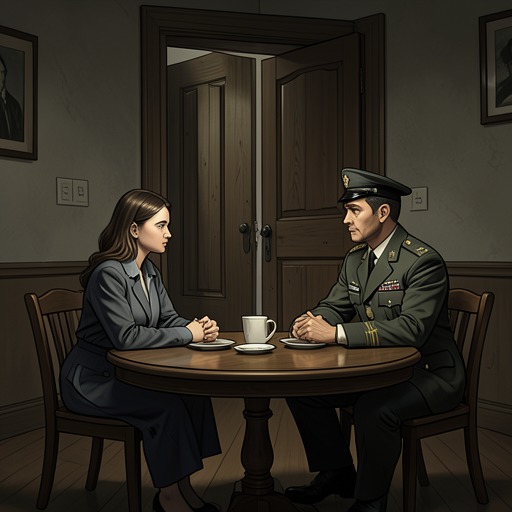
Victoria Hattersley—General Sir Aubrey de la Pole Blessington marriage
Poor ThingsVictoria Hattersley’s marriage to General Sir Aubrey de la Pole Blessington is a hidden piece of Bella Baxter’s past: publicly obscure, yet startlingly exposed when a stranger recognizes Bella as the General’s wife. The relationship links an unrecorded marital history to the novel’s unstable accounts of identity and memory, while the contrasting evidence leaves the reader to distinguish documented circumstance from Duncan Wedderburn’s extravagant theory.
Marriage and Public Record
Hattersley was twenty-four when she married Blessington, three years before his death in 1883. Once nicknamed “Thunderbolt” Blessington, he was then a Liberal member of Parliament for Manchester North. On 27 December, he died by his own hand in the gun-room of Hogsnorton, his country house at Loamshire Downs. The account gives no details of the marriage beyond its existence and duration; it does not establish what the spouses’ private life was like or why their relationship ended, if it did.
The public record is notable for what it omits. Neither the obituaries nor the funeral accounts mention Blessington’s widow. The account also states that no legal separation from him or death for Hattersley was ever recorded. That silence does not prove that she remained with him until his death, nor does it establish her fate afterward. Instead, the surviving facts make the marriage unusually difficult to situate: it is confirmed, but its later course and outcome are left undocumented.
Recognition in Gibraltar
The marriage resurfaces during Bella Baxter and Duncan Wedderburn’s travels. In Gibraltar, after the pair leave their ship, Bella is confronted by a well-dressed woman who greets her as Lady Blessington and recalls meeting her four years earlier at Cowes, aboard the Prince of Wales’ yacht. The woman’s recognition is immediate and confident. Bella, by contrast, says that people usually call her Bell Baxter when she is with Wedderburn.
The exchange turns a formal social recognition into a crisis of identity. The woman insists that Bella is the wife of General Blessington; Bella responds with curiosity rather than recognition, wondering whether she might have an additional military husband and asking what he is like. She also says that God told her she had been in South America four years earlier. The two accounts cannot be reconciled within the scene: the stranger remembers a meeting and a married identity, while Bella has no corresponding memory. Bella’s uncertainty is not evidence that the woman is mistaken, but the episode initially leaves the recognition unverified by Bella herself.
After the woman walks away, Bella recalls having seen her in an open carriage the previous day and hearing that she was the wife of an old admiral who governed Gibraltar. Bella wants to ask her more, particularly about the supposed husband and the earlier meeting. Her response gives the disclosure its peculiar force: marriage appears not as a remembered bond but as a possible fact about her life that another person can report to her.
Wedderburn’s Explanation
Wedderburn presents the encounter as the point at which he understands that Bella has no memories of her life before the shock associated with the crack circling her skull beneath her hair. He addresses Godwin Bysshe Baxter as someone who already knows the explanation of that mark. The scene thus connects the lost marital past with the novel’s larger concealment of Bella’s origins, but Wedderburn’s confidence about what the evidence proves remains part of his own account.
Later, Wedderburn names Hattersley as the identity under which Bella came to General Blessington. He claims that his professional sources as a lawyer have enabled him to penetrate Baxter’s secret, and he folds the marriage into a sweeping theory about a recurring female figure who destroys powerful men. In that theory, Hattersley is one identity in a succession of legendary and historical women, while Baxter becomes the hidden force manipulating them. These claims are Wedderburn’s interpretation, not independently established details of the marriage. His language transforms a sparse biographical fact into a grand accusation and makes the account’s reliability part of the disclosure.
Significance of the Relationship
The marriage’s significance lies in the tension between documentary fact and narrative speculation. A dated account confirms that Hattersley was Blessington’s wife and that he died by suicide; the missing references to a widow and the absence of recorded separation or death leave the rest unresolved. In Gibraltar, a stranger supplies the identity Bella cannot remember, and Wedderburn turns that recognition into a theory about Baxter’s secret designs.
The relationship therefore complicates rather than settles Bella’s identity. The social world can recognize her as a general’s wife even when she experiences that identity as unfamiliar, while the surviving record confirms the marriage without explaining its aftermath. Wedderburn’s interpretation supplies a dramatic pattern, but its excess also marks the distance between evidence and inference. Hattersley’s marriage is both a real part of Bella’s revealed past and an opening through which competing accounts of that past enter the story.