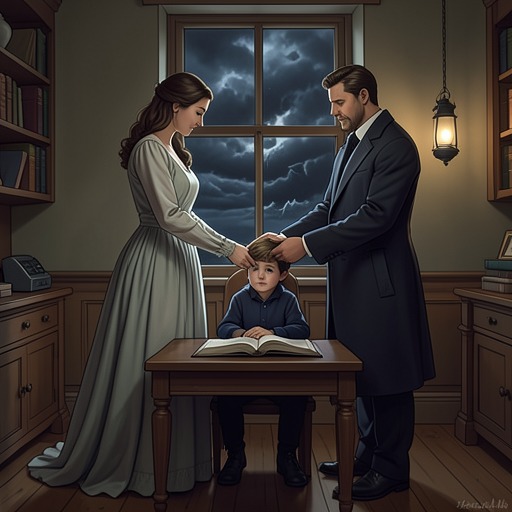
Victoria McCandless (Bella Baxter)—Godwin Baxter
Poor ThingsVictoria McCandless (Bella Baxter)—Godwin Baxter is a relationship of shelter and instruction that Victoria experiences as love, though Godwin refuses her romantic advances. He becomes her rescuer from a marriage that has denied her bodily autonomy, her guide to understanding the conditions that formed her, and the model for a medical life she resolves to pursue. Their intimacy is genuine but asymmetrical: Victoria wants to make Godwin her husband and cure him, while he offers care, education, and a home without surrendering his independence.
From Medical Consultation to Refuge
Godwin first enters Victoria’s life when she is still married to General Sir Aubrey de la Pole Blessington. After a third hysterical pregnancy, she is seeking a clitoridectomy at the General’s wish. Godwin questions the treatment and listens as she explains her childhood, education, and marriage. He tells her that she has been badly treated by selfish and poorly educated men, and warns that the operation will not help. His recognition gives voice to what Victoria had long felt but could not confidently know. Yet he initially says he cannot help her leave: without shelter, money, or experience of earning a living, departure would put her in danger.
Victoria answers this refusal with a conditional appeal: if, at some later time, a homeless and friendless woman came to his Scottish home, could he turn away someone he had treated kindly? Two months later, the condition becomes reality. Having learned that the General is expecting a child with a servant ten years younger than Victoria, she travels to 18 Park Circus. Godwin receives her without questioning her and asks his mother, Mrs. Dinwiddie, to treat Victoria as his sister and let her stay until she can afford a home of her own. The welcome is not merely a practical rescue. It places Victoria within a household and gives her room to begin a different life.
A Shared Household and a New Understanding
Godwin protects Victoria by inventing a family history for her. Because he cannot openly shelter the runaway wife of an English baronet and general, he says she is Bella Baxter, the amnesiac daughter of married South American cousins killed in a train crash. The fiction gives him a defensible explanation for her presence and creates a setting in which he can teach her what she has not learned without requiring her to discard everything she already knows. He urges her to remember painful experiences with intelligent interest rather than let them prevent clear thought.
That teaching becomes concrete through Godwin’s hinged doll’s house. He directs Victoria to compare the scullery maid, who scrubs laundry in the basement, with the master’s daughter at the piano, being trained to attract a rich husband. The girl at the piano might be the same girl as the servant if her clothes and hair were changed, but their social positions keep them apart. Victoria identifies their shared condition: both are used by other people and allowed to decide nothing for themselves. In this exchange, their closeness becomes intellectual as well as protective. Godwin helps her connect her own memories of domestic labor and instruction to a larger pattern of women’s constrained choices; she, in turn, demonstrates that she can grasp and articulate the pattern.
The household also gives Victoria a new social inheritance. Mrs. Dinwiddie’s conversation, humour, and straightforwardness help shape the voice and manners Victoria later describes as Scottish. Godwin’s willingness to acknowledge his unmarried mother contrasts with the concealment required for Victoria’s own arrival. Her invented identity makes refuge possible, but it also means that their life together begins under a necessary falsehood.
Love, Refusal, and Independence
Victoria’s gratitude and trust deepen into passionate love. Godwin does not encourage the desire: he explains that he wants neither a master nor a mistress and describes himself as a dog shaped like a man. Victoria cannot accept this boundary and believes she can convert him to humanity. One night she goes naked by candlelight to his bedroom, where dogs surround and guard him. Godwin’s dogs gently tug her away, and the attempted seduction ends without changing his refusal. The scene makes the difference between their wishes unmistakable: Victoria seeks erotic union as well as companionship, while Godwin insists on a life that remains his own.
His rejection does not extinguish her devotion. When Godwin explains that he inherited a syphilitic illness from his father and expects it eventually to cause insanity and general paralysis, he says he intends to take a painless poison himself when symptoms appear. Victoria responds by deciding to become a doctor—not to cure him, since he considers that impossible, but to save other lives and, in her words, replace him. Godwin accepts the seriousness of her ambition and says her studies can be directed toward it. At the same time, he recommends that she find an efficient, unselfish husband who will support her work while meeting needs he considers starved. His advice recognizes her agency but still imagines its practical exercise within marriage, a tension that sits beside Victoria’s determination to choose her own purpose.
Parting, Return, and Godwin’s Death
Godwin takes Victoria on a tour that includes hospitals and medical lectures in fourteen capital cities. The journey extends her knowledge, though Victoria later understands that he also meant to get her away from him. After studying modern sexual hygiene and birth control with a Viennese specialist, she remains emotionally attached to Godwin. Back in Glasgow, she clings so closely to his company that he can do little or go nowhere without her. Her happiness at having more of him than anyone else can have is matched by the freedom her presence costs him. Their attachment thus carries an enduring contradiction: the person who gave her independence becomes the person she most wants to possess.
When Victoria returns to Park Circus, Godwin is already dying. His body has shrunk and his hand trembles; the illness is progressing, and he needs help with some functions that his mother can no longer manage. Archibald McCandless is present, and Godwin’s approaching death has softened his former dislike of him. Godwin asks Victoria to marry McCandless, leave her what he owns, and care for his dogs. He also asks that one of her sons bear his name and that Mrs. Dinwiddie be treated as a grandmother to the children. These requests turn his final attention toward Victoria’s future family and the people and animals who will remain after him.
Godwin fears that the medicine will take his mind and that Victoria will cease to love him, but he is glad to see her before taking it. Victoria takes the draught from McCandless, gives Godwin the only kiss they ever share, supports his head, and helps him drink. His death closes the possibility of the relationship becoming what Victoria wanted, while confirming its other forms: he has sheltered, taught, and trusted her, and she remains with him through the final act he chose for himself.
Significance of the Bond
The relationship is not simply a thwarted romance. Godwin’s refusal is inseparable from his defence of personal freedom, while his care gives Victoria conditions in which to develop a voice, interpret her past, and imagine a vocation. Their exchanges about women’s dependence expose how marriage, class, and domestic work can limit choice even when the women in question occupy very different positions. Victoria’s love sometimes takes the form of possessiveness, but her wish to become a doctor redirects that intensity toward a purpose beyond Godwin himself. In the end, she cannot save him or secure the romantic union she desires; she can, however, carry forward the knowledge and ambition he helped her claim.