Victoria McCandless’s medical training and qualification
Poor ThingsVictoria McCandless’s medical training turns her grief at the prospect of losing Godwin Baxter into a professional purpose: if she cannot save him, she will become a doctor and save others. Her education follows Baxter’s challenge to the hierarchy of medicine, placing nursing, practical work and service to women at its foundation; her qualification in 1890 leads directly to a charitable clinic staffed and taught by local women.
A vocation formed by loss
Godwin Baxter tells Victoria that he inherited a syphilitic illness from his father, the surgeon Sir Colin Baxter, and expects it eventually to cause insanity and general paralysis. He does not know when the first symptoms will appear. His plan is to take a painless poison himself when they do, rather than ask Victoria to become a doctor for his sake. She answers that she will become one for the world’s sake: if she cannot replace him as the person she loves, she can replace his work.
Baxter accepts this resolve and promises to direct her studies toward medicine. His suggestion that she first find a husband who will support her ambitions meets with her declaration that, if he will not, starvation can be her husband instead. The exchange frames her education as a struggle over who will determine its purpose. Her ambition is hers, not a substitute for the marriage Baxter imagines might make it practicable.
Nursing as the ground of medical education
Baxter’s advice grows from his criticism of the medical profession. He recalls that Sir Colin operated in private homes rather than hospitals, sterilizing instruments and his operating theatre when hospital authorities still ignored or denounced aseptic practice. In Baxter’s account, public hospitals teach doctors to earn money from the rich by practising on the poor, while affluent patients secure private care. He also invokes the fate of Semmelweis, whose antiseptic findings were rejected despite sharply reducing deaths in the maternity hospital where he worked; Semmelweis died in a mental hospital after deliberately contracting septicaemia.
Baxter argues that good nursing, rather than the smooth bedside manner cultivated by doctors, is the more genuine healing art. He claims that most hospital patients would recover if nursing continued even if the doctors and surgeons disappeared. His own exclusion from hospital practice except in the poorest charity clinic helps explain the bitterness behind this judgment, but his proposed educational reform is concrete: doctors should be recruited from nursing or begin their careers in it, and professional training should start with manual work.
When Victoria considers medical study, the barriers are immediate. Baxter says that only four women in Britain are then doctors, all with degrees from foreign universities. The Enabling Bill of 1876 and Sophia Jex-Blake’s work have opened Dublin University to women medical students, and he expects Scottish universities to follow. Meanwhile, he proposes that he return to the charity wards of an east Glasgow infirmary if Victoria enrols as a trainee nurse. If she succeeds under ward discipline, he will arrange for her to assist him as a theatre nurse. Practical experience, he believes, will make later lectures more meaningful than the memory exercises faced by many first-year students.
Clinical aims and professional independence
Victoria’s plans for practice are specific. Asked whether she wants to become a general practitioner or serve particular groups, she says she wants to help little girls, mothers and prostitutes. She intends to teach women who come to her the most modern and effective methods of contraception. Baxter and Archibald McCandless counsel her to keep that intention private until she is able to practise: advice given in the consulting room, they reason, is less likely to provoke public scandal than a campaign before she has established herself. They recommend waiting at least five years after qualification before advocating birth control publicly, while acknowledging that the length of the delay must ultimately be her choice.
Medical authority also becomes part of Victoria’s defence of Bella Baxter’s identity. When Sir Aubrey de la Pole Blessington treats the drowned woman who recovered at Baxter’s home as his wife, Baxter insists that the woman is someone else. He produces signed reports from specialists who examined Bella during a world tour; despite differences in their terminology and opinions, the reports agree that she is sane, strong and cheerful. They attribute her amnesia to a skull injury and the loss of an unborn child, while describing her other mental powers as exceptionally keen. The episode shows medical expertise being used not simply to classify a woman, but to contest a husband’s claim over who she is.
Qualification and the clinic
Bella Baxter’s later life is passed under the name Victoria. In 1886 she uses that name to enrol at the Sophia Jex-Blake School of Medicine for Women in Edinburgh. Four years later, Glasgow University awards her a Doctor of Medicine under the same name. Her training thus carries her from the limited openings Baxter describes to a qualification that permits her to establish an independent medical practice.
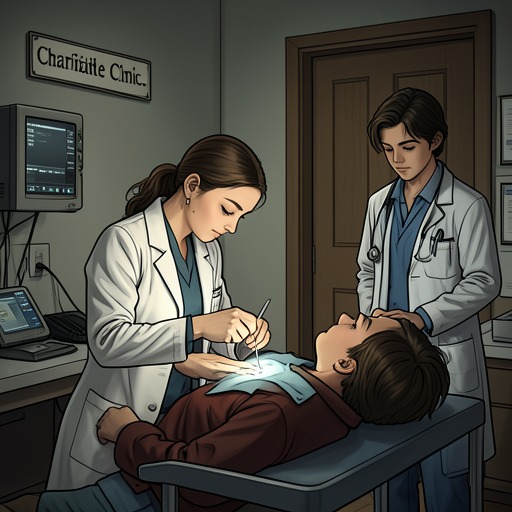
In 1890 Victoria opens the Godwin Baxter Natal Clinic in Dobbie’s Loan, near the Cowcaddens. It is a purely charitable foundation, run by Victoria with a small staff of local women whom she trains herself. The clinic gives institutional form to the purpose she had declared when Godwin disclosed his illness: medical work for those who might otherwise lack access to care.
Teaching as a continuing practice
Victoria’s approach to training extends beyond her own qualification. She does not keep her assistants indefinitely. After a year, she replaces each trained employee, telling a devoted helper that there is nothing more she can teach her and urging her to help her neighbours or seek work with a doctor who can offer new instruction. Several former helpers enrol as nurses in city hospitals, although a ward sister complains that they ask too many questions. The contrast suggests that Victoria regards questioning and onward learning as assets, even when established hospital discipline finds them inconvenient.
She also refuses to separate clinical work from the bodily demands borne by her patients. Between 1892 and 1898 she gives birth to three sons at two-year intervals, continuing her clinical work until the last two or three days of each pregnancy and returning soon afterward. She explains that poor women cannot afford prolonged rest and that she is more fortunate than most because her husband supports her. Her medical career therefore develops not through detachment from women’s everyday constraints, but through a practice shaped by direct awareness of the unequal conditions under which they seek care.