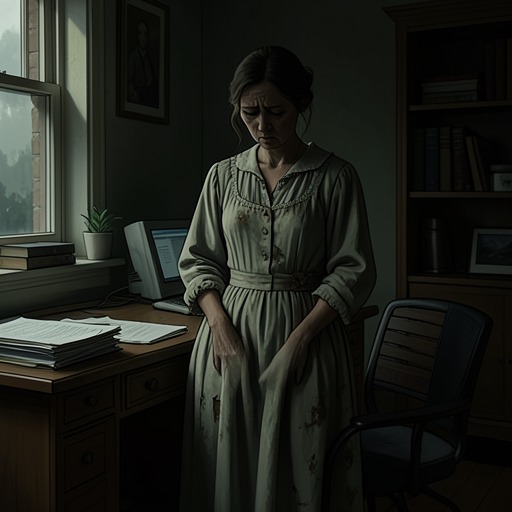
Victoria McCandless’s two sons killed at the Somme
Poor ThingsThe deaths of Victoria McCandless’s two youngest sons at the Battle of the Somme turned her opposition to the First World War into a personal reckoning. They had joined the army almost as soon as war was declared and were killed soon afterward. For their mother, their loss was not only a family tragedy: it demanded an explanation for how her sons could enter a system that treated human bodies as instruments of killing, despite the values in which she believed they had been raised.
War, activism, and loss
From 1900 onward, Victoria McCandless was an active suffragette. The outbreak of war in 1914 shocked her profoundly. She wanted working people and soldiers to stop it through a strike, but her two youngest sons instead enlisted almost at once and were killed at the Somme. The rapidity of their decision and the suddenness of their deaths stood in painful contrast to the political action she had hoped would bring the conflict to an end.
Her opposition also brought her into conflict with the Fabians, whose tolerance of the war she condemned. She appeared on platforms with Keir Hardie, Jimmy Maxton, John Maclean, and other Clydeside Socialists and advocates of Scottish home rule who opposed the war. These public campaigns gave political expression to a grief that was also intimate: the men she wished to see refuse the machinery of war were her own sons.
The lives war transformed
Victoria McCandless remembered the three boys as having been prepared for peaceful professional lives as Scottish public servants. Their parents had wanted them to use humane modern ideas to address the social task of creating a Britain where everyone had a clean home and useful, fairly paid work. For the first six or seven years of their lives, she recalled, she had had considerable power over them, supported by money and a loving husband. She and her husband differed politically—she was a radical Socialist and he a Liberal—but she described their home as clean and spacious and their parents as loving, educated, and adventurous.
That upbringing made the sons’ immediate response to war harder for her to comprehend. She rejected explanations based on an inherent depravity in human nature or in men, and she did not think the militaristic history taught at school could account for their choices, since the reading and teaching at home had counteracted it. Instead, she turned the question against herself: why had she failed to give them enough self-respect to resist what she called an “epidemic of suicidal obedience”?
Bodies, obedience, and the war machine
In her account, military inspection exposed the bodily submission demanded by war. Men were made to queue naked while a clothed man examined their genitals; she understood this ritual as an entry into a system in which the ideal soldier treated his body as an insensitive machine. The machine, in turn, did not belong to the soldier: it was steered by remote controllers. Her two youngest sons had willingly entered that system, and their beautiful bodies were mangled and crushed into mud.
The eldest son’s response offered a different but related form of complicity. Baxter McCandless made his mind, rather than his body, part of the war machine, working from his desk in the Department of Imperial Statistics. In a letter to Patrick Geddes, his mother accused him of falsifying the significance of deaths and injuries in France by comparing them with peacetime accidents, a calculation she said comforted war-industry profiteers. She came to regard him as a victim of self-disrespect too, though he had not died at the Somme. He died in 1919, aged twenty-seven, after being struck by a Paris taxi while attending Lloyd George at the peace conference.
Aftermath and significance
The deaths left Victoria McCandless unable to treat the war as an abstraction or to blame it simply on governments, schools, or human nature. She believed that prosperous people, including those who ordered and officered the fighting, had also taken part in an epidemic of belligerence; overcrowded living conditions alone could not explain the scale of obedience. Her medical understanding of epidemics led her to ask what conditions had produced this one and whether its causes could be found and prevented.
Her account therefore makes bereavement the beginning of an inquiry rather than its conclusion. She accepted that her sons had been raised in a humane home, yet she could not reconcile that fact with their swift participation in the war. By asking what she herself had failed to give them, she made their deaths evidence of a deeper failure of self-respect—and a question she believed she had to answer if she was to be of use to others.