Victorian Glasgow's public health crisis
Poor ThingsVictorian Glasgow's public health crisis is not a single outbreak but a condition produced by industrial pollution, preventable illness, infant mortality, and unequal access to care. The novel links the city's unhealthy environment to social policy and medical institutions: poor people endure the greatest exposure and risk, while the profession often treats illness without challenging its causes. Against that system, Godwin Baxter argues for prevention, nursing, and practical care, and Bella Baxter's later medical ambitions give those arguments a public and professional future.
Industrial Conditions and Prevention
Godwin Baxter's account of public health begins with the conditions that make people ill. He argues that practitioners should unite to prevent disease rather than work separately to cure it, and identifies sunlight, cleanliness, exercise, fresh air, pure water, good food, and clean, roomy housing as basic protections. In his view, effective health policy must also prohibit work that poisons people or prevents them from obtaining these necessities. His program makes illness a social and environmental question, not simply a defect to be treated at the bedside.
Archibald McCandless counters that Britain depends on industrial production and overseas markets, and warns that social legislation could displace profits and leave thousands without food. Baxter accepts the economic constraint but sees it as evidence of the system's priorities: until Britain relinquishes its market dominance, he says, medicine will serve as a charitable mask for a plutocracy that leaves harmful conditions in place. He describes his voluntary work in an east-end clinic as a way of soothing his conscience, not as a solution to the causes of illness. His estimate that an abdominal transplant would require a thirty-three-hour operation, preceded by at least a fortnight spent finding and preparing a compatible donor, makes the conflict concrete: while he pursued experimental surgery, poor patients could die or suffer because they lacked conventional treatment.
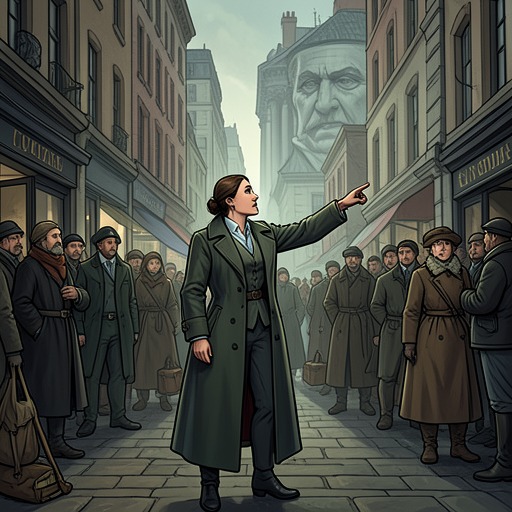
The story gives industrial harm a physical landscape. After a fortnight of hot, still weather, smoke and gases hang over Glasgow in a gritty haze, coating surfaces and irritating the eyes and nostrils. Along the Kelvin River, waste from an upstream paper mill pours over a weir as green froth and runs through West End Park, obscuring the river beneath opaque scum. The narrator imagines this pollution entering the oil-fouled River Clyde. The passage makes contamination part of ordinary urban life rather than an isolated accident: a walk for exercise leads through polluted air and water before the narrator reaches the Loch Katrine Memorial Fountain, whose spray offers a small contrast to the fouled river. The scene places environmental exposure alongside the novel's broader concern with the conditions that make health possible.
Medical Institutions and Unequal Care
Baxter's criticism extends to public hospitals. He describes them as places where doctors earn money by practising on the poor, while wealthier patients receive private treatment or surgery at home. His account of Sir Colin Baxter offers a contrast: Sir Colin operated in family houses, boiled his instruments, and sterilized his operating theatre when hospital boards were ignoring or denouncing aseptic practice. Baxter recounts that surgeons continued using dirty scalpels and bloodied coats despite deaths from infection, and invokes the Hungarian obstetrician Semmelweis, whose warnings about antisepsis were rejected. In the novel's account, Semmelweis deliberately contracted septicaemia and died of the disease he had spent his career fighting, after his superiors forced him out.
Baxter's own exclusion from hospital work beyond the poorest charity clinics helps explain his hostility to the profession, but the narrative also presents nursing as a substantive alternative to medical hierarchy. He credits improved hospitals to good nursing and argues that nurses are the truest practitioners of healing; in his deliberately stark estimate, most admitted patients would recover if nursing continued even if doctors and surgeons suddenly died. The claim shifts attention from professional status and technical intervention to the sustained work of care. It also anticipates his insistence that medical education should begin with manual work and nursing rather than treating hospital patients as material for detached training.
The scale of neglect is especially visible in maternal and infant health. Baxter says that hundreds of young women drown themselves each year under the pressure of poverty and social prejudice, and describes infants born with severe malformations who cannot survive without artificial assistance. He recounts that some babies without digestive tracts would starve after the umbilical cord was cut unless someone smothered them first, an act doctors and nurses were forbidden to order even though it occurred. In Glasgow, which he identifies as Britain's second-largest city and foremost in infant mortality, many parents cannot afford a coffin, funeral, and grave for every dead child. His image of the medical profession as a limbo for the unchristened connects clinical neglect to religious belief, poverty, and the absence of material support for grieving families.
Reproductive Care and Medical Training
The crisis also includes the limited and unequal provision of sexual and reproductive healthcare. In France, Bella Baxter tells Millie Cronquebil that she can no longer work at the establishment where women are subjected to medical inspection. She calls the procedure unfair and inefficient because the women are healthy when they begin working there and, she argues, clients bring the diseases. Since the clients would not agree to examination and there are too few doctors, Bella proposes training the women to examine each client themselves. The exchange turns a system that regulates women's bodies into a question of who receives protection and who is made to bear the risk.
Baxter's plans for Bella connect such immediate needs to professional reform. He reports that Britain has only four women doctors at that point, all holding degrees from foreign universities, while the Enabling Bill of 1876 and Sophia Jex-Blake's work have helped open routes into medical education. He proposes that Bella begin in charity wards as a trainee nurse, progress to work as a theatre nurse, and later enter medical college, so that formal lectures will build on practical experience. Bella wants to serve girls, mothers, and prostitutes, groups Baxter notes are generally treated by people whose bodies differ from their patients'. She also intends to teach modern contraception, though Baxter and Archibald McCandless advise her to keep that aim private until she can practise, and to delay public advocacy until she has several years of clinical experience. Their advice exposes a tension between protecting a reformer's ability to work and allowing her to speak openly about the care she believes necessary.
A Continuing Public Health Argument
The novel's presentation of the crisis links distinct scales of harm: polluted air and water, preventable infection, inadequate hospital care, infant deaths, and obstacles to reproductive health. These are not treated as unrelated misfortunes. Baxter's preventive program locates illness in housing, work, food, and water; the hospital debate shows how class determines where and how patients are treated; and Bella's proposals ask who controls medical knowledge and who is expected to accept risk. Her later opening of the Godwin Baxter Natal Clinic with Archibald McCandless carries this argument into an institution devoted to care, while its eventual loss under hostile publicity shows how vulnerable such work remains. The public health ideal is therefore practical but contested: better treatment matters, yet the novel insists that health also depends on changing the conditions that produce illness and on making care accessible to those who have least power to demand it.