
The Case Against Rusty
Presumed InnocentThis flow traces how a prosecutor's suspicion of Rusty hardens into an indictment and then loses force under scrutiny at trial.
increasing Bearing strength in each event
 decreasing
Bearing strength in each eventdecreasingSuspicion in the Office
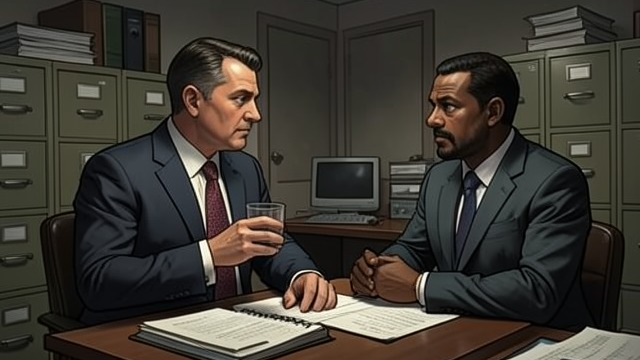
Suspicion in the Office
Evidence points inward
Once Nico Delia Guardia takes office, Tommy Molto confronts Rusty with his fingerprints on the glass and records of calls to Carolyn. Rusty's prior affair gives those facts a personal context, while his failure to disclose it makes his conduct look deliberate.
The old investigation reversed
Rusty had supervised the homicide inquiry and had himself pressed for fingerprints and telephone records. The evidence he helped obtain now becomes the state's case against him, transforming ordinary investigative decisions into apparent signs of guilt.
From colleague to target
Nico and Molto tell Rusty that he is under investigation. Rusty hires Alejandro Stern, but his first explanation—that he was home—does not account for the accumulating physical evidence.
Indictment and Exposure

Indictment and Exposure
Formal accusation
A grand jury indicts Rusty for Carolyn's murder. The charge turns his private affair, his public office, and the unexplained physical evidence into a single public spectacle.
A damaging circumstantial case
The state presents fingerprints, phone records, fibers matching carpet in Rusty's home, and biological evidence interpreted as evidence of recent consensual sex. None is a direct account of the killing, but together they create a coherent and alarming narrative.
The cost beyond court
The indictment brings national attention and humiliating scrutiny to Rusty's family. He worries less about prison itself than losing Nathaniel's childhood and becoming permanently defined by an accusation he cannot easily answer.
The Case Weakens
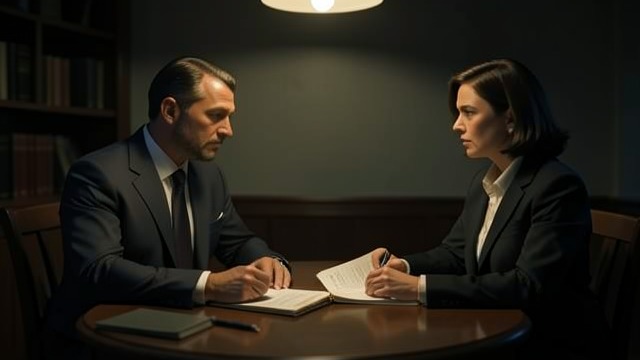
The Case Weakens
A central witness falters
The prosecution's witnesses and exhibits do not all support the story Nico intends to tell. Mrs. Krapotnik cannot reliably identify Rusty, and the bus witness admits she cannot say whether he was the man she saw.
Forensic doubt
The missing glass complicates the fingerprint evidence. More damagingly, Dr. Kumagai's notes reveal Carolyn had undergone tubal ligation, making the alleged use of spermicide difficult to explain and raising doubt about whether the tested specimen came from her body.
The prosecution ends
After the jury hears that Rusty never confessed to Dr. Robinson, Judge Larren Lyttle ends the trial. Nico dismisses the case rather than prolong it, leaving Rusty legally free but not publicly or privately certain.
After the election in April
Late June through mid-July
During the August trial
