
Institutional Loyalty and Corruption
Presumed InnocentThis flow traces the informal loyalties that protect public officials and blur the boundary between professional service and private favor.
increasing Bearing strength in each event
 decreasing
Bearing strength in each eventdecreasingThe Office as a Political Machine
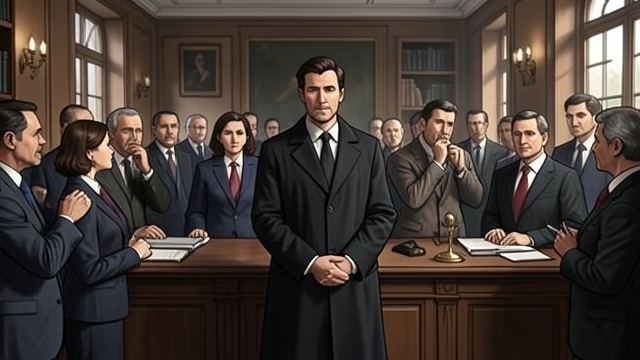
The Office as a Political Machine
A public institution under strain
The prosecutor's office manages enormous caseloads with limited staff and resources. Raymond presents himself as independent, but the office remains intertwined with party politics, police relationships, and the practical need to secure support.
Personal loyalties matter
Rusty sees decisions shaped by friendships, favors, and future ambitions. The police share information unevenly, and public employees anticipate changes in power rather than behaving as neutral parts of a single system.
A blurred public mission
The murder investigation is supposed to serve justice, but Raymond also needs results for his campaign and Nico sees the case's political value. The institution's purpose becomes entangled with the personal interests of those who run it.
The North Branch's Informal Economy

The North Branch's Informal Economy
Routine favors and payments
The North Branch operates amid bribery, bondsmen, police arrangements, and informal influence. Leon Wells's case illustrates a system in which people expect that money or a personal connection can alter a court outcome.
Carolyn and Lyttle's involvement
Leon says Carolyn arranged the payment and Lyttle received it. Raymond later admits knowing something about their relationship and their dealings, but he insists the episode was treated as a closed and foolish past rather than an ongoing enterprise.
A record kept from view
The old matter remains buried until Carolyn reopens it. The office's failure to document or disclose the history gives current investigators a distorted picture and makes later claims of neutrality difficult to trust.
Loyalty's Price

Loyalty's Price
Protection over disclosure
Raymond protects Larren's reputation and resists making the old corruption public. Stern later suggests that fear of exposure influenced how the trial ended, while Raymond's account confirms that he concealed the past to protect his friend.
A second concealment
Rusty in turn refuses to disclose his theory about Barbara. His silence protects Nathaniel and preserves his own ability to continue living within the family, but it allows a public narrative he considers incomplete to stand.
No clean institutional repair
Rusty returns to office while the murder remains unsolved and the corruption untried. The institution continues, but its appearance of order rests on selective truth and private accommodations rather than a complete accounting.
During Raymond's administration
Nine years before the main events
From the trial's end to the final chapters
